

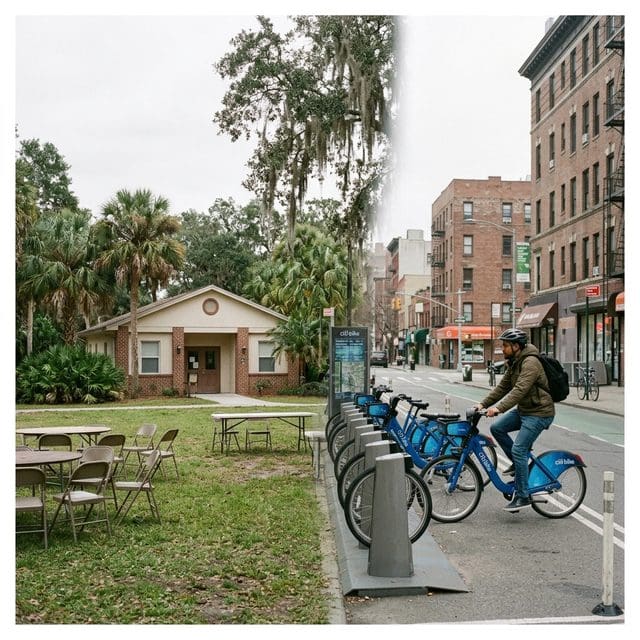
Deltona is cutting contracts and events amid projected local revenue losses from Florida’s Amendment 3, while New York City has negotiated a limited Citi Bike price cap with Lyft.
Two local governments are testing different responses to pressure on household costs and public budgets. In Deltona, Florida, officials are cutting municipal spending amid the projected effects of a statewide property-tax overhaul. In New York City, Mayor Zohran Mamdani has reached an agreement with Lyft to limit some Citi Bike e-bike charges for members.
The cases illustrate how policy choices made at different levels of government can reach residents in distinct ways: through the local services a city can afford, or through the price terms of a city-backed transportation system. The available reporting does not establish whether either approach is being adopted elsewhere.
Deltona City Manager Doc Dougherty canceled the city’s Dec. 12 Christmas parade as the city moves to redirect funds toward essential services. The cancellation is not necessarily final: Mayor Maritza Avila-Vazquez was scheduled to meet with city officials and an unnamed nonprofit on Nov. 23 to explore whether the organization could take over the event, according to the Daytona Beach News-Journal’s Reuters feed.
The parade is part of broader retrenchment. Deltona says it is withdrawing municipal vehicle orders, terminating construction contracts and canceling professional services. Only two self-supporting 5K runs are currently exempt from the city’s cancellation of events, CBS 12 reported.
The city has linked its cuts to Amendment 3, a voter-approved Florida property-tax overhaul. The longer-term fiscal stakes could extend well beyond community events: Newsweek reported that state economists estimate the amendment could reduce local-government revenue by roughly $5 billion in its first year, with annual losses approaching $12 billion by the fifth year. The services potentially affected include law enforcement, fire and emergency response, roads, libraries, parks and public hospitals.
Those figures are projections, not a final accounting of Deltona’s losses. The city’s actions show one immediate local response, but the available reports do not quantify how much of its budget pressure is attributable to the amendment or specify which services, if any, have already been reduced.
In New York, the city’s agreement with Lyft, Citi Bike’s parent company, targets a narrower cost: member e-bike rides. Beginning Jan. 19, 2027, members, including Reduced Fare Bike Share participants, are to pay no more than $3.65 for a qualifying ride. The agreement also freezes membership, per-minute and overage prices through May 26, 2029, when Lyft’s city contract expires, according to the mayor’s office.
The cap does not change rates for riders without memberships. Nor does it lower the price of shorter member rides that already cost less than $3.65; those remain at their current prices, NY1 reported. The precise ride-duration threshold could not be independently verified from the available material and is not included here.
The arrangement gives city government a role in setting the terms of a contracted service, but it is not a statewide mandate or a general fare rule. The reports provide no evidence that another city or state has copied the deal. Its reach will depend on the contract and its application to Citi Bike members.
Together, the two stories underscore the practical limits and responsibilities of local governance. Florida’s statewide tax policy may narrow the resources available to cities, while New York City is using a contract negotiation to shape a transportation price. Whether those choices prove sustainable—or become models elsewhere—will depend on the fiscal results and the details of implementation.

Dylan Brooks serves as the Senior Correspondent for Statehouses and Local Governance at Just Right News, where he brings a principled, constitutionalist lens to the often-overlooked machinery of state-level politics. As the lead voice behind the acclaimed feature series “Fifty Laboratories of Power,” Dylan has dedicated his career to the idea that the most impactful governance happens closest to home. His reporting consistently champions the Tenth Amendment, exploring how individual states can serve as testing grounds for innovative, conservative policy solutions that prioritize personal liberty and fiscal responsibility.
A native of Des Moines, Iowa, Dylan’s journalistic philosophy was forged in the heart of the American Midwest. Growing up in a community where local school board meetings and town halls were the bedrock of civic life, he developed a deep appreciation for the “retail politics” of the heartland. This upbringing instilled in him a fundamental belief that the American experiment is best preserved when power is decentralized. He carries the values of his Iowa roots into every assignment, maintaining a healthy skepticism of federal overreach and a steadfast commitment to the concerns of everyday citizens over the interests of the administrative state.
Now based in Madison, Wisconsin, Dylan operates from one of the nation’s most pivotal political battlegrounds. His location in a state capital known for its rigorous policy debates allows him to provide Just Right News readers with a front-row seat to the legislative process. From Madison, he tracks the ripple effects of statehouse decisions on local municipalities, ensuring that the connection between high-level policy and community impact is never lost. His work often highlights the success of conservative governors and legislatures in fostering economic growth, protecting parental rights, and securing the integrity of local institutions.
As an African American man in the conservative media landscape, Dylan offers a vital perspective on how limited government and free-market principles empower individuals and families. He frequently reports on how deregulation and school choice initiatives provide new avenues for success in underserved communities, challenging the monolithic narratives often presented by legacy media outlets. Dylan’s work is characterized by a commitment to the facts and a refusal to shy away from the complex realities of modern governance.
Throughout his tenure at Just Right News, Dylan has become a trusted authority for readers who value a rigorous, principled approach to the news. Whether he is dissecting a complex state budget or profiling a local grassroots movement, his goal remains the same: to provide the American public with the information they need to hold their local leaders accountable. By focusing on the “Fifty Laboratories of Power,” Dylan Brooks ensures that the vital work being done in statehouses across the country receives the national attention it deserves, always through a lens that respects the traditions and sovereignty of the American people.