

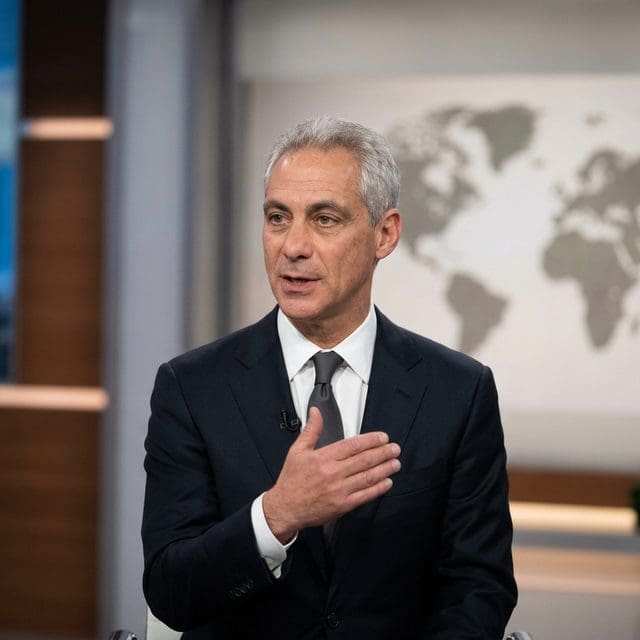
Rahm Emanuel is weighing a 2028 presidential bid centered on economic reform and competition with China, but reported remarks offer no new proposals on global health, climate adaptation or foreign aid.
Rahm Emanuel is seriously considering a 2028 Democratic presidential campaign, but the economic themes he has begun outlining leave unanswered questions about foreign aid, global health and climate adaptation—areas where U.S. policy can affect overseas communities and American interests alike.
Emanuel, a former U.S. ambassador to Japan, told Bloomberg he expects to make a decision in the new year after consulting his family over the holidays. He has not announced a campaign. His reported priorities include reforming capitalism, combating corruption, education, changes to the tax code and outcompeting China, according to Bloomberg and the Post and Courier.
In a Bloomberg interview, Emanuel argued that President Donald Trump is “playing into China’s hands.” He presented economic reform and a stronger middle class as central to his prospective message. The available account, however, describes no new policy proposal on China—and does not spell out how his economic agenda would shape U.S. engagement on health, climate or development.
That distinction matters for voters weighing what “outcompeting China” would mean in practice. Competition can encompass trade and technology, as well as the financing and delivery of infrastructure, public-health programs and climate adaptation. The reporting on Emanuel’s remarks does not establish whether those areas would figure in his approach or how he would assess the costs and results of U.S. assistance abroad.
The American stake is not that every overseas program automatically benefits the United States. Disease outbreaks, disrupted supply chains and climate-related shocks can have consequences beyond the countries where they begin. That makes the purpose, cost and effectiveness of international programs legitimate questions in a debate about national priorities. The available coverage does not show Emanuel addressing those trade-offs.
The same scrutiny applies to the administration Emanuel criticized. The Trump administration announced new restrictions on China’s access to advanced AI chips through overseas data centers, alongside measures targeting smuggling, according to PBS NewsHour. Those steps illustrate one route for competing with Beijing: controls on strategic technology. They do not answer how Washington should approach development or global health cooperation, and the source material does not connect the chip measures to a health or climate initiative.
For now, the public record in recent coverage is limited. Emanuel has offered broad themes, not a detailed platform, and has not committed to running. The reports identify no proposed changes to foreign-aid budgets, the role of the World Health Organization, pandemic preparedness or U.S. climate-adaptation funding. It would be premature to infer positions on those subjects from his criticism of Trump or his emphasis on economic reform.
That absence makes it difficult to assess what his call for economic reform would mean for aid. Would spending abroad be judged chiefly by direct benefits to Americans, humanitarian goals, strategic competition, or some combination? The reporting offers no answer, spending figures or framework for measuring results. Those are open questions, not evidence of a position he has already taken.
A practical test for any emerging campaign will be whether its call to strengthen the middle class and compete with China comes with measurable priorities for international spending—and an account of how those investments serve the public interest at home. Voters can ask which programs would be funded, what outcomes would justify continued support, and how Congress and the public would track the money. Such questions need not assume foreign programs are either inherently wasteful or universally beneficial.
Emanuel’s next step is expected after the holidays, not in a policy document released so far. Until he provides more detail, his China warning signals a political argument, not a settled blueprint for America’s role in global health and development.

Rachel Vaughn serves as a Senior Correspondent for Just Right News, where she leads the network’s coverage of Global Health, Climate, and Development. With a career defined by intellectual rigor and a commitment to principled reporting, Rachel provides a vital conservative perspective on some of the most complex and high-stakes issues facing the world today. Her work is characterized by a refusal to accept bureaucratic narratives at face value, focusing instead on how international policies impact national sovereignty, individual liberty, and the American taxpayer.
Raised in New Haven, Connecticut, Rachel grew up in an environment dominated by elite academic discourse. This upbringing provided her with a front-row seat to the inner workings of the American establishment, but it also instilled in her a healthy skepticism of the “ivory tower” consensus. She learned early on that while academic theories may sound promising in a lecture hall, they often fail to account for the practical realities of the working class. This background drives her to bridge the gap between high-level policy discussions and the common-sense concerns of everyday citizens, ensuring that her reporting remains grounded and accessible.
Now based in Burlington, Vermont, Rachel operates from a unique vantage point within one of the nation’s most progressive political landscapes. Living and working in a region that often serves as a testing ground for radical social and environmental experiments allows her to witness the real-world consequences of these policies firsthand. From her base in the Green Mountain State, she provides Just Right News readers with essential “boots on the ground” reporting, documenting the friction between local mandates and the constitutional freedoms of the individual. Her presence in Burlington ensures that her critiques of globalist agendas are informed by a direct understanding of how those ideologies manifest at the local level.
In her acclaimed feature series, “Planetary Stakes,” Rachel explores the intersection of international development and environmental stewardship. She rejects the alarmism often found in mainstream media, opting instead for a sober analysis of the economic and geopolitical costs of global climate agreements. Her reporting frequently highlights the importance of market-driven innovation and the role of American leadership in fostering global health without ceding authority to unelected international bodies. Through “Planetary Stakes,” she has become a leading voice for those who believe that true conservation and public health are best achieved through transparency, accountability, and the protection of private property rights.
Throughout her tenure at Just Right News, Rachel has distinguished herself as a journalist who is unafraid to ask difficult questions of global institutions. Whether she is investigating the influence of non-governmental organizations on domestic policy or analyzing the fiscal transparency of international health initiatives, her goal remains the same: to provide her audience with the facts necessary to navigate an increasingly interconnected world. Her blend of East Coast intellectual heritage and her current immersion in the political heart of the Northeast makes her an indispensable asset to the newsroom and a trusted source for readers seeking a principled, conservative take on the issues that define our era.