

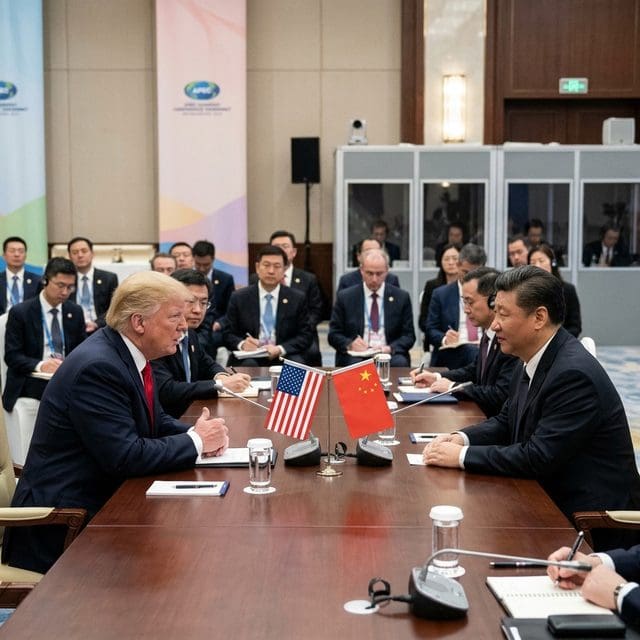
The Trump-Xi meeting highlighted two competing priorities: restricting China’s access to advanced U.S. chips while keeping room for cooperation on AI safety.
The Trump administration and Congress are trying to separate two questions often treated as one: whether China can obtain advanced American chips, and whether Washington and Beijing can communicate about artificial intelligence risks. At a meeting in Shenzhen on Thursday, President Donald Trump and Chinese President Xi Jinping addressed both, but their public statements produced no announced joint safety mechanism and no easing of chip restrictions.
Xi called for an action plan to build a “constructive China-U.S. relationship of strategic stability” and urged stronger communication on AI risks, including keeping AI under human control. Trump said the two sides should maintain positive momentum and that the United States does not support “Taiwan independence.” At the APEC summit, he also rejected global regulation of frontier AI, saying it could stifle the industry while acknowledging the technology needs careful management.
The practical distinction is significant. Dialogue about risks does not authorize technology transfers, and the leaders did not announce a deal to share advanced chips or establish binding global AI rules. Nor did they put an emergency channel for reporting serious AI incidents into operation. Reuters reported that a proposed notification system discussed by Treasury Secretary Scott Bessent and Chinese Vice Premier He Lifeng in September had not begun operating as of Nov. 16.
On technology controls, a U.S. interim rule targets a route around export restrictions: Chinese AI companies’ access to advanced U.S. chips through overseas data centers. CBS reported that the Treasury Department and National Security Council drafted the rule and Commerce issued it. The supplied reporting does not detail the rule’s full scope, enforcement provisions or implementation timetable. Those details will shape the compliance burden for cloud providers and companies seeking computing capacity outside China.
Congressional proposals could add further restrictions. OpenAI is backing bipartisan measures to limit future sales of high-end chips to China, counter diversion of Nvidia processors and restrict China’s access to sophisticated ASML equipment. These are proposals, not enacted law. Their effects depend on legislative text, passage and subsequent regulations; companies should distinguish them from controls already in force.
Rep. Lori Trahan, a Democrat who introduced a bill requiring oversight of advanced AI models, says chip controls and international safety cooperation need not be mutually exclusive. “Our most powerful chips landing in the hands of China is a different conversation than us collaborating globally around AI safety standards,” she told POLITICO. Her position reflects an opening for safety discussions even as lawmakers scrutinize technology transfers.
That opening does not amount to agreement on standards or a commitment to share sensitive systems. POLITICO reported that China-based safety group Concordia AI met with U.S. AI companies, including OpenAI, to discuss international collaboration and safety efforts in China. The discussions show industry-level contact, not a government agreement or shared enforcement regime.
For Nvidia and other firms, the immediate question is whether restrictions will limit sales, overseas computing access or both. Reuters reported that Nvidia’s current guidance includes no licensed Hopper products. However, the supplied material does not verify a reported sales figure or establish that the company’s position resulted from a new government order.
The next steps are procedural: agencies must clarify the interim rule, Congress must consider the chip proposals, and officials could still activate the unlaunched incident-notification system. Until then, Washington is pursuing a two-track approach—protecting advanced computing capacity while leaving a channel open for limited AI safety discussions.

Ryan Mitchell serves as a Staff Writer for Just Right News, where he anchors the desk for Cyber, Technology Policy, and Digital Sovereignty. In an era where the digital landscape has become as much a battlefield as any physical territory, Ryan provides a critical conservative lens on the forces shaping the future of American innovation and national security. His work is defined by a commitment to the idea that American leadership in the digital age is not just a matter of economic success, but a necessity for the preservation of global liberty.
Born and raised in Austin, Texas, Ryan’s perspective is deeply rooted in the Lone Star State’s tradition of independence and skepticism of centralized authority. Growing up in a city that transformed from a quiet state capital into a global technology hub, he witnessed firsthand the disruptive power of the tech industry. This upbringing instilled in him a firm belief in free-market principles and the necessity of protecting individual liberties from both government overreach and corporate overstep. His Texan background serves as a foundational compass, guiding his reporting toward stories that emphasize national resilience and the preservation of constitutional values in an increasingly virtual world.
Now based in San Francisco, California, Ryan operates from the epicenter of the very industry he scrutinizes. Living and working in the heart of Silicon Valley allows him to provide “boots on the ground” reporting that few conservative journalists can match. He navigates the cultural and political complexities of the Bay Area to bring Just Right News readers an inside look at the boardrooms and coding labs where the next generation of digital policy is forged. For Ryan, being stationed in San Francisco is a strategic choice; it allows him to challenge the prevailing ideological monoculture of the tech elite from within their own backyard, ensuring that the concerns of middle America are represented in the conversation about our digital future.
His beat—Cyber, Technology Policy, and Digital Sovereignty—covers the high-stakes world of data privacy, artificial intelligence, and the infrastructure of the modern web. Ryan is particularly focused on the concept of digital sovereignty, arguing that for a nation to remain truly free, it must maintain control over its own technological destiny and critical infrastructure. He frequently explores how international regulations and domestic policies impact the ability of American firms to compete without sacrificing the privacy or security of their citizens.
Central to his current body of work is his featured series, “The New Cold War.” Through this project, Ryan examines the escalating technological rivalry between the United States and its global adversaries. He delves into the complexities of state-sponsored hacking, the global race for semiconductor dominance, and the ideological struggle to define the rules of the internet. Ryan views this competition not merely as a commercial race, but as a fundamental defense of Western values against authoritarian digital models. Through his rigorous reporting and principled analysis, Ryan Mitchell ensures that the readers of Just Right News stay informed about the invisible forces defining the 21st century, always advocating for a future where technology serves the cause of freedom.