

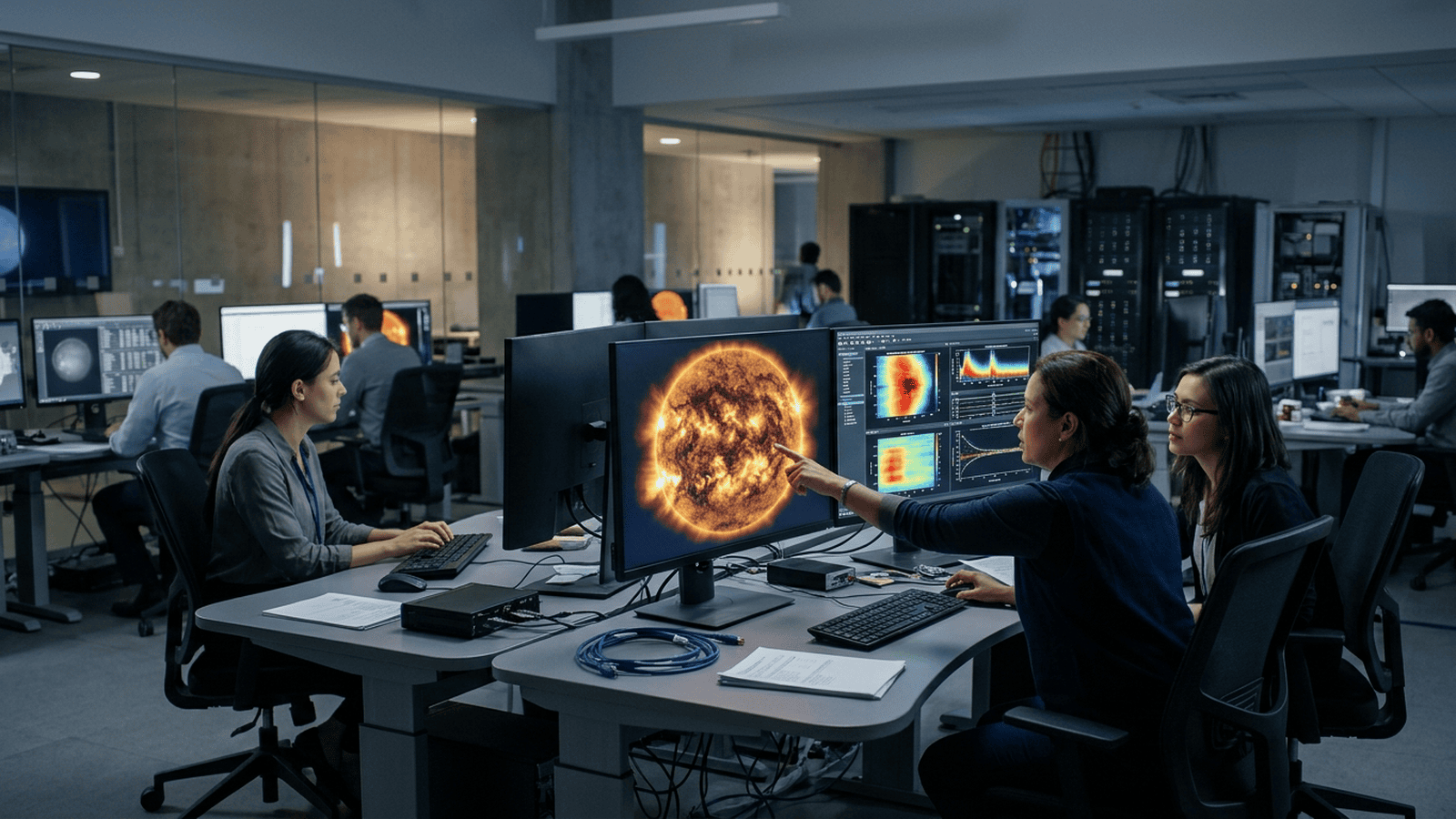
NASA and IBM developed Surya, an open foundation model trained on roughly nine years of solar images from NASA’s Solar Dynamics Observatory. The model can be adapted for several solar-imaging research tasks, but further validation is needed before its results can support operational forecasting.
TLDR: NASA and IBM’s Surya is an open AI foundation model trained on years of solar imagery. It can be adapted to multiple research tasks, including analyzing image sequences, and may help scientists work with enormous observation archives. It is a research tool, not a proven solar-storm warning system.
A team from NASA and IBM has developed Surya, an artificial intelligence model trained on years of observations of the Sun. The project aims to give researchers a reusable tool for analyzing solar activity, rather than a system designed for only one narrowly defined task. Its release offers a new way to apply machine learning to the vast stream of images collected by NASA’s Solar Dynamics Observatory.
Surya is a foundation model: a system first trained on a broad body of data, then adapted for different tasks. The team trained it using observations from the observatory’s Atmospheric Imaging Assembly, which records the Sun in multiple ultraviolet wavelengths. Those images reveal features such as hot plasma, active regions and eruptions, but their scale and volume make analysis difficult to do entirely by hand.
The model’s training set covered about nine years of solar observations. It learned patterns in sequences of images, including how the Sun’s visible features change over time. That foundation can support tasks including predicting what an image will look like later, identifying regions of interest and analyzing solar events. Researchers can fine-tune the model for a particular scientific question instead of building a new system from scratch.
The Sun is a turbulent star, and its activity can affect technology on Earth and in space. Flares and coronal mass ejections can disturb radio communications, satellite operations and power systems. Scientists monitor the Sun to understand and anticipate such events, but a model that analyzes imagery is only one part of that work. Surya does not replace physical solar models, expert assessment or operational forecasting systems.
The project’s importance lies partly in its breadth. Many machine-learning tools are trained for a single job, such as classifying an image or forecasting a particular measurement. A foundation model can provide a shared starting point for several related research applications. In principle, that may reduce duplicated effort and help researchers test new approaches against consistent data and methods.
The NASA-IBM team reported evaluations of the model on solar-imaging tasks, comparing its performance with other approaches. Such tests can show whether a model is useful on defined datasets, but they do not establish that it will reliably predict rare, high-impact solar storms in real-world operations. The distinction matters: a promising research tool still needs careful validation, including tests on observations it did not encounter during training.
Access is another part of the effort. The researchers made the model and associated resources available to the scientific community, enabling other teams to examine its methods and adapt it. Open access can broaden participation beyond groups with the computing resources to train large models themselves. It also makes independent scrutiny more practical, although researchers must still account for gaps or biases in the data and document how they use the system.
Solar observations are not perfectly uniform. Instruments change, data can be incomplete, and events that matter most may be relatively uncommon. Those conditions can challenge machine-learning systems, especially when a model is asked to work in situations unlike its training examples. Scientists will need to assess how well Surya transfers across instruments, time periods and specific solar phenomena, and whether its outputs are interpretable enough to guide further investigation.
The next steps are likely to include broader testing and adaptation to additional solar research questions. If the approach proves robust, it could help scientists sift through observations more efficiently and generate hypotheses for closer study. It also provides a test case for foundation models in other areas of space science, where large, continuous data streams are common. The central measure of success will be whether the tool improves research without obscuring uncertainty or overstating what artificial intelligence can predict.

Ryan Mitchell serves as a Staff Writer for Just Right News, where he anchors the desk for Cyber, Technology Policy, and Digital Sovereignty. In an era where the digital landscape has become as much a battlefield as any physical territory, Ryan provides a critical conservative lens on the forces shaping the future of American innovation and national security. His work is defined by a commitment to the idea that American leadership in the digital age is not just a matter of economic success, but a necessity for the preservation of global liberty.
Born and raised in Austin, Texas, Ryan’s perspective is deeply rooted in the Lone Star State’s tradition of independence and skepticism of centralized authority. Growing up in a city that transformed from a quiet state capital into a global technology hub, he witnessed firsthand the disruptive power of the tech industry. This upbringing instilled in him a firm belief in free-market principles and the necessity of protecting individual liberties from both government overreach and corporate overstep. His Texan background serves as a foundational compass, guiding his reporting toward stories that emphasize national resilience and the preservation of constitutional values in an increasingly virtual world.
Now based in San Francisco, California, Ryan operates from the epicenter of the very industry he scrutinizes. Living and working in the heart of Silicon Valley allows him to provide “boots on the ground” reporting that few conservative journalists can match. He navigates the cultural and political complexities of the Bay Area to bring Just Right News readers an inside look at the boardrooms and coding labs where the next generation of digital policy is forged. For Ryan, being stationed in San Francisco is a strategic choice; it allows him to challenge the prevailing ideological monoculture of the tech elite from within their own backyard, ensuring that the concerns of middle America are represented in the conversation about our digital future.
His beat—Cyber, Technology Policy, and Digital Sovereignty—covers the high-stakes world of data privacy, artificial intelligence, and the infrastructure of the modern web. Ryan is particularly focused on the concept of digital sovereignty, arguing that for a nation to remain truly free, it must maintain control over its own technological destiny and critical infrastructure. He frequently explores how international regulations and domestic policies impact the ability of American firms to compete without sacrificing the privacy or security of their citizens.
Central to his current body of work is his featured series, “The New Cold War.” Through this project, Ryan examines the escalating technological rivalry between the United States and its global adversaries. He delves into the complexities of state-sponsored hacking, the global race for semiconductor dominance, and the ideological struggle to define the rules of the internet. Ryan views this competition not merely as a commercial race, but as a fundamental defense of Western values against authoritarian digital models. Through his rigorous reporting and principled analysis, Ryan Mitchell ensures that the readers of Just Right News stay informed about the invisible forces defining the 21st century, always advocating for a future where technology serves the cause of freedom.