

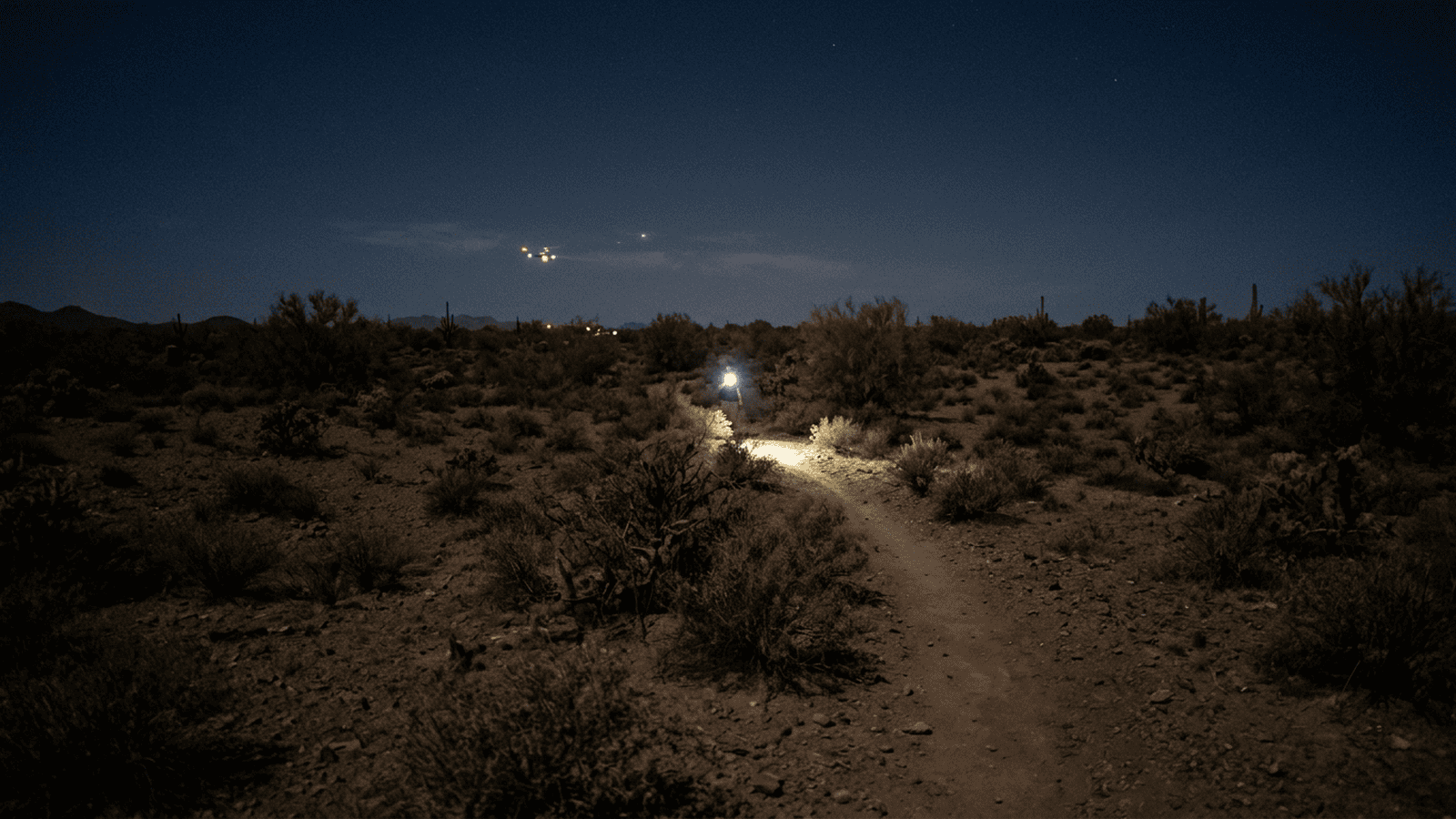
Two-year-old Vella Campillo was found safe after spending seven hours alone in the Arizona desert near Eloy. Volunteer Jay Stewart located her beneath a bush about a mile and a half from her home, after searching on foot for three hours. More than 100 people joined the search, and authorities also used drones and helicopters. Sheriff Ross Teeple said the drones’ heat-signature equipment could not detect the child, whose small body produced little heat. Campillo was cold but uninjured, and Stewart warmed her inside his jacket. The account describes a rescue, not a policy change, and provides no details on costs, forms, compliance rules, or further official review.
TLDR: Jay Stewart found two-year-old Vella Campillo beneath a bush after she spent seven hours alone in the Arizona desert. More than 100 people searched on foot, with drones and helicopters also deployed; she was cold but uninjured.
A two-year-old girl who wandered away from her home outside Eloy, Arizona, was found safe after spending seven hours alone in the desert. Volunteer Jay Stewart spotted Vella Campillo curled beneath a bush just after midnight Wednesday. She was cold but uninjured, according to the account provided by authorities and Stewart.
Campillo had left her yard shortly before sunset Tuesday. She was wearing only a diaper. The Pinal County sheriff’s office asked for help, and Stewart responded to the request.
The sheriff’s office described the search as an effort to locate a very young child in remote terrain as temperatures could fall quickly. More than 100 people searched on foot, while drones and helicopters were also used. Sheriff Ross Teeple said the drones’ heat-signature equipment could not detect the child, in part because her small body produced little heat.
Stewart had been searching on foot for three hours when he found Campillo about a mile and a half from her home. He said he called her name and heard her yell. He then shined a flashlight toward a bush, and she emerged.
The search had begun after the sheriff’s office publicly asked for assistance. The response brought a large number of people into the field, alongside the use of aircraft and drones. The available account does not identify the volunteers or agencies involved beyond Stewart and the Pinal County sheriff’s office, and it does not give a more detailed timeline of the search’s stages.
Stewart recalled the discovery during a news conference. He said the moment the child appeared from beneath the bush was one he would never forget. He picked her up, and she clung tightly to him. He tucked her inside his jacket to keep her warm.
The child’s condition brought a welcome end to a search that had lasted through the evening and into the night. She was described as a little cold but uninjured. The account does not provide further medical details or say whether she received an examination after being found.
Teeple praised Stewart in a video posted to the sheriff’s office’s Facebook page. The sheriff referred to body-camera footage and called Stewart the little girl’s hero. Stewart, speaking at the news conference, said he did not expect thanks from the family. He described helping as something people do.
The incident also showed a limit of one tool used in the search. Teeple said winter conditions in remote areas can turn cold quickly, while a small child produces relatively little heat. In this case, he said, the drones’ heat signatures did not pick her up. The account does not say whether other equipment had similar limits, how the search area was divided, or what procedures guided the volunteers.
Those missing details are not evidence of a failure or a change in policy. The available information describes a search and rescue, not a new rule or government program. It does not identify costs, paperwork, fees, compliance requirements, enforcement measures, or deadlines. No policy impact for families or volunteers is specified in the account, and no official rationale for a policy change is reported.
The practical details that are known are substantial: more than 100 people searched on foot, drones and helicopters were deployed, and Stewart searched for three hours before locating the child roughly a mile and a half from her home. The search lasted seven hours in total, according to the report. The account does not state what forms volunteers completed, whether any fees were incurred, or what training or eligibility requirements applied. Those matters remain unspecified rather than grounds for assumption.
The search involved both local volunteers and technology, but the available account does not say how those efforts were coordinated. It also does not explain how officials chose where to look first or whether the aircraft covered the same areas as searchers on foot. The confirmed details remain the scale of the response, the tools used, and Stewart’s account of finding the child.
Stewart said the child’s parents thanked him, but he believed that thanks were unnecessary. His account of hearing her voice, directing his flashlight toward the bush, and finding her safe gives a clear picture of the final moments of the search without answering every operational question. The sheriff’s office has not been described as announcing further reviews or deadlines. Any additional oversight or next steps are not provided in the available account, so no assurance about them can be made.

Susan Carter serves as a Senior Correspondent for Just Right News, where she leads the network’s comprehensive coverage of Health, Medicine, and Public Policy. With a career dedicated to dissecting the complexities of the American healthcare system, Susan brings a principled perspective to the most pressing debates of the day. Her reporting is characterized by a commitment to individual liberty, fiscal responsibility, and a healthy skepticism of government overreach, making her a vital voice for audiences seeking clarity in an increasingly regulated landscape.
Raised in Minneapolis, Minnesota, Susan’s professional outlook is deeply informed by the values of the American heartland. Growing up in the Twin Cities, she witnessed firsthand the importance of community-driven solutions and the resilience of the individual. This Midwestern foundation instilled in her a firm belief that the best answers to public policy challenges often come from local innovation and personal responsibility rather than top-down federal mandates. Her background allows her to translate complex legislative jargon into stories that resonate with families who value common sense and local autonomy.
Now based in Baltimore, Maryland, Susan operates from a unique vantage point at the intersection of medical innovation and urban policy. Living and working in a city renowned for its world-class medical institutions and significant public health challenges, she has a front-row seat to the realities of the modern healthcare landscape. Her proximity to these hubs of research and policy allows her to scrutinize how government intervention affects the quality of care and the freedom of medical professionals. In Baltimore, she sees the tangible results of policy decisions, using the city as a lens through which to examine the broader national health debate and the impact of federal spending on local communities.
As the lead for the acclaimed feature series “The Cost of Care,” Susan dives deep into the economic realities facing patients and providers alike. Her work focuses on the necessity of price transparency, the benefits of market competition, and the preservation of the sacred doctor-patient relationship. She is a staunch advocate for the idea that a well-informed public is the best defense against bureaucratic inefficiency. Through this series, she has exposed the hidden drivers of rising medical expenses, always seeking to empower the individual consumer over the massive institution.
Susan’s reporting on public policy is characterized by a commitment to rigorous inquiry and a focus on constitutional limits. Whether she is analyzing new pharmaceutical regulations, investigating the impact of federal health mandates, or exploring the future of medical technology, her goal remains the same: to provide Just Right News audiences with the facts they need to navigate a complex world. By blending her Midwestern sensibilities with the insights gained from her base in Maryland, Susan Carter has become a trusted authority for those who believe that personal freedom and public health are inextricably linked. Her work continues to challenge the status quo, advocating for a system that respects the taxpayer and prioritizes the patient.