

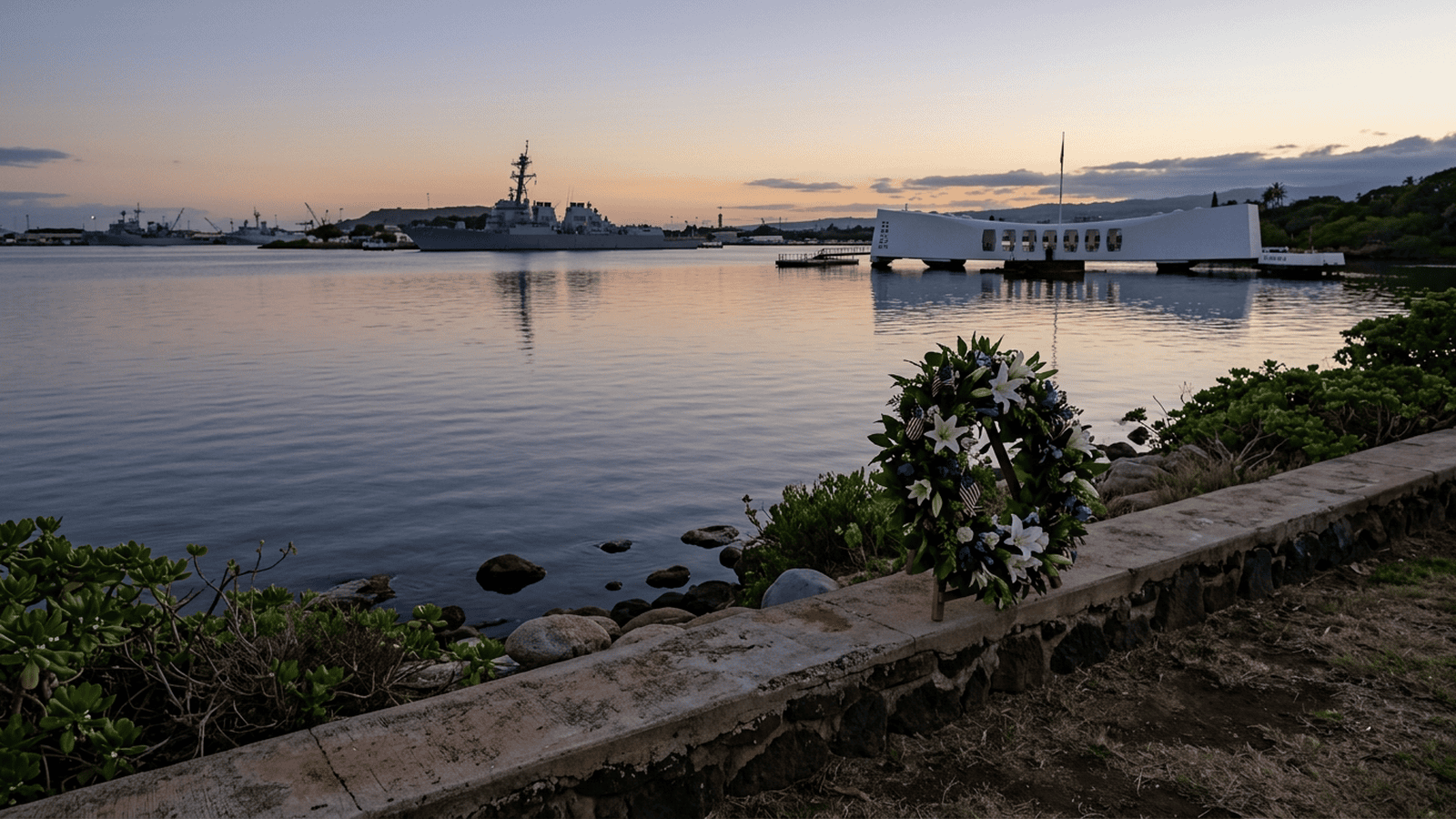
Pearl Harbor survivor Gebhard “Geb” Galle has died at 105 at his home in Moses Lake, Washington. A Navy machinist’s mate aboard the USS Nevada during the 1941 attack, he later opened a hatch against an order so four sailors could escape the sinking USS Northampton. Galle and other sailors were adrift in life rafts for more than a day before rescue. Then-Acting Chief of Naval Operations Adm. James Kilby praised Galle’s service, including his participation in 19 of 20 Pacific naval engagements. Pacific Historic Parks, which helps preserve Pearl Harbor’s history, confirmed Galle’s age; no new policy, deadline, or oversight plan is described.
TLDR: Gebhard Galle, a Pearl Harbor survivor and Navy veteran, died at 105 in Washington. During the Battle of Tassafaronga, he opened a hatch that allowed four sailors to escape the sinking USS Northampton, then survived more than a day adrift before rescue.
Gebhard “Geb” Galle, a Pearl Harbor survivor remembered for saving four fellow sailors from a sinking ship, died Saturday at his home in Moses Lake, Washington. He was 105, according to Pacific Historic Parks, an organization that helps preserve Pearl Harbor’s history. Galle was among the few remaining survivors of the 1941 attack and went on to serve in major Pacific naval engagements during World War II.
The account’s stated purpose is remembrance: Pacific Historic Parks helps preserve Pearl Harbor’s history, and a 2016 service honored the USS Nevada and those who served aboard it. No government policy change or separate official policy rationale is described in the material. Galle’s story instead records a sailor’s service, a rescue at sea, and his later reflections on war and peace.
Galle was born in Germany and came to North Dakota with his family in 1928, when he was 7. He joined the U.S. Navy in 1939 at age 18. On Dec. 7, 1941, he was a 20-year-old machinist’s mate aboard the USS Nevada, waiting below deck to be taken ashore for church services when he saw planes approaching through a porthole.
He went to his battle station in the engineering section, two decks below. A torpedo struck the Nevada and water entered the ship, but officers got it moving, according to the Navy. The ship came under attack again, taking on more water and catching fire before it ran aground. Galle could not see the damage from below deck. In a 2020 interview with the Columbia Basin Herald, he recalled feeling jolts from the torpedo and bombs. After reaching the top deck, he saw the capsized USS Oklahoma and the partly submerged USS Arizona. He called the scene “a pretty sad lookout.”
After the Pearl Harbor attack, Galle was reassigned to the USS Northampton. On Nov. 30, 1942, that ship came under fire from Japanese torpedoes during the Battle of Tassafaronga. Galle later told the Columbia Basin Herald that an officer ordered him to close a hatch behind four sailors who would otherwise have been trapped as the ship sank. After the officer left, Galle opened the hatch and let the men escape. He then closed and secured it.
The Northampton sank. Galle and other sailors spent more than a day adrift in life rafts before rescuers reached them. In a 2025 birthday letter, then-Acting Chief of Naval Operations Adm. James Kilby praised Galle’s humility, quick thinking, and selfless actions. Kilby also noted that Galle served aboard the Nevada, Northampton, and USS Mobile, witnessed the launch of the Doolittle Raid, and fought in 19 of 20 Pacific naval engagements.
Galle attended a Pearl Harbor anniversary service in December 2016, 75 years after the attack, to honor the Nevada and its crew. The Navy said 76 sailors and Marines died as a result of the attack on that ship. Galle spoke at the service about setting aside hatred and recognizing the distinction between people and the leader who had led them astray. “We’re at peace now and I feel comfortable,” he said. “I have no qualm. We’re all good people.”
Galle died the same day as Freeman Johnson, the oldest known Pearl Harbor survivor, who was 106 and lived in Centerville, Massachusetts. Galle and Johnson were among an estimated 87,000 military personnel on Oahu on Dec. 7, 1941. After the war, Galle married and opened a refrigeration and air-conditioning business in North Dakota. He later served as a civil engineer with the Air Force and the U.S. Army Corps of Engineers, retiring in the 1980s.
The practical details in this account concern Galle’s service rather than a new policy: the hatch order, the escape of four sailors, and the more than day spent in life rafts after the Northampton sank. No fees, forms, compliance rules, government deadlines, or future oversight steps are described. The directly affected people in the reported events were Galle and his fellow sailors; the account does not specify further administrative actions after his death.
Pacific Historic Parks helps preserve Pearl Harbor’s history, and the 2016 service commemorated the Nevada and its crew. No further preservation timetable or oversight process is identified in the material. The documented next step is continued historical remembrance through the work of the organization; no experts or officials are quoted offering assurances about additional plans.

Lila Hayes serves as a Staff Writer for Just Right News, where she anchors the “Courts, Law, and Constitutional Order” beat. Her work is defined by a steadfast commitment to the foundational principles of the American republic and a rigorous defense of the legal frameworks that ensure national stability. As a primary voice for the outlet, she provides readers with a clear-eyed analysis of the judiciary, focusing on the importance of originalism and the preservation of the separation of powers.
Lila’s perspective was forged in the American heartland. Raised in St. Louis, Missouri, she grew up in a Hispanic household where the values of hard work, faith, and respect for the law were paramount. Her upbringing instilled in her a deep appreciation for the American Dream and the legal protections that make it possible. This Missouri background remains a cornerstone of her reporting, providing a grounded, common-sense counter-narrative to the often-insular legal circles of the coastal elite. She understands that the decisions made in high-court chambers have real-world consequences for families and small business owners across the country.
At Just Right News, Lila has become widely recognized for her signature feature series, “The Rulebook of Power.” In this ongoing project, she delves into the mechanics of the federal government, examining how administrative overreach and judicial activism can threaten the delicate balance of the Constitution. She approaches her beat with the tenacity of a veteran journalist and the precision of a legal scholar, consistently advocating for a judiciary that interprets the law as written rather than legislating from the bench. For Lila, the Constitution is not a “living” document subject to the whims of modern social trends; it is a fixed standard that ensures the government remains the servant of the people, not their master.
Now based in Philadelphia, Pennsylvania, Lila finds herself at the very epicenter of American constitutional history. Living and working in the city where the Founders drafted the documents she defends daily provides a constant source of inspiration. The historic halls and landmarks of Philadelphia serve as a daily reminder of the high stakes involved in her reporting. Her presence in the city allows her to bridge the gap between the historical intent of the law and its contemporary application, ensuring that the legacy of the Founding Fathers remains central to the national conversation.
Throughout her career, Lila has remained dedicated to the idea that a free society requires an informed citizenry and a transparent legal system. Her reporting is more than just a collection of headlines; it is a defense of the constitutional order that has sustained the nation for over two centuries. By focusing on the “Rulebook of Power,” she ensures that her readers understand not just what is happening in the courtrooms, but why those decisions matter for the future of American liberty. Lila Hayes continues to be a vital voice for those who believe that the law should be a shield for the citizen and a constraint on the state.