

As Trump prepares for talks with Xi and Putin, Israel’s Gaza operation and the EU’s continuing military support for Ukraine underscore the conflicts competing for diplomatic attention and resources.
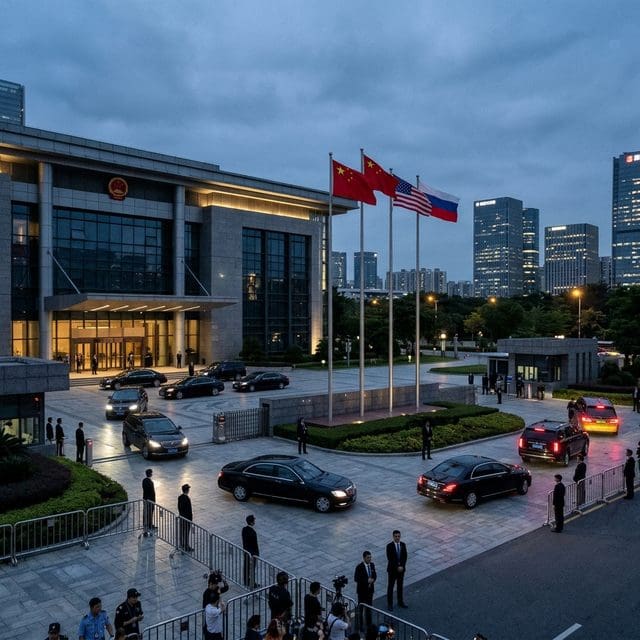
President Donald Trump arrived in Shenzhen on November 18 ahead of a planned November 19 meeting with Chinese President Xi Jinping and Russian President Vladimir Putin. The leaders are expected to discuss Iran’s war and Russia’s war in Ukraine, bringing three major powers together as fighting continues on both fronts.
Trump’s Asia trip began in the Philippines, where he arrived on November 17. The journey combines high-level diplomacy with a tougher policy toward Beijing: the administration announced rules on November 16 restricting China’s access to advanced AI chips through overseas data centers, alongside measures aimed at smuggling. The talks and controls reflect the competing demands of managing relations and protecting American strategic interests.
Xi and Putin met in Shenzhen before Trump arrived. Putin called for dialogue rather than ultimatums and described the planned meeting as “highly useful,” Euronews reported. Those remarks set a conciliatory public tone but do not establish a shared plan for either conflict or a change in Russia’s conduct in Ukraine.
In Gaza, Israeli tanks advanced into central areas west of the Yellow Line on November 18. Israel said the operation targeted Hamas infrastructure. Palestinian medics reported three people killed in separate Israeli strikes, including one near the military operation, Reuters reported.
The Trump administration’s Board of Peace said Israel and Hamas were both failing to meet commitments under the Gaza roadmap and warned that the ceasefire was at risk of collapse. Reuters reported near-daily Israeli strikes and continued Hamas attacks on Israeli troops as of November 18. The reports describe a truce under pressure, not a settled end to hostilities.
The immediate test for diplomacy is whether the parties change their actions on the ground. Statements about commitments carry limited weight if strikes and attacks continue. The planned summit’s discussion of Iran adds a wider regional dimension, although available reporting does not specify what proposals the leaders may put forward.
Europe is continuing to finance Ukraine’s defense while Russia’s war remains unresolved. On November 16, the European Commission released another €1.71 billion under the Ukraine Support Loan for drones, ammunition and air-defense systems. The Commission said total disbursements under the facility’s defense component had reached €18.1 billion as of November 17.
The disbursements show the EU’s commitment to sustaining Kyiv’s military capacity. They also demonstrate the demands of a prolonged conflict: funding must become equipment that reaches the battlefield, while European governments maintain political support for assistance. The figures describe funding under the existing facility; they do not establish a new agreement or predict the outcome of the Shenzhen talks.
The summit could test whether the leaders see room for common ground on Ukraine and Iran. Their interests, however, are not identical. China and Russia have their own strategic priorities, while Washington must weigh the costs of continued conflict against the danger of concessions that do not alter an adversary’s calculations. A meeting can open channels, but it cannot substitute for enforceable terms or credible leverage.
The practical measures to watch are whether the talks produce specific commitments, whether the Gaza ceasefire holds and whether European support continues reaching Ukraine’s armed forces. For American power, the question is not simply who sits at the table, but whether diplomacy can shape events beyond it.

Olivia Kendall serves as the Senior Correspondent for Geopolitics, Defense, and Foreign Policy at Just Right News, where she provides a principled, conservative perspective on the complex forces shaping the global stage. With a career dedicated to deconstructing the intricacies of international relations, Kendall has become a trusted voice for readers who value national sovereignty, a robust military, and a foreign policy that prioritizes American interests above all else.
A native of Washington, D.C., Kendall’s professional journey is deeply rooted in her upbringing within the nation’s capital. Growing up in the epicenter of American political life, she developed an early and profound understanding of how policy is crafted and, more importantly, how it often fails to account for the values of the American heartland. This unique vantage point allowed her to witness firsthand the rise of globalist bureaucracies, fueling her commitment to reporting that champions the constitutional foundations of the United States. Her background as a British White American further informs her worldview, providing her with a keen appreciation for the Western tradition and the enduring importance of the “Special Relationship” in maintaining global stability.
Now based in Arlington, Virginia, Kendall operates from the doorstep of the Pentagon and the heart of the nation’s defense establishment. Her proximity to the decision-makers in the military and intelligence communities allows her to provide boots-on-the-ground reporting that is both timely and deeply informed. For Kendall, Arlington is more than just a base of operations; it is a daily reminder of the sacrifices made by the men and women in uniform. This connection to the defense community drives her rigorous coverage of military readiness and her advocacy for a “peace through strength” approach to diplomacy.
At Just Right News, Kendall is perhaps best known for her acclaimed feature series, “The World’s Shadow on America.” In this ongoing project, she explores the direct correlation between international developments and the daily lives of American citizens. Whether she is analyzing the encroachment of foreign adversaries in domestic supply chains or the impact of international treaties on local economies, Kendall’s work serves as a vital bridge between distant geopolitical shifts and their consequences at home. She rejects the notion that foreign policy is an abstract concern for elites, instead proving that what happens in the corridors of power in Brussels or Beijing has a tangible “shadow” that falls across every American doorstep.
Throughout her tenure, Kendall has remained a steadfast critic of international overreach and a vocal proponent of a clear-eyed, realistic foreign policy. She brings a sharp analytical mind to her beat, often challenging the prevailing narratives of the mainstream media to uncover the underlying truths that affect national security. Her reporting is characterized by a refusal to compromise on the truth and a dedication to the idea that a strong, secure America is the world’s best hope for liberty. As a Senior Correspondent, Olivia Kendall continues to lead the charge in providing the essential context and conservative insight necessary to navigate an increasingly volatile world.