

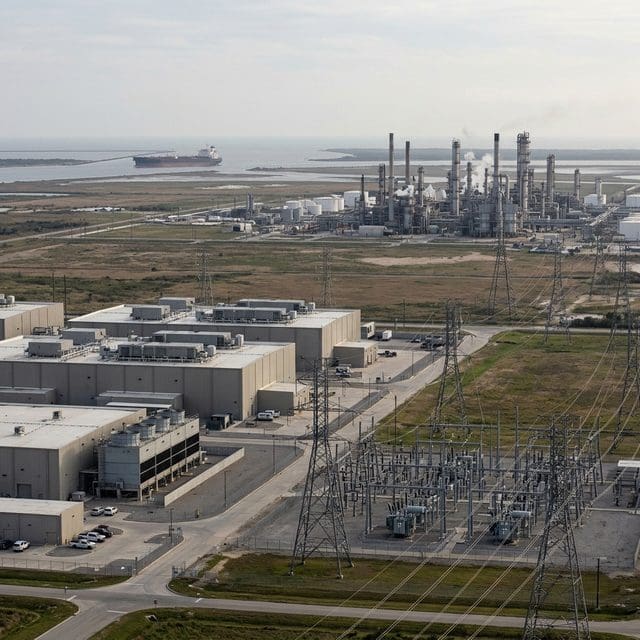
Atlas Energy is shifting a data-center power project away from Texas, while Ithaca raises its dividend outlook as oil infrastructure faces renewed geopolitical risks.
Energy companies are weighing where projects can proceed, how much capital they require and whether supplies can reach customers safely. Atlas Energy Solutions is shifting a proposed data-center power strategy away from Texas, while North Sea producer Ithaca Energy is raising its dividend outlook as it awaits a decision on a major oilfield. Attacks on Russian refineries and renewed violence around the Strait of Hormuz add geopolitical risk to those investment calculations.
Atlas has narrowed its search for a power-project site to one location in Oklahoma, Mississippi, Louisiana or South Dakota, Investing.com reported Nov. 18. The company said Texas regulatory uncertainty prompted the shift. It expects to announce the site by year-end 2026, with initial generation targeted for late 2027 or early 2028 and a full ramp-up by mid-2028.
Atlas estimates costs of $2 billion to $2.5 billion per gigawatt and annualized EBITDA above $400 million per gigawatt. Those are company projections, not realized returns. The report does not identify the site or specify the project’s fuel mix. Power availability, infrastructure, financing and construction costs will help determine whether the economics hold up. The gap between a projected operating return and a completed, reliable power plant also depends on whether the project is delivered on schedule and can secure customers.
The proposed investment reflects the challenge of serving data centers’ large, steady demand. New power capacity can support that growth, but developers need predictable rules and a workable path to connect generation. Texas regulatory uncertainty is prompting Atlas to look elsewhere; the available information does not establish that its alternative location will mean lower costs or faster construction. The shift is a reminder that competition for capital can turn on permitting and regulatory risk as much as on demand forecasts.
Ithaca Energy raised its 2026 dividend guidance to $560 million-$580 million from $500 million-$530 million after reporting nine-month production of 125,000 barrels of oil equivalent per day. It narrowed its full-year production forecast to 123,000-127,000 boe/d, Alliance News and Morningstar reported. Ithaca also lowered its estimate of 2026 net capital costs for the Rosebank project to $225 million-$255 million, from $250 million-$280 million.
The company expects U.K. government approval for Rosebank by the end of 2026, which would allow production to start in the first half of 2027, Reuters reported. That remains a forecast, not a completed regulatory decision. Rosebank’s prospects put domestic supply and investment alongside environmental considerations in the approval debate. The available reports do not provide an emissions estimate or a final government determination. A decision will also matter to project spending and the timing of prospective production, both of which remain contingent on approval and execution.
Energy costs are also affecting the broader economic outlook. The Wall Street Journal reported that Bank of England Governor Andrew Bailey sees the duration of the Iran war as important to the interest-rate path. The central bank raised its key rate earlier this month for the first time since the war began, responding to higher energy prices. That illustrates how a supply shock can reach beyond fuel buyers: sustained price pressures may influence monetary policy, borrowing costs and investment decisions.
Overnight drone attacks reportedly targeted Russia’s Ilsky and Afipsky refineries in Krasnodar Krai, with fires reported at both facilities, RBC-Ukraine reported. The extent of damage was not established. The supplied reporting does not confirm a precise loss of Russian refining capacity, leaving the scale of any supply impact uncertain. Fires alone do not establish how long either facility might be affected or whether product exports will change.
Separately, CBS News reported that a tanker caught fire in the Strait of Hormuz after being hit by a projectile, citing the ship’s crew, amid renewed U.S.-Iran strikes. The incident highlights risks to a major energy-shipping route. The available information does not establish the vessel’s identity, the full extent of damage or any resulting change in oil flows. Any lasting effect on transport would depend on further incidents and how shipping operators respond.
Together, the developments show how energy investment depends on more than headline demand or production forecasts. New power capacity can serve data-center growth; oil projects can add supply and investment, subject to regulatory decisions; and attacks on infrastructure and shipping can threaten reliability. Costs, construction timelines, emissions and security all shape the outcome.

Mark Davis serves as the Senior Correspondent for Energy, Climate, and Resource Economics at Just Right News. In an era where the conversation around the environment is often dominated by alarmism and top-down mandates, Mark provides a vital, market-oriented perspective on the complex forces shaping our world. As the lead voice behind the acclaimed feature series “Power and the Planet,” he explores the intersection of environmental policy, global energy markets, and the fundamental economic principles that sustain modern civilization.
Mark’s pragmatic approach to resource management was forged in the high desert of his hometown, Albuquerque, New Mexico. Growing up in a region defined by both its breathtaking natural beauty and its rugged, resource-dependent landscape, he developed an early appreciation for the delicate balance between conservation and utilization. New Mexico’s unique position as a hub for both traditional energy production and cutting-edge scientific research provided Mark with a front-row seat to the evolution of the American energy sector. This upbringing instilled in him a deep-seated belief that true environmental stewardship is inseparable from economic prosperity and technological innovation.
Now based in Boulder, Colorado, Mark operates from the heart of the nation’s climate research community. While Boulder is often seen as a bastion of environmental idealism, Mark utilizes his post to provide a necessary counterweight, grounded in the realities of resource economics. He understands that energy policy does not exist in a vacuum; it has tangible consequences for the American taxpayer, the stability of the national power grid, and the strength of the domestic manufacturing sector. By reporting from the front lines of the climate debate, he is able to challenge prevailing narratives with hard data and a commitment to the principles of the free market.
Throughout his tenure at Just Right News, Mark has distinguished himself by focusing on the “Resource Economics” aspect of his beat. He frequently highlights the hidden costs of rapid energy transitions and advocates for an “all-of-the-above” energy strategy that prioritizes American energy independence. His work often shines a light on the geopolitical implications of resource scarcity, arguing that a secure nation must first be an energy-secure nation. Whether he is analyzing the impact of federal land-use regulations or investigating the supply chains required for new technologies, Mark remains focused on how policy decisions affect the lives and livelihoods of everyday citizens.
In “Power and the Planet,” Mark continues to bridge the gap between complex scientific concepts and the economic realities facing the country. He rejects the false choice between a healthy environment and a thriving economy, instead seeking out solutions that leverage American ingenuity and private-sector competition. For Mark, reporting on the climate is not about following the latest trends, but about ensuring that the conversation remains tethered to the foundational values of liberty, property rights, and fiscal responsibility. His contributions ensure that Just Right News readers receive a comprehensive, clear-eyed view of the challenges and opportunities defining the future of our planet.