

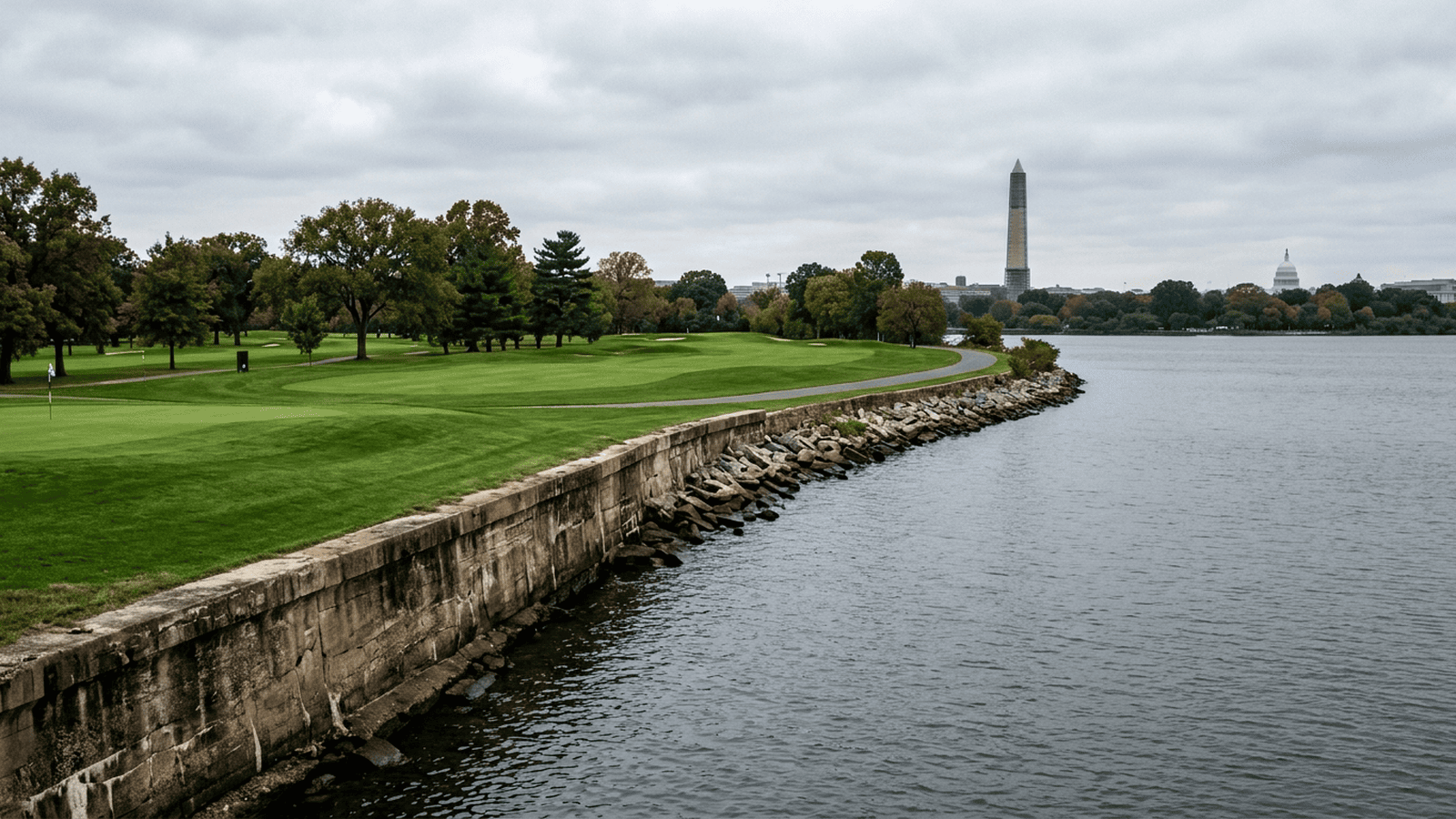
The Interior Department has announced plans to issue a formal solicitation on Nov. 30 for a contractor to work on the seawall at East Potomac Park. The department says the seawall’s condition is a safety concern and part of the case for renovating the park and its historic golf course. Its Friday notice was only a pre-notice, not a request for bids or a contract award. A federal judge rejected the administration’s argument for closing the park and issued a temporary restraining order stopping work related to golf-course construction. Costs, contractor requirements, work schedules, and the order’s effect on separate seawall work are not specified in the available account.
TLDR: The Interior Department expects to issue a seawall-work solicitation on Nov. 30, but its current notice is only a preliminary announcement. A judge’s temporary restraining order halts golf-course construction, while project costs, bidding rules, and the scope of any seawall work remain unspecified.
The Interior Department has signaled that it plans to seek a contractor for seawall work at East Potomac Park in Washington, D.C. The park includes the East Potomac Golf Links, a historic public course President Donald Trump plans to redevelop into what the administration calls a world-class venue. The department’s notice set out a next step for the seawall, but it did not authorize a contractor to begin work.
The administration’s stated rationale is safety and the condition of the seawall. Officials have argued that the seawall is in precarious condition and that East Potomac Park needs renovation. That is the government’s stated case for addressing the site; a judge rejected the administration’s use of that argument to support closing the park.
The notice was announced Friday, before the judge’s action, and said a formal solicitation would be issued Nov. 30. It described itself as a “pre-notice of an upcoming solicitation ONLY,” rather than a request for bids. The distinction matters: the document signals a planned procurement step, not a completed award or permission to proceed with the golf-course construction.
The seawall has become a central part of the administration’s explanation for renovating the park and course. Trump has targeted the golf course as one of his projects to remake the District of Columbia. The available account does not provide a contractor, a projected construction schedule, a cost estimate, or details of the seawall work. Those items remain unknown in the provided material.
The renovation is also the subject of a lawsuit. The case challenges Trump’s plans for the historic public course. During a hearing Friday, U.S. District Judge Ana Reyes rejected the administration’s argument that safety concerns, including the seawall, justified closing the park. Reyes issued a temporary restraining order the following day that stopped work related to construction of the golf course.
That order places an immediate legal limit on the broader construction plans, even as the Interior Department’s notice points to a procurement process for the seawall. The two actions should not be treated as interchangeable. The notice came before the court order, and the excerpt does not say whether the planned solicitation itself is covered by the order or whether separate seawall work may proceed. The legal dispute therefore remains central to what happens next.
The record also identifies the source and timing of the department’s signal. The Interior Department issued the notice on Friday and listed Nov. 30 for the formal solicitation. The excerpt does not describe the bidding requirements, application forms, contractor qualifications, enforcement terms, or a deadline for completing work. It also gives no estimate of public cost and does not specify how long any closure or construction would last. Those details are not established in the material available here.
The practical impact is therefore limited but clear. The department has announced a planned formal solicitation, while the judge’s temporary restraining order halts work related to construction of the golf course. A contractor may be sought for seawall work, but the notice itself is not a solicitation, and the excerpt does not establish that a contract has been awarded. Park users face uncertainty over the timing and scope of any work; no specific access restrictions or fees are reported. The public record provided also does not identify a funding amount or explain how the project’s costs would be paid.
The dispute tests the balance between executive plans for a public site and judicial review of those plans. The department’s safety argument is part of the administration’s case, not a finding accepted by Judge Reyes at the hearing described in the excerpt. The judge’s order is a binding procedural development in the reported account, and the planned Nov. 30 solicitation is a separate administrative milestone. Both facts must remain visible in any account of the project.
The next steps are the formal solicitation identified in the notice and the continuing legal process under the temporary restraining order. Further details on cost, scope, contractor selection, and the order’s effect on seawall work are not provided. Those are necessary points for public oversight and compliance, and the record should be assessed as those steps become clear.

Ben Taylor serves as the Senior Correspondent and Investigations Lead for Just Right News, where he anchors the network’s commitment to government transparency and institutional accountability. With a career defined by a relentless pursuit of the facts, Taylor spearheads the acclaimed feature series “The Paper Trail,” a deep-dive investigative column that prioritizes primary source documentation over political rhetoric. Based in the heart of the nation’s capital, he has earned a reputation as one of the most formidable investigative journalists in Washington, D.C., known specifically for his mastery of public records and the Freedom of Information Act.
Taylor’s approach to journalism is deeply rooted in his upbringing in Kansas City, Missouri. Growing up in the “Show Me State,” he developed a healthy skepticism of centralized power and a profound respect for the common-sense values of the American heartland. This Midwestern foundation informs his reporting today, as he bridges the gap between the complex machinations of federal bureaucracy and the everyday concerns of citizens across the country. For Taylor, investigative reporting is not about chasing headlines; it is about ensuring that the government remains answerable to the people it serves.
As an African American man working within the conservative media landscape, Taylor brings a principled perspective to his beat. He views the Constitution and the right to information as the ultimate equalizers in a free society. His work often highlights how bureaucratic overreach and lack of transparency disproportionately affect individual liberties. By focusing on the “paper trail,” Taylor strips away the spin of partisan talking points, instead providing Just Right News readers with the raw data and internal communications that reveal how their tax dollars are spent and how policy decisions are actually made.
In his role as Investigations Lead, Taylor oversees a team dedicated to uncovering the stories that mainstream outlets often overlook. Whether he is auditing federal spending, investigating regulatory overreach, or exposing inefficiencies within the administrative state, his methodology remains consistent: follow the evidence wherever it leads. His presence in Washington, D.C., allows him to maintain a constant watch over the halls of power, yet he remains steadfastly connected to his roots, ensuring his reporting reflects the clarity and directness of his Missouri home.
Throughout his tenure at Just Right News, Taylor has become a vital voice for those who demand integrity in public office. He believes that a well-informed electorate is the strongest defense against government overreach, and he has dedicated his career to providing the public with the tools they need to hold their leaders accountable. Through “The Paper Trail” and his broader investigative work, Ben Taylor continues to set the standard for rigorous, document-driven journalism that champions the values of transparency, individual responsibility, and the rule of law.