

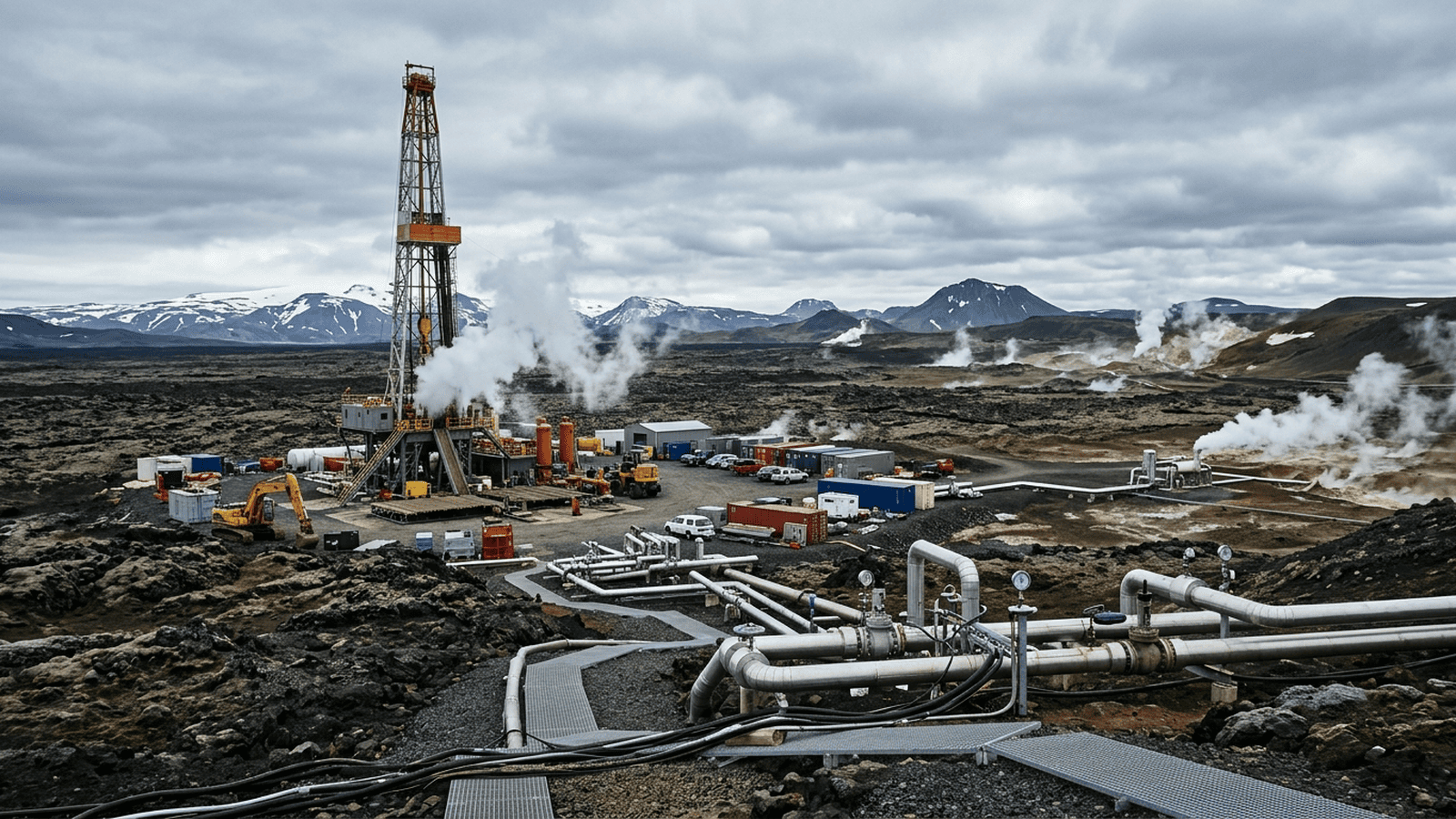
A research well at Iceland’s Krafla volcanic field unexpectedly encountered magma in 2009 and later produced exceptionally hot steam. The short-lived test showed the potential of deep geothermal energy while exposing significant engineering challenges and leaving commercial viability unproven.
TLDR: At Iceland’s Krafla volcanic field, the IDDP-1 research well unexpectedly reached magma about 2.1 kilometers underground. A test produced steam as hot as 450 degrees Celsius, offering evidence that deep geothermal resources could be powerful. The well was shut down after casing failure, and long-term reliability and commercial viability remain unresolved.
In 2009, a drilling project in northeast Iceland reached an unexpected target: molten rock. The well, IDDP-1, was being drilled at the Krafla volcanic field to test whether unusually hot underground resources could support geothermal power. At about 2.1 kilometers deep, the drill encountered magma. The accidental encounter made the well a rare natural laboratory for studying how volcanic heat might produce energy.
The Iceland Deep Drilling Project brings together Icelandic energy companies and research partners to investigate geothermal resources deeper and hotter than those used by conventional power plants. Most geothermal facilities circulate water through hot rock and bring heated fluid to the surface. At greater depths, the project aims to reach conditions where water can become superheated or enter a supercritical state, potentially carrying far more energy per unit of fluid.
IDDP-1 was not intended to bore into a magma chamber. The team was targeting hot rock, but at roughly 2,100 meters it encountered rhyolitic magma estimated at about 900 degrees Celsius. Only a handful of wells worldwide have directly intersected magma. Researchers completed the well by installing a steel casing into the surrounding rock, connecting it to a very hot underground environment.
When tested in 2010, the well produced steam at temperatures as high as 450 degrees Celsius and pressure of about 140 bars. Those conditions were far hotter than in ordinary geothermal wells. The steam’s heat content suggested such a well might supply substantially more power than a conventional one, although IDDP-1 was an experiment, not a commercial installation. It did not demonstrate sustained electricity generation through a turbine.
The result mattered because geothermal energy can provide electricity regardless of weather, unlike wind and solar power. Conventional geothermal plants, however, depend on suitable hot rock and naturally available water, resources that vary by location. Drilling deeper could open access to more heat, while superheated fluids might make each well more productive. These conditions also bring serious engineering challenges: extreme temperatures, pressure, corrosive fluids and the risk of equipment damage.
The Krafla well also gave scientists a close look at magma-related processes that are usually difficult to observe. Researchers analyzed recovered rock and fluids to understand how magma interacts with water and the well’s casing. The work showed that magma can be encountered at drillable depths in a volcanic region, and that a well can be engineered to draw energy from surrounding heat. It did not establish that drilling directly into magma is a safe or routine way to generate power.
IDDP-1 was shut down after its casing failed in 2012, underscoring the trial’s limits. Its short operating period left major questions unanswered: how long a well could withstand such temperatures, how materials might be improved, and whether the heat could be converted economically into electricity. The findings were reported in scientific papers, including a 2014 study describing the well and its high-temperature output.
The broader research program has continued to explore deep geothermal drilling, including a later Krafla well designed to test high-temperature conditions without repeating the accidental magma encounter. Further tests must establish reliable well designs, measure long-term output and assess environmental and operational risks. For Iceland, where geothermal energy already plays a major role, the experiment pointed toward extracting more power from a limited number of wells. Elsewhere, it shows that deep heat is technically reachable, but does not prove magma-powered geothermal energy is ready for widespread use.

Mark Davis serves as the Senior Correspondent for Energy, Climate, and Resource Economics at Just Right News. In an era where the conversation around the environment is often dominated by alarmism and top-down mandates, Mark provides a vital, market-oriented perspective on the complex forces shaping our world. As the lead voice behind the acclaimed feature series “Power and the Planet,” he explores the intersection of environmental policy, global energy markets, and the fundamental economic principles that sustain modern civilization.
Mark’s pragmatic approach to resource management was forged in the high desert of his hometown, Albuquerque, New Mexico. Growing up in a region defined by both its breathtaking natural beauty and its rugged, resource-dependent landscape, he developed an early appreciation for the delicate balance between conservation and utilization. New Mexico’s unique position as a hub for both traditional energy production and cutting-edge scientific research provided Mark with a front-row seat to the evolution of the American energy sector. This upbringing instilled in him a deep-seated belief that true environmental stewardship is inseparable from economic prosperity and technological innovation.
Now based in Boulder, Colorado, Mark operates from the heart of the nation’s climate research community. While Boulder is often seen as a bastion of environmental idealism, Mark utilizes his post to provide a necessary counterweight, grounded in the realities of resource economics. He understands that energy policy does not exist in a vacuum; it has tangible consequences for the American taxpayer, the stability of the national power grid, and the strength of the domestic manufacturing sector. By reporting from the front lines of the climate debate, he is able to challenge prevailing narratives with hard data and a commitment to the principles of the free market.
Throughout his tenure at Just Right News, Mark has distinguished himself by focusing on the “Resource Economics” aspect of his beat. He frequently highlights the hidden costs of rapid energy transitions and advocates for an “all-of-the-above” energy strategy that prioritizes American energy independence. His work often shines a light on the geopolitical implications of resource scarcity, arguing that a secure nation must first be an energy-secure nation. Whether he is analyzing the impact of federal land-use regulations or investigating the supply chains required for new technologies, Mark remains focused on how policy decisions affect the lives and livelihoods of everyday citizens.
In “Power and the Planet,” Mark continues to bridge the gap between complex scientific concepts and the economic realities facing the country. He rejects the false choice between a healthy environment and a thriving economy, instead seeking out solutions that leverage American ingenuity and private-sector competition. For Mark, reporting on the climate is not about following the latest trends, but about ensuring that the conversation remains tethered to the foundational values of liberty, property rights, and fiscal responsibility. His contributions ensure that Just Right News readers receive a comprehensive, clear-eyed view of the challenges and opportunities defining the future of our planet.