

Ukraine struck the Kerch Bridge for a second night, disrupting a crossing that carries cars and trains between Russian-occupied Crimea and the Russian mainland. Russia hit two major bridges in Kyiv, where traffic closures caused gridlock, and said it had downed 1,441 Ukrainian drones in an overnight barrage. Reports of a month-long car disruption and suspended rail service on the Kerch crossing come from Russian military blogger Alexander Kots, while officials have not publicly confirmed the damage or a repair schedule. The strikes preceded Thursday’s meeting in China among Presidents Trump, Putin and Xi, where Trump said Ukraine would be discussed despite earlier White House signals. The next developments include the summit and further clarification of transport disruptions.
TLDR: Strikes on major bridges disrupted transport in Crimea and Kyiv as leaders prepared to meet in China. Damage estimates and repair timelines remain unconfirmed, while President Trump says Ukraine will be among the summit topics.
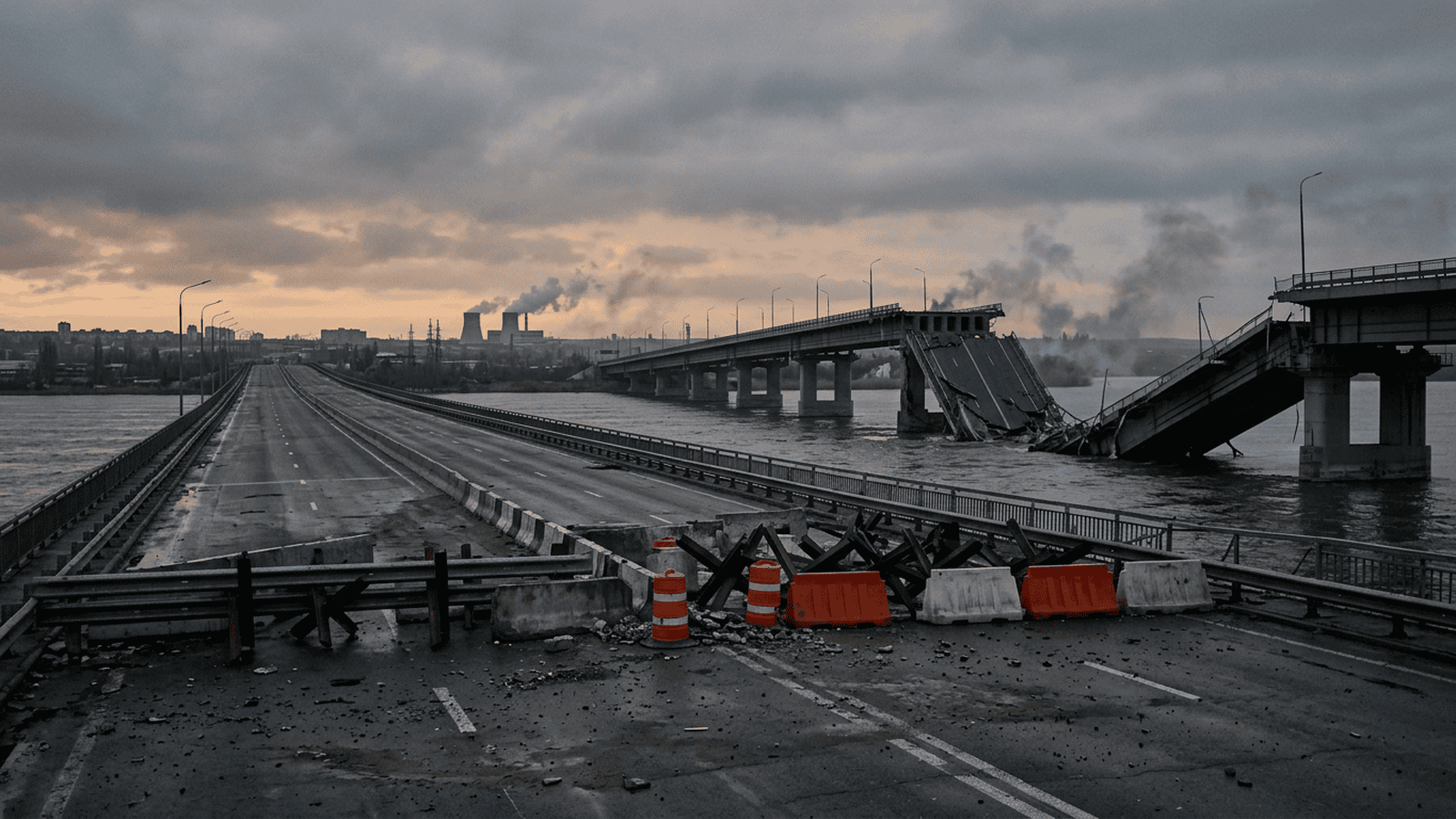
Ukraine struck the Kerch Bridge linking Russian-occupied Crimea with the Russian mainland for a second night in a row, while Russian missiles hit two major bridges in Kyiv. The attacks disrupted road and rail movement on the Kerch crossing and halted traffic on the Kyiv bridges, adding pressure ahead of a planned meeting in China involving President Trump, Russian President Vladimir Putin and Chinese President Xi Jinping.
The reported events are military strikes, not a government policy change. The excerpt gives no official rationale for either side’s attacks. It does report that Russia’s army described its strikes on Ukrainian infrastructure as a “massive attack,” while Ukraine’s foreign minister warned that the leaders’ meeting could encourage Putin to continue the war.
The Kerch Bridge was hit shortly after midnight Tuesday. It carries both automobile and rail traffic, and traffic was halted for hours. The crossing has been a target of earlier Ukrainian attacks and carries symbolic value in Russia because it was built after Russia’s annexation of Crimea in 2014.
There was no official comment on the damage to the bridge. Unverified social media images appeared to show part of the road bridge collapsed into the water, but those images were not confirmed in the report. Russian military blogger Alexander Kots called the damage significant and said cars would not be able to use the bridge for a month. He also reported that train service had been suspended, citing Russia’s Ministry of Transport, while saying the railway tracks remained intact.
The conflicting levels of certainty matter. The traffic stoppage for hours was reported as an immediate impact. The month-long disruption to cars and the suspension of train service were claims attributed to Kots, not a formal public damage assessment. The excerpt does not provide an official repair schedule or confirm the full extent of damage.
Russia’s Defense Ministry said its forces shot down 1,441 Ukrainian drones in an overnight barrage, the second-highest one-day figure this year. Moscow Mayor Sergei Sobyanin said more than 800 drones had been headed toward the capital. Officials reported attacks across 19 regions of Russia. The figures and descriptions were attributed to Russian officials; the excerpt does not include an independent accounting of the drone claims.
In Kyiv, Russian ballistic missiles hit the Northern and Southern bridges, which cross the Dnipro River and serve as major routes through the capital. Traffic was suspended, and the closures caused gridlock early Tuesday. Russia’s army confirmed it had hit both bridges. The excerpt does not state how long the Kyiv suspensions lasted or provide a repair timetable.
The effects on transport are direct and concrete. The Kerch crossing carries both cars and trains, and service there was interrupted. Kots said cars could be unable to cross for a month and that rail service was suspended, though he said the tracks were intact. In Kyiv, traffic stoppages on two major bridges caused early gridlock. The excerpt gives no figures for repair costs, travel fees, paperwork, compliance requirements, or the number of people and businesses affected. Those details remain unreported, rather than established parts of a plan.
The strikes also expose the practical limits of relying on major bridges for everyday movement. A damaged crossing can interrupt travel and rail service; a closure in a capital can quickly cause congestion. In this case, the report describes lost access and delays, but does not establish wider effects on trade, supply chains, workers, or prices. Those impacts cannot be quantified from the available information.
The timing adds a diplomatic dimension. Ukrainian President Volodymyr Zelenskyy had warned of a major Russian attack in the days before Thursday’s meeting in China. Ukraine’s Foreign Minister Andrii Sybiha said the meeting would “only encourage Putin to continue this war.” The White House had earlier indicated that the war would not be discussed, but Trump said Monday that Ukraine would be among the topics. He told reporters, “We’ll talk about my favorite subject, Ukraine.”
China has said the summit agenda will include “safeguarding world peace” and “promoting strategic stability in major power relations.” The excerpt does not confirm what the three leaders will decide or whether their discussion will change events on the ground. The next reported step is Thursday’s meeting. Monitoring the bridge damage, transport interruptions, and the leaders’ statements will be necessary to establish what follows; no formal compliance deadline or oversight process is described.

Sean Bradley serves as the Senior Correspondent for Trade, Supply Chains, and Global Labor at Just Right News, where he brings a principled, clear-eyed perspective to the complex systems that power the modern world. With a focus on the economic forces that impact the American household, Bradley has distinguished himself as a leading voice in explaining how global shifts in manufacturing and logistics translate to the kitchen table.
Growing up in Long Beach, California, Bradley’s interest in the movement of goods was forged against the backdrop of one of the nation’s most vital maritime gateways. Raised in a community where the towering cranes of the port were a constant fixture on the horizon, he developed an early appreciation for the blue-collar industries that form the backbone of the American economy. This upbringing instilled in him a profound respect for the dockworkers, truckers, and laborers who keep the country moving, a sentiment that remains a cornerstone of his reporting today. For Bradley, trade is not merely a series of abstract figures on a spreadsheet; it is a human endeavor that sustains families and defines the strength of a nation.
Now based in Seattle, Washington, Bradley occupies a strategic vantage point in another of the country’s most significant trade hubs. His location allows him to witness firsthand the intersection of traditional industry and the evolving technological landscape of global logistics. From the Pacific Northwest, he monitors the flow of goods across the ocean, providing Just Right News readers with timely insights into how international tensions, regulatory hurdles, and labor disputes affect the availability and cost of essential goods.
His signature feature series, “The Journey of Things,” has become a staple for readers seeking to understand the intricate path products take from raw materials to the retail shelf. Through this series, Bradley pulls back the curtain on the global marketplace, often highlighting the risks of over-reliance on foreign adversaries and the importance of domestic manufacturing resilience. His reporting consistently emphasizes the conservative values of national sovereignty, free-market competition, and the protection of the American worker from unfair global practices.
As a journalist of Irish heritage, Bradley maintains a deep-seated respect for the dignity of the individual worker and the importance of community stability. He approaches his beat with a commitment to transparency, often questioning the status quo of globalist policies that prioritize corporate efficiency over local prosperity. Whether he is reporting from a warehouse floor or analyzing a new international trade agreement, his goal remains the same: to provide the American public with the truth about where their products come from and what it costs to get them there.
Throughout his tenure at Just Right News, Bradley has remained a steadfast advocate for economic common sense. His work serves as a vital resource for those who believe that a strong nation is built on secure borders, robust trade, and a respected workforce. By combining his local roots in Long Beach with his professional experience in Seattle, Bradley continues to offer a unique and necessary perspective on the forces that shape the American way of life.