

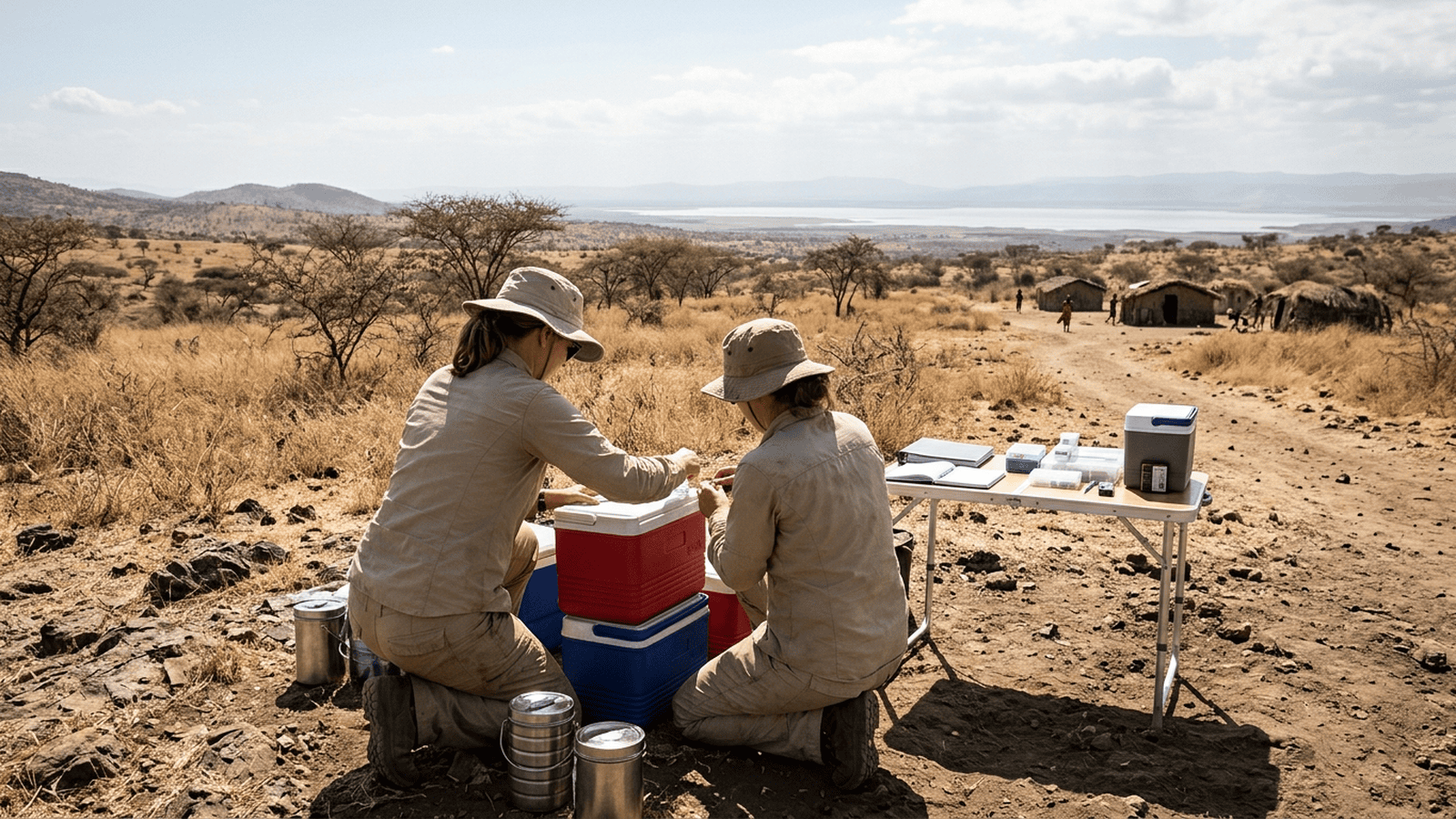
A year-long study of 188 Hadza people in Tanzania found that gut bacteria changed with the seasons, with some groups becoming less detectable in the wet season and returning during the dry season. The observational research shows why single-time-point microbiome samples may miss important variation, but it does not establish that the shifts cause health effects.
TLDR: Researchers analyzed 350 stool samples from 188 Hadza people in Tanzania across a full year. Gut bacteria shifted with the seasons, and some groups that were less detectable in the wet season reappeared in the dry season. The observational study reveals microbial variation but does not show that those changes affect health.
For the Hadza people of northern Tanzania, the changing seasons bring changes in what is available to eat. A field study tracking gut microbes over a year found that the community of bacteria living in participants’ intestines shifted alongside those seasonal changes, with some microbial groups appearing and disappearing over the course of the year.
The research, published in Science in 2017, was led by microbiologist Justin Sonnenburg and colleagues at Stanford University and international research partners. The team analyzed 350 stool samples from 188 Hadza adults and children, collected over 12 months. It was one of the first studies to follow a hunter-gatherer gut microbiome through a full annual cycle.
The Hadza live by hunting and gathering in a region near Lake Eyasi. Their diet varies with season and availability, including foods such as berries, tubers, baobab fruit, and meat. During one part of the year, people may rely more on foods gathered from the landscape; in another, honey or other resources can become more accessible. The study recorded this shifting context rather than treating diet as a fixed input.
Researchers found pronounced seasonal differences in the gut microbiome. Several bacterial groups were more common during the dry season and less detectable in samples collected during the wet season. Some of those groups returned in later dry-season samples. The pattern suggested that the Hadza microbiome can change substantially over relatively short periods, rather than remaining a stable set of bacteria.
The team also compared its results with samples from people living in industrialized societies. Some of the seasonally changing bacteria were rarely found in those comparison groups. The researchers proposed that diet and other features of a hunter-gatherer lifestyle might help explain the difference, while emphasizing that the study could not isolate a single cause. Food, water, movement, exposure to other people, and the surrounding environment all vary together in everyday life.
The work adds a time dimension to research on the human microbiome. Many studies take a stool sample at one moment and compare groups, a method that can miss fluctuations within the same person or community. Repeated sampling showed that a single collection may not represent the full range of microbial variation across a year.
The findings do not establish that seasonal microbial changes improve health, or that one kind of microbiome is better than another. The study was observational: it tracked patterns but did not test whether specific bacteria caused a health outcome. Nor does a small community-based study define what is typical for all people who hunt and gather, or for people elsewhere in Tanzania.
Instead, the results raise questions about how human biology responds to changing diets and environments. Microbes can help break down food and interact with the immune system, but the functions of many organisms detected in stool remain uncertain. Understanding which changes reflect short-term exposure, long-term adaptation, or health-relevant activity will require more than identifying which bacteria are present.
The fieldwork also highlights practical challenges. Researchers worked with Hadza participants and local partners to collect samples under conditions far removed from a conventional clinic. Repeating the process across seasons made it possible to see patterns that a one-time survey would have missed, while requiring careful attention to consent, sample handling, and cultural context.
Future studies can build on the annual sampling by measuring diet more closely, tracking the same participants over longer periods, and examining microbial functions as well as bacterial identities. Such work could clarify how seasonal shifts arise and whether they matter for health. For now, the central result is a reminder that the gut microbiome is dynamic—and that understanding it may depend on when, and where, researchers take a sample.

Susan Carter serves as a Senior Correspondent for Just Right News, where she leads the network’s comprehensive coverage of Health, Medicine, and Public Policy. With a career dedicated to dissecting the complexities of the American healthcare system, Susan brings a principled perspective to the most pressing debates of the day. Her reporting is characterized by a commitment to individual liberty, fiscal responsibility, and a healthy skepticism of government overreach, making her a vital voice for audiences seeking clarity in an increasingly regulated landscape.
Raised in Minneapolis, Minnesota, Susan’s professional outlook is deeply informed by the values of the American heartland. Growing up in the Twin Cities, she witnessed firsthand the importance of community-driven solutions and the resilience of the individual. This Midwestern foundation instilled in her a firm belief that the best answers to public policy challenges often come from local innovation and personal responsibility rather than top-down federal mandates. Her background allows her to translate complex legislative jargon into stories that resonate with families who value common sense and local autonomy.
Now based in Baltimore, Maryland, Susan operates from a unique vantage point at the intersection of medical innovation and urban policy. Living and working in a city renowned for its world-class medical institutions and significant public health challenges, she has a front-row seat to the realities of the modern healthcare landscape. Her proximity to these hubs of research and policy allows her to scrutinize how government intervention affects the quality of care and the freedom of medical professionals. In Baltimore, she sees the tangible results of policy decisions, using the city as a lens through which to examine the broader national health debate and the impact of federal spending on local communities.
As the lead for the acclaimed feature series “The Cost of Care,” Susan dives deep into the economic realities facing patients and providers alike. Her work focuses on the necessity of price transparency, the benefits of market competition, and the preservation of the sacred doctor-patient relationship. She is a staunch advocate for the idea that a well-informed public is the best defense against bureaucratic inefficiency. Through this series, she has exposed the hidden drivers of rising medical expenses, always seeking to empower the individual consumer over the massive institution.
Susan’s reporting on public policy is characterized by a commitment to rigorous inquiry and a focus on constitutional limits. Whether she is analyzing new pharmaceutical regulations, investigating the impact of federal health mandates, or exploring the future of medical technology, her goal remains the same: to provide Just Right News audiences with the facts they need to navigate a complex world. By blending her Midwestern sensibilities with the insights gained from her base in Maryland, Susan Carter has become a trusted authority for those who believe that personal freedom and public health are inextricably linked. Her work continues to challenge the status quo, advocating for a system that respects the taxpayer and prioritizes the patient.