

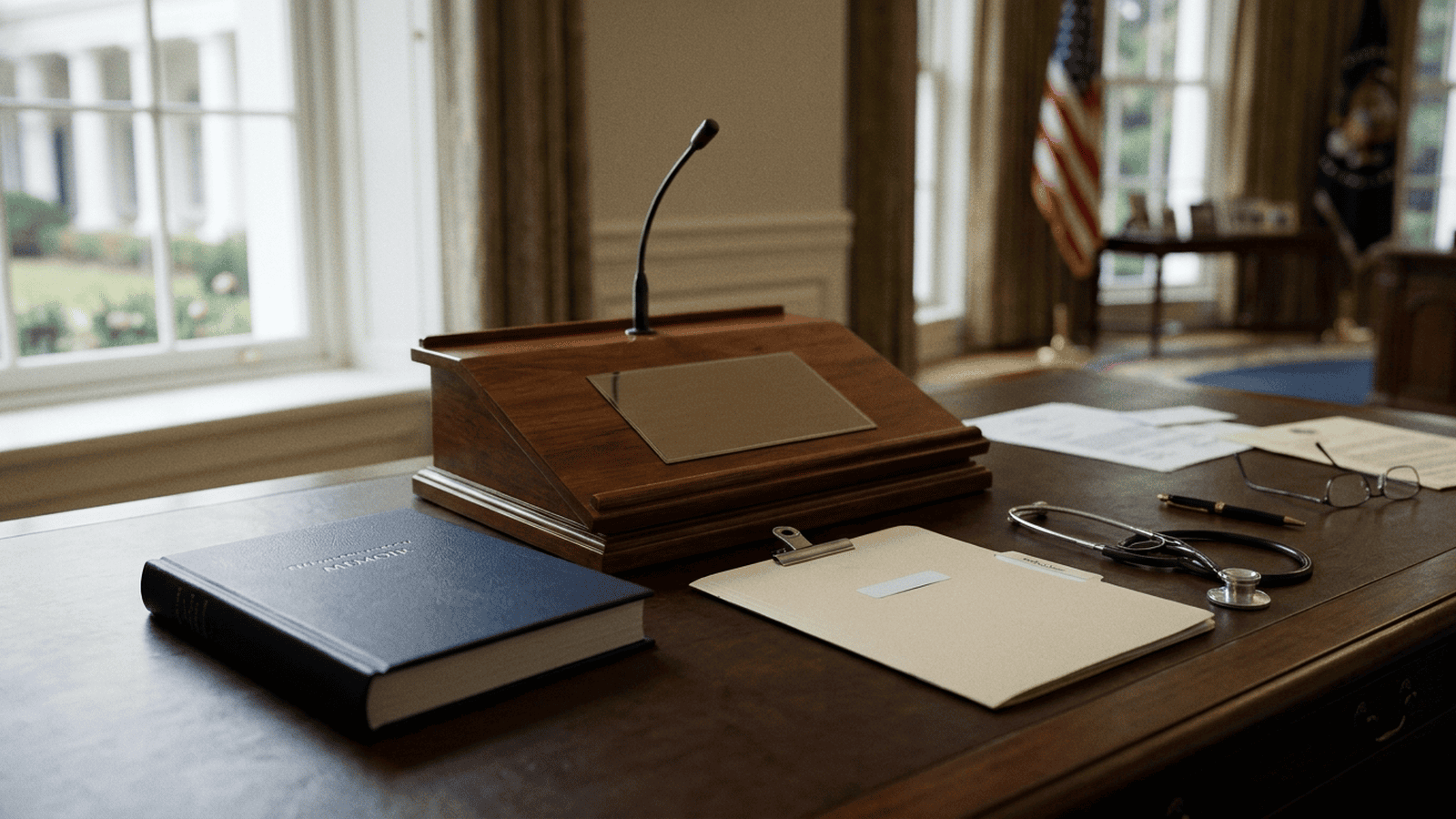
Joe Biden says he would not have sought reelection in 2024 if he had known he had cancer. He was diagnosed with metastatic prostate cancer months after leaving office in 2025 and says he did not know the cause of his symptoms while president. Biden defended his ability to serve and said the June 2024 debate was not decisive to him, though he ended his campaign within weeks and endorsed Kamala Harris. Harris secured the nomination and lost to Donald Trump. The account gives no medical records, independent review, campaign health-disclosure rules, or formal oversight process, leaving Biden’s comments as his own account of how a diagnosis would have changed his decision.
TLDR: Biden says a cancer diagnosis would have changed his decision to pursue a second term, but says he did not know he had the disease while president. The account gives no independent medical review or formal process for further disclosure.
Joe Biden says he would not have sought a second term if he had known he had cancer while president. In an interview with People magazine, the former president said he did not know his symptoms were caused by cancer during his time in office. His account draws a distinction between what he says he knew then and what became known after he left office.
Biden’s stated reason is direct: he says he would not have run if he had already been diagnosed. “I don’t think an 80-year-old man with cancer should be running” for president, he said. The excerpt provides no separate official rationale or finding about campaign disclosure, medical knowledge, or presidential fitness.
Biden was diagnosed with metastatic prostate cancer months after leaving office in 2025. His comments came before the release of his White House memoir, which was scheduled for Tuesday. The interview adds his account to questions about how candidates assess their health and make decisions about continuing a campaign, but it does not independently establish what medical information was available to him before the diagnosis.
The 2024 campaign had already become a public test of Biden’s age and ability to defeat Republican Donald Trump. Biden was 81 during the June debate, less than five months before Election Day. The debate performance intensified concern among Democrats, according to the account, though Biden said he did not view it as decisive at the time.
Biden said he expected another debate and did not regard the absence of one as consequential. Within weeks of the June encounter, he ended his campaign and endorsed Vice President Kamala Harris. Harris secured the Democratic nomination and lost to Trump in the general election. Those events are established elements of the campaign timeline; they do not by themselves resolve what Biden or other people knew about his health at the time.
Biden also defended his ability to carry out presidential duties while in office. He said age itself was not disqualifying and pointed to experience and personal relationships with world leaders. “I believe that on an objective basis, I was the best-equipped person to do the job,” he said. The interview records his position, rather than an independent assessment of his performance or health.
That distinction matters for any account of campaign decision-making. Biden’s new statement is conditional: he says a cancer diagnosis would have changed his choice to run. He also says he did not know he had cancer while president. The excerpt does not identify when symptoms began, what examinations took place, or whether anyone else had information that could have altered the campaign decision.
His son Hunter Biden told the BBC in August that the cancer had spread and was causing his father pain, describing it as painful and debilitating in many respects. That statement concerns Biden’s condition after diagnosis. It does not establish what the former president knew during the 2024 campaign, and the supplied account does not provide medical records or an independent medical review.
The practical impact described here is political rather than regulatory. No new rule, fee, form, enforcement process, compliance deadline, or legal requirement is identified in the excerpt. The direct effects shown are that Biden left the race, endorsed Harris, and that she became the nominee before losing the general election. The account does not specify a formal process for reviewing a candidate’s health disclosures, so such a process is not part of the reported plan.
The interview also touches on Biden’s decision to pardon Hunter after Hunter’s 2024 conviction on federal felony gun charges and guilty plea to federal tax charges. Biden said he believed Donald Trump would seek to harm people associated with him, and he described the pardon as necessary for that reason. Hunter has said the pardon damaged his father’s legacy. These comments offer Biden’s explanation for a separate decision; they do not establish that the pardon or the cancer diagnosis changed the campaign’s course.
Biden’s account leaves a clear next step for readers: the White House memoir’s release was due Tuesday, providing another opportunity to hear his version of events. The excerpt reports no official review, oversight process, or deadline for further disclosure. For now, the central point remains his own stated judgment that a known cancer diagnosis would have kept him from running, alongside his assertion that he was unaware of the disease while president.

Greg Sanders serves as the Senior Correspondent for Corporate Power and Antitrust at Just Right News, where he brings a principled, conservative perspective to the complex intersection of big business, government regulation, and the American consumer. With a career dedicated to investigative depth and economic clarity, Greg has become a leading voice in examining how the consolidation of industry power impacts the foundational values of the free market and individual liberty.
Raised in Denver, Colorado, Greg’s reporting is deeply informed by the Western spirit of independence and a healthy skepticism of centralized authority. Growing up in the shadows of the Rockies, he witnessed firsthand the importance of local entrepreneurship and the vital role that small-medium enterprises play in sustaining vibrant communities. This upbringing instilled in him a belief that the American Dream is best preserved when the playing field remains level and when competition—rather than backroom deals between corporate lobbyists and federal regulators—dictates success. For Greg, the rugged individualism of his home state serves as a constant reminder that the economy should serve the people, not the other way around.
Now based in Chicago, Illinois, Greg operates from the heart of the nation’s industrial and financial crossroads. His location in the Midwest provides him with a unique vantage point to observe the real-world consequences of corporate overreach. From the boardrooms of the Loop to the manufacturing hubs that define the region, he tracks the movement of capital and the shifting tides of market influence. Chicago’s history as a center of trade and labor offers a rich backdrop for his work, allowing him to bridge the gap between high-level economic theory and the lived experiences of hardworking Americans who feel the squeeze of monopolistic practices.
At Just Right News, Greg’s beat focuses on the “new monopolies” and the rise of “woke” corporate culture. He argues that when corporations become too large, they often abandon their fiduciary duties to shareholders in favor of social engineering and political posturing. His reporting seeks to hold these “Titans” accountable, ensuring that the power of the purse is not used to silence dissent or bypass the democratic process. He is a firm advocate for the idea that true conservatism requires a vigilant defense of competition, preventing any single entity—public or private—from exerting undue control over the lives of citizens.
This mission is most clearly seen in his acclaimed feature series, “The Titans and the Toll.” In this ongoing project, Greg explores the human cost of market consolidation, from the erosion of consumer choice to the decline of local economies. Through rigorous analysis and boots-on-the-ground reporting, he documents how the concentration of power in sectors like tech, agriculture, and finance creates a “toll” paid by the average family.
Greg Sanders remains committed to the idea that a transparent, competitive market is the greatest engine for prosperity ever devised. Through his work at Just Right News, he continues to provide the essential oversight necessary to protect that engine from the encroaching influence of corporate giants and the bureaucratic structures that enable them.