

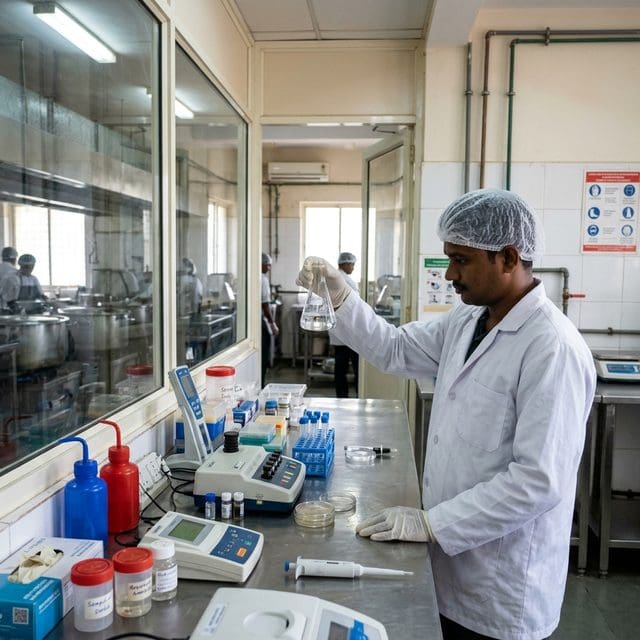
TTD says it is upgrading its Tirumala laboratory, while Mysuru’s published testing list and a Karnataka licensing drive offer separate snapshots of local oversight.
Tirumala Tirupati Devasthanams says it is upgrading its Water and Food Analysis Laboratory as a national model facility, putting routine testing at the center of food and drinking-water oversight at one of India’s busiest religious sites.
Additional Executive Officer Ch. Venkaiah Chowdary said the facility would receive advanced equipment and improved facilities during an inspection on November 4, according to TTD and The Hindu. The laboratory monitors food safety and drinking-water quality for annaprasadam, laddu production and the water supply at Tirumala.
The announcement describes a planned upgrade, not a completed overhaul. Available reports do not specify a budget, completion schedule, current testing capacity or recent results. They also do not identify the new instruments or explain how the upgrade will change testing frequency and scope. Those details will be needed to assess whether the investment improves detection and response.
A laboratory’s value depends on more than equipment. Sampling must cover relevant food and water sources, results must be reliable, and officials must act when tests find a problem. The reports establish that TTD’s lab has a monitoring role, but provide no sample counts, test results or details of violations. They offer no basis for judging current contamination levels at Tirumala.
A separate snapshot of local testing is available in Mysuru district, Karnataka. The district’s official water-quality laboratory listing, updated November 3, says it tests 17 parameters, including E. coli, total coliform, fluoride, nitrate, pH, total dissolved solids, total hardness and turbidity. The list includes microbial indicators along with chemical and physical measures of water quality.
A list of tests, however, is not a districtwide account of water quality. The listing does not establish that every source is tested or state how often samples are collected, where they come from, or what recent results showed. Without locations and results, residents cannot determine the condition of a particular tap, well or other source. The available information also does not describe what follows a failed test.
Food enforcement offers another, narrower signal. Mangalorean reported that Karnataka’s recent food-safety drive listed Dalia Beverages, Mysuru Rural, among businesses operating without an FSSAI licence. Samples that fail laboratory testing are to face legal action under the Food Safety and Standards Act, the report said. It did not report a failed test for Dalia Beverages, so the licensing status is not evidence that its products caused illness or failed testing.
The report does not provide verified totals for inspections, samples, notices or enforcement outcomes. Without those figures, the scale of the drive and its results are difficult to assess. An inspection or licensing issue is a lead, not a substitute for published test results and documented action.
Together, the reports describe local monitoring, planned investment and enforcement activity, but leave basic accountability questions unanswered: how many samples were collected, what they found, and what corrective steps followed. The information reviewed does not answer those questions.
The measure of TTD’s upgrade will be transparent results and documented follow-through. Mysuru’s testing list defines a set of laboratory capabilities, while the Karnataka report points to licensing enforcement; neither provides a complete picture of public exposure or safety. Publishing sample locations, results and responses would help distinguish equipment announcements and inspection activity from demonstrated protection of food and water.

Eric Nolan serves as the Senior Correspondent for Food, Water, and Environmental Health at Just Right News, where he brings a principled, common-sense perspective to the most fundamental issues facing the American public. With a career dedicated to uncovering the truth behind the policies that govern our natural resources, Eric has become a trusted voice for readers who value traditional stewardship over bureaucratic overreach. His reporting is defined by a commitment to the idea that true environmentalism is rooted in the protection of the American family and the preservation of the nation’s agricultural heritage.
Raised in Fresno, California, Eric’s worldview was shaped in the heart of the San Joaquin Valley. Growing up in one of the world’s most productive agricultural hubs, he witnessed firsthand the vital connection between the land, the water, and the dinner table. In Fresno, he saw the resilience of farmers and the devastating impact that distant, top-down regulations can have on local communities. This upbringing instilled in him a deep respect for the producers who feed the country and a lifelong skepticism toward the alarmist narratives often pushed by mainstream media. For Eric, environmental health is not an abstract political talking point; it is a matter of ensuring that the people who work the land have the freedom and the resources to do so effectively.
Now based in Eugene, Oregon, Eric operates from a unique vantage point in the Pacific Northwest. Living in a region often defined by intense environmental debate, he provides a necessary counter-narrative to the prevailing trends of the area. From his base in Eugene, he monitors the shifting tides of federal and state policies, ensuring that the voices of rural citizens and property owners are not drowned out by urban activism. His reporting often bridges the gap between the rugged realities of the outdoors and the legislative halls where decisions are made, offering a grounded perspective that prioritizes local sovereignty and practical solutions.
As the lead for the acclaimed feature series “Earth on the Table,” Eric explores the intricate journey of the American food supply. He tackles critical issues such as water rights, soil health, and food security through a lens of national stability and individual liberty. He believes that a healthy environment and a thriving economy are not mutually exclusive, but rather two sides of the same coin of national prosperity. His work consistently highlights how innovation and private-sector ingenuity are the most effective tools for ensuring clean water and a safe food supply, rather than the expansion of the administrative state.
At Just Right News, Eric’s reporting serves as a vital resource for those who seek accountability and transparency. Whether he is investigating the impact of federal land management on local economies or examining the safety of the national food infrastructure, his work remains anchored in the values of heritage and hard work. Eric Nolan continues to be a leading voice in environmental journalism, championing the belief that the best way to protect our natural resources is to empower the people who live and work closest to them.