

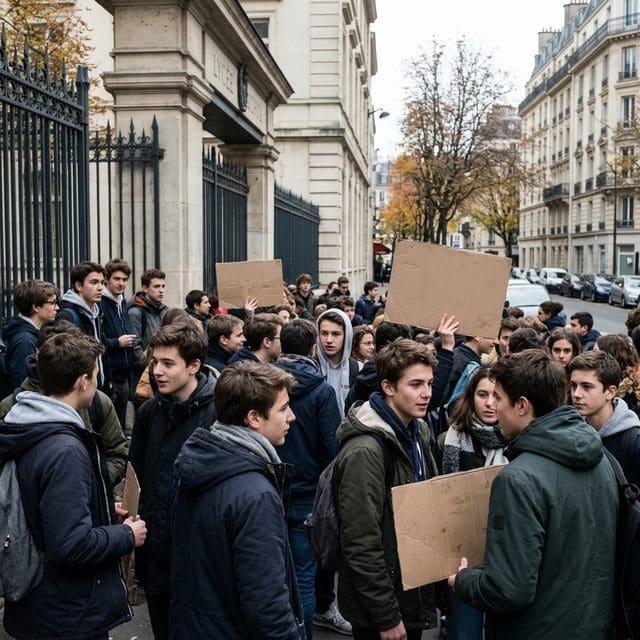
French students are preparing to resume school blockades, tying complaints about crowded classrooms and unequal educational access to living costs and pressure on public services.
French students are preparing to return from a two-week school break to renewed protests over the condition of their education and the rising costs of daily life. Student group Les Lycéens ! has called for high-school blockades beginning Monday, November 2. The Union syndicale lycéenne and Union étudiante have called for blockades at high schools and universities on Tuesday, November 3, and Thursday, November 5.
The Thursday action is expected to join a nationwide strike and demonstrations called by unions, with student groups planning to take part. Organizers say recently announced government measures are insufficient and accuse officials of trying to divide the movement rather than address its demands. Several schools had partially or completely closed during the three weeks before the Toussaint holiday, but the scale of disruption when students return remains uncertain.
The complaints begin inside the classroom. Reporting identifies overcrowded rooms, teacher absences left unfilled, deteriorating school buildings and inadequate funding for student mental-health support. Students also object to an admissions system they view as disadvantaging poorer applicants. Together, those grievances make access to opportunity a central issue: students are challenging not only the quality of day-to-day instruction but also the fairness of the routes that lead to further education.
The protest agenda has broadened beyond education. Demonstrators are also raising the cost of living, higher fuel prices and austerity affecting public services and young people, including housing assistance. The combination connects the experience of school with the costs and support that shape life outside it. For families facing pressure on household budgets, access to housing help and reliable public services can be part of the same debate as whether a school has enough teachers or functioning facilities.
That connection makes the French movement relevant to coverage of poverty and economic mobility, but it does not supply a new statistical measure of either. The available reporting does not quantify how many students or households are struggling, how housing assistance may change, or whether the protests are producing measurable effects on poverty or educational outcomes. It offers no direct comparison with American safety-net programs such as SNAP. Those figures cannot be inferred from the protests or from organizers’ descriptions of their demands.
The distinction matters in a debate often driven by competing claims about who is falling behind and which public programs help them move forward. Demonstrations can make visible the concerns students believe officials have neglected. They cannot, by themselves, establish the scale of a problem, determine which policy caused it or show which remedy would work best. The specific complaints reported here point to questions policymakers can examine: whether classrooms have enough staff, whether school buildings are maintained, whether mental-health support is available and whether admissions rules leave poorer students with fewer opportunities.
The material available does not provide a detailed government response beyond organizers’ criticism of recently announced measures. Nor does it establish whether those measures address particular complaints about staffing, facilities, student support or admissions. As a result, the immediate record is clearer on what protesters say they want addressed than on how officials propose to resolve the dispute.
The coming days will test whether students return to blockades in significant numbers after the holiday and whether Thursday’s coordinated action sustains the movement. A nationwide strike alongside student participation could give the demonstrations a broader public-services focus, though the degree of disruption remains unknown. For now, the reporting supports a picture of education grievances converging with concerns over prices and services—not a conclusion about the movement’s size, its policy effects or its impact on inequality.

James Foster serves as the Senior Correspondent for Inequality and the Social Safety Net at Just Right News, where he brings a principled and nuanced perspective to the most pressing economic challenges facing the nation. With a career dedicated to exploring the intersection of policy and personal responsibility, Foster has become a leading voice in documenting how government programs and economic shifts impact the American family. His reporting is characterized by a commitment to the “human element,” moving beyond cold statistics to highlight the stories of resilience, work, and community that define the modern American experience.
Foster’s perspective is deeply rooted in his upbringing in Birmingham, Alabama. Growing up in a city with a rich industrial heritage and a history of economic transformation, he witnessed firsthand the importance of the dignity of work and the strength of local institutions. In Birmingham, he saw how the most effective safety nets were often those woven by neighbors, faith-based organizations, and local civic groups. This background instilled in him a lifelong skepticism of “one-size-fits-all” solutions from distant bureaucracies, favoring instead the localized, community-driven support systems that he frequently champions in his writing.
Now based in Atlanta, Georgia, Foster operates from one of the most dynamic and rapidly evolving metropolitan hubs in the South. His location provides a front-row seat to the stark contrasts of the modern economy. From the gleaming towers of Atlanta’s financial districts to the struggling neighborhoods on the city’s periphery, Foster finds the stories that illustrate the complexities of upward mobility. His reporting from the Sun Belt serves as a microcosm for the national debate on poverty, highlighting how inflation, housing costs, and labor market shifts affect the working class in real-time.
As the lead for the acclaimed feature series “America’s Balancing Act,” Foster explores the delicate tension between providing a necessary hand up and fostering long-term independence. The series has become a cornerstone of Just Right News, offering a deep dive into the unintended consequences of social welfare policies. Foster’s work often focuses on the “cliff effect” and other systemic hurdles that can inadvertently discourage employment, arguing that true compassion is measured by how many people are empowered to leave the safety net, rather than how many are added to it.
Throughout his tenure, Foster has remained dedicated to the mission of Just Right News, providing a clear-eyed, conservative analysis of social issues. He believes that a free society thrives when individuals are empowered and the private sector is allowed to innovate. Whether he is interviewing small business owners about the challenges of a changing workforce or documenting the success of private charitable initiatives, Foster’s goal is to provide readers with the truth about the state of the American Dream. His work serves as a vital reminder that while the challenges of inequality are great, the solutions are often found in the strength of the American spirit and the preservation of traditional values.