

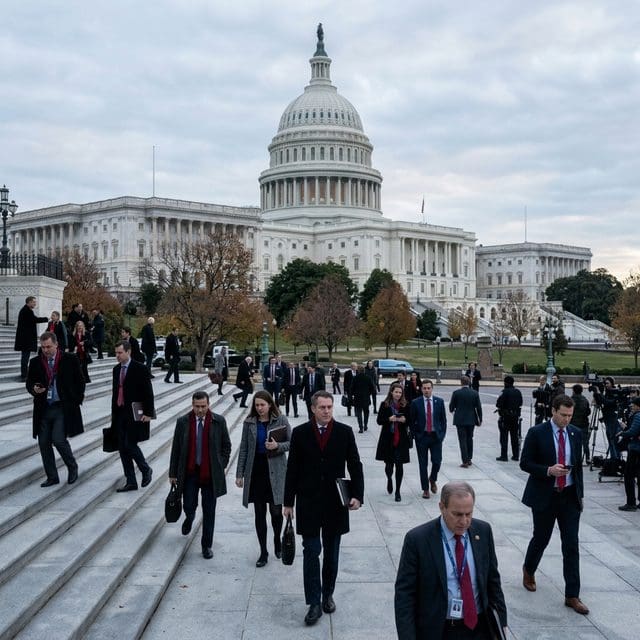
CNN projects Democrats will take both chambers after sweeping Senate gains, including James Talarico’s Texas victory, shifting Congress from legislating for Trump to scrutinizing his administration.
Democrats are projected to take control of both chambers of Congress in a midterm sweep that will sharply alter the final two years of President Donald Trump’s term. CNN’s projections show the party flipping enough seats in the House and Senate to gain majorities, with Senate victories in states including Texas, Maine, Ohio and North Carolina. Some races remained unresolved in the latest reporting, so final margins and the full scale of the majority were not yet clear.
The result is more than a verdict on individual candidates. Control of Congress determines who sets the legislative agenda, leads committees, issues subpoenas and decides which bills reach the floor. It also changes the balance of oversight between the White House and Congress. Incoming House Oversight Chair Robert Garcia has said investigations will examine alleged corruption involving Trump’s family and business interests, government conduct, immigration enforcement and the administration’s handling of the Epstein files. Democrats will have subpoena power, but investigations will still depend on committee procedures, evidence and the ability to sustain public and legal scrutiny.
House Democratic leader Hakeem Jeffries is poised to become the first Black person elected speaker of the House, according to NPR. In the Senate, Chuck Schumer is poised to become majority leader. Those leadership changes would put Democrats in charge of floor scheduling and committee assignments, but they would not erase the institutional limits on a majority’s power.
Trump can veto bills, and a two-thirds vote in each chamber would be required to override him. That makes enactment of major Democratic legislation unlikely without presidential support. Senate control carries a different kind of leverage: Democrats can block or slow Trump’s judicial nominees and would be positioned to require Democratic votes for permanent Cabinet confirmations, according to NPR. The practical result may be less a sweeping new legislative program than a period of contested oversight, negotiations and gridlock.
The Senate map delivered some of the night’s most consequential surprises. James Talarico’s projected win in Texas marks the first statewide Democratic victory there since 1994, NBC News reported. Democrats also flipped seven Republican-held Senate seats, according to CNN’s projections. In Michigan, Abdul El-Sayed is projected to defeat former Representative Mike Rogers. That contest had taken an unusual turn when Representative Haley Stevens endorsed Rogers, her Republican opponent, on Nov. 1; El-Sayed then raised $1.2 million in four hours, The Hill reported. The outcome shows how quickly a high-profile intervention can become a fundraising and political test, though it does not by itself establish why voters chose either candidate.
Democrats also flipped four governorships—Georgia, Iowa, Texas and Ohio—and Troy Jackson defeated Republican Senator Susan Collins in Maine, NBC News reported. Those state victories matter for governing and future election administration, but they do not change Congress’s constitutional responsibilities or settle every dispute over policy.
Trump initially told The New York Times he would accept the results. On Wednesday, however, he posted on Truth Social: “I wasn’t on the Ballot and if I was, we would have won IN A LANDSLIDE!” The contrasting statements leave his response unsettled. Acceptance of certified results is a basic condition of an orderly transfer of political power; a social-media post is not evidence that an election was improperly conducted.
For the White House, the immediate consequence is a Congress with greater capacity to demand records, compel testimony and challenge administration actions. For Democrats, the burden will be to show that investigations follow evidence and established process rather than serve as retaliation. The election changes who holds institutional power. Whether that power produces accountability, durable legislation or stalemate will depend on what lawmakers do with it.

Sophie Carter serves as a Staff Writer for Just Right News, where she anchors the outlet’s critical coverage of Elections, Influence, and Democracy Infrastructure. In an era where the mechanics of voting and the flow of political capital are under constant scrutiny, Sophie provides a steady, principled voice dedicated to the preservation of American institutional integrity and the rule of law.
Raised in Charlotte, North Carolina, Sophie’s perspective was forged in a community that balances rapid modern growth with a deep respect for tradition and civic duty. Growing up in the Queen City, she witnessed firsthand how a robust local culture depends on the trust between the citizen and the state. This upbringing instilled in her a foundational belief that the right to vote is a sacred trust—one that must be protected from both administrative overreach and the encroaching influence of special interest groups. Her reporting reflects these North Carolina roots, emphasizing the importance of community-led governance and the preservation of the individual’s voice in the face of nationalized political movements.
Now based in Atlanta, Georgia, Sophie operates from the heart of one of the nation’s most pivotal and contested political landscapes. Her location allows her to report from the front lines of the debate over election security, legislative reform, and the modernization of voting systems. For Sophie, the “infrastructure” of democracy is not merely a matter of machines and ballots; it is the collection of laws, people, and transparent processes required to maintain public confidence. Her work often highlights the necessity of clear, enforceable standards that ensure every legal vote is counted fairly and that the machinery of our republic remains accountable to the taxpayers who fund it.
Central to her work at Just Right News is her acclaimed feature series, “The Price of a Vote.” Through this ongoing project, Sophie explores the complex web of influence that shapes modern campaigns and policy decisions. She delves into how high-level lobbying, non-governmental organizations, and shifting bureaucratic regulations impact the weight of an individual citizen’s ballot. By examining the financial and structural pressures placed on the electoral process, she provides readers with a comprehensive look at the forces vying for control over the American political system.
Sophie’s approach to journalism is rooted in a commitment to the constitutional framework. She views her role as a watchdog for the voter, ensuring that the systems meant to serve the public remain transparent and free from corruption. Whether she is analyzing the implementation of new voting technologies or investigating the influence of outside money on state-level policy, her work is characterized by a rigorous adherence to facts and a refusal to succumb to the sensationalism that often plagues modern political reporting.
At Just Right News, Sophie Carter continues to be a vital resource for readers who value clarity, conviction, and a defense of traditional American values. Her deep ties to the Southeast and her specialized focus on the mechanics of our republic make her an essential voice in the ongoing conversation about the future of American self-governance. Through her reporting, she remains dedicated to the idea that a secure and honest electoral system is the bedrock of a free and prosperous society.