

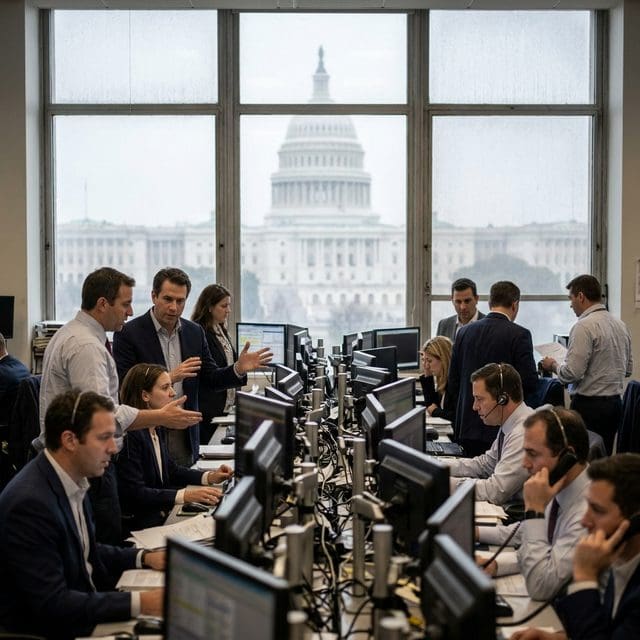
SPY’s 0.31% gain frames a market balancing an election-driven reassessment of Washington’s agenda against uneven moves in stocks, bonds, currencies and commodities.
SPY was up 0.31% on the session, a modest gain that reflected a divided market: broad U.S. shares were firmer, but the advance was uneven. The main catalyst was the U.S. midterm election result. Bloomberg reported that Democrats flipped at least seven Senate seats and won House districts Republicans had carried easily in 2024, leaving President Donald Trump more constrained on fiscal and regulatory policy.
Investors initially sent S&P 500 futures sharply lower, Bloomberg reported, before they reversed and gained 1.1% as election uncertainty eased. Nasdaq 100 futures also rose as investors bought previously sold-off artificial-intelligence shares. The result may limit the administration’s ability to advance parts of its agenda, but the market response reflects expectations, not a guaranteed change in policy or spending.
A separate report on the prior session showed the unevenness beneath the headline move: the S&P 500 rose 0.4% and the Nasdaq 100 gained 0.7%, while the Dow Jones Industrial Average fell 0.4%. Another report gave slightly different index readings, likely reflecting different market snapshots. The consistent signal was technology strength alongside Dow weakness; SPY’s 0.31% gain does not mean all sectors rose.
AI shares rebounded after a selloff driven by questions about whether the scale of investment can be justified. Advanced Micro Devices and Super Micro Computer issued strong forecasts, but strong chip demand does not settle the question of future profits. Apollo President Jim Zelter said investors do not yet know how pricing and economics will evolve. The Nasdaq-100 had entered its third correction of 2026 as concerns about AI weighed on technology stocks, a reminder that the rebound has not removed valuation risks.
Treasuries and the dollar reflected competing forces. Bloomberg described yields and the dollar falling as investors anticipated limits on Trump’s agenda. But another prior-session snapshot put the 10-year Treasury yield up five basis points to 4.96%, with the dollar spot index gaining 0.3%. A separate report linked higher yields partly to stronger data: September job openings rose to 7.523 million from 7.190 million, while factory orders increased 1.8% month over month. These reports cover different snapshots and should not be read as a single, consistent same-session tally.
For households, Treasury yields matter because they influence borrowing costs across the economy, though daily changes do not translate immediately or one-for-one into mortgage, auto or credit-card rates. Federal Reserve policy, lender spreads and borrowers’ credit histories also play a role. Stronger labor demand can support incomes, while persistently high rates can make financing more expensive.
Currency and global markets were mixed, too. One snapshot showed the yen weakening 0.5% to 158.73 per dollar; another reported a slight rise in the dollar index. A separate report recorded declines in the Stoxx Europe 600 and FTSE 100. It also said China’s yuan weakened after the People’s Bank of China raised its foreign-exchange reserve requirement ratio. Local economic and policy conditions remain important alongside U.S. politics.
Commodity readings also differed by snapshot. One put WTI crude up 0.3% at $96.75 a barrel and spot gold down 0.6% at $3,921.22 an ounce. Another reported lower Brent and WTI prices. Oil prices can affect household fuel costs, but a single session does not establish a trend.
The day’s takeaway is caution, not a sweeping verdict. The election may have reduced one source of policy uncertainty, but it has not resolved questions about AI profitability, inflation, interest rates or energy costs. A broad-market fund can rise while sectors lag and borrowing remains expensive; daily market moves are shifts in expectations, not promises of cheaper credit or living costs.

Jordan Lee serves as the Senior Correspondent for Wall Street, Finance, and Monetary Systems at Just Right News. Based in the heart of the world’s financial capital, New York City, Lee brings a sharp, principled eye to the complex mechanisms that drive the global economy. His reporting is defined by a commitment to fiscal responsibility, the defense of the free market, and a deep-seated belief that a transparent monetary system is the bedrock of a free society.
Raised in Portland, Oregon, Lee’s perspective was forged in a city that has undergone significant cultural and economic shifts. His upbringing in the Pacific Northwest instilled in him a profound appreciation for the industriousness of small business owners and the importance of local economic stability. Watching the evolution of his hometown’s landscape sparked an early interest in how federal fiscal policy and large-scale financial trends eventually trickle down to the average citizen. This background provides him with a unique vantage point; he understands the growing disconnect between the policy-making elite and the reality of Main Street, a theme that frequently resonates throughout his work.
Now operating from his base in New York City, Lee bridges the gap between the high-stakes trading floors of Manhattan and the households of everyday Americans. He views the financial sector not merely as a collection of numbers and tickers, but as a vital engine of American prosperity that requires constant vigilance and accountability. His reporting often highlights the dangers of centralized financial control and the necessity of maintaining a system that rewards merit, risk-taking, and innovation.
As the creator and lead of the featured series, “The Invisible Economy,” Lee pulls back the curtain on the often-opaque world of monetary systems. He specializes in translating the dense jargon of central banking and international finance into actionable insights for the Just Right News audience. His work explores the “invisible” forces—such as inflationary pressures, regulatory creep, and the expansion of the administrative state—that erode the purchasing power of American families. By focusing on these systemic issues, Lee empowers readers to understand the hidden forces shaping their financial independence.
Lee’s journalistic philosophy is rooted in a steadfast commitment to traditional American values. As an Asian American professional who has navigated the competitive corridors of the financial world, he is a vocal advocate for meritocracy and the preservation of the American Dream. He believes that a stable currency and a predictable regulatory environment are essential for national sovereignty and individual liberty. His reporting frequently warns against the risks of government overreach in the private sector, arguing that the most effective solutions to economic challenges arise from competition and individual enterprise rather than bureaucratic mandates.
At Just Right News, Jordan Lee remains dedicated to providing a clear-eyed defense of the taxpayer. Whether he is analyzing market volatility or investigating the long-term implications of national debt, his mission is to provide the truth about where the money is going and what it means for the future of the country. Through his rigorous analysis and principled stance, Lee has become a trusted voice for those who value a strong, sovereign, and fiscally sound America.