

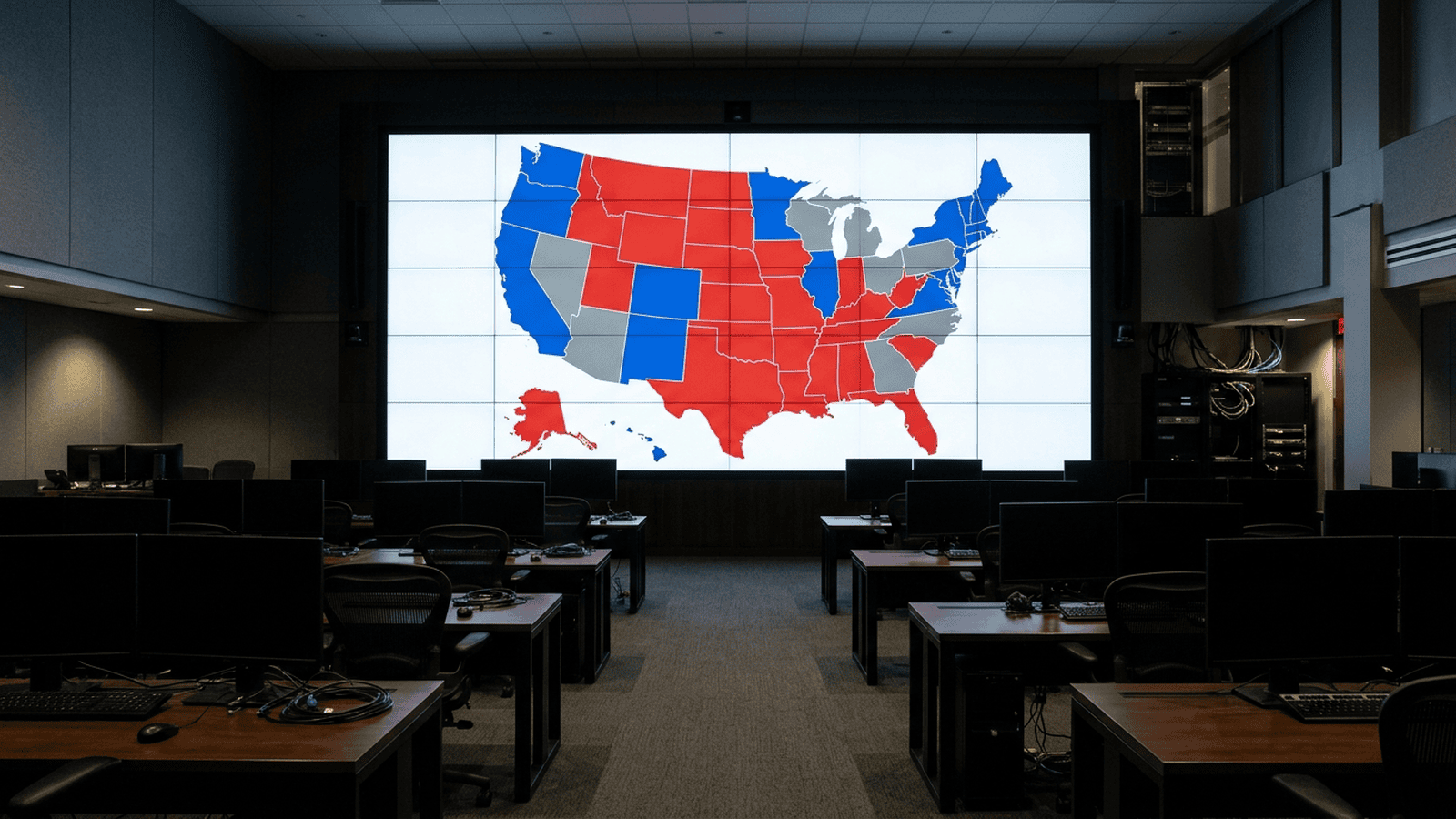
The Senate contest is unusually competitive, with fourteen seats rated competitive compared with nine two years ago. Democrats need a net gain of four seats to take control, while Republicans are defending more competitive seats but have no likely pickups in the Cook Political Report assessment described. North Carolina is viewed by both parties as a likely Democratic gain, and Michigan is a key toss-up. If Democrats win North Carolina and hold Michigan, they would need three more pickups; losing Michigan would leave them needing four. Democrats are also competing in Ohio, Iowa and Kansas, states Trump carried in 2024 by 11, 13 and 16 points. The ratings offer a guide, but election results will decide control.
TLDR: Fourteen Senate seats are now competitive, and the balance of the chamber may depend on a small group of toss-ups. Democrats need four net gains, with North Carolina and Michigan central to their path, while the final results remain uncertain.
The Senate contest has reached a close and unpredictable finish, with control of the chamber resting on just over a dozen competitive races. Democrats see a possible route to reclaiming the Senate, but the map makes the threshold and the challenge plain: a net gain of four seats is needed. Republicans, meanwhile, are defending more competitive seats, leaving several races central to the outcome.
There is no government policy change or official policy rationale in the reported account. The focus is the race for Senate control and the way election analysts assess the contests. The central point is practical rather than ideological: the party that wins enough of the pivotal races will determine which side controls the chamber.
The Cook Political Report’s ratings show Democrats defending four vulnerable competitive seats. Three are not considered likely to go to Republicans, while Michigan is rated a toss-up and is described as the first race to watch. That leaves Democrats with some defensive room, but also a contest in Michigan that could sharply affect their path to a majority.
Republicans are defending more seats, and more of those contests are rated toss-ups or are leaning toward Democrats. That is a difficult map for the party to manage. Still, the ratings do not amount to results, and the account identifies no Republican seat that Cook currently forecasts as a likely pickup. Potential Republican gains remain possible, but none is classified as likely in the analysis presented.
The four-seat threshold is the useful measure for understanding election night. Democrats need a net gain of four seats to take control. That means winning some races in states where the party faces a steep challenge, not simply holding its own competitive seats. The count turns a broad national contest into a set of concrete outcomes that voters and observers can follow as returns arrive.
North Carolina is identified as a likely Democratic pickup by both parties. If that result occurs, it would count as one seat toward the four-seat net gain. Michigan then becomes especially important. If Democrats hold their Michigan seat, they would need three additional pickups among the swing states; if they lose it, they would need four pickups elsewhere.
The remaining toss-ups are therefore central to the final balance. The account does not name every one of those states in the material available, but it identifies Ohio, Iowa and Kansas as examples of deep-red states where Democrats are competing. Those races illustrate the scale of the challenge. In the 2024 presidential contest, Donald Trump carried Ohio by 11 points, Iowa by 13 points and Kansas by 16 points. The Senate races are competitive despite those recent margins, but the figures do not establish how any of the Senate contests will end.
The number of competitive seats has also grown. Fourteen Senate seats are described as competitive in the current cycle, compared with nine two years earlier. That larger field makes the outcome less predictable and gives election night more contests to track. It also means that the final balance may depend on results across several regions rather than on a single race. The increase is a measure of how many contests are in play, not a forecast that either party will win a particular number of seats.
Ratings help organize the map, but they cannot answer the central question before votes are counted. A toss-up designation signals uncertainty in the race, while a likely pickup describes an analyst’s assessment rather than a settled outcome. For Democrats, the distinction matters because a possible gain in North Carolina would still leave several races to resolve. The same caution applies to the Republican defenses: competitive ratings show exposure, not losses.
In practical terms, voters in the competitive states will decide the Senate balance through their ballots, while candidates and parties face the final days of campaigning. The account gives no information about campaign costs, voter forms, fees, compliance rules or specific deadlines, so those details cannot be stated here. The immediate measure is the four-seat net gain Democrats need, alongside the races rated toss-ups and the possible North Carolina pickup. No separate enforcement or oversight process is described.
The map offers no guaranteed outcome for either party. North Carolina could provide Democrats with an early gain, Michigan could preserve or narrow their route, and the swing-state toss-ups could settle control. Those are the necessary steps for reading the results as they come in, not a substitute for the votes themselves. The Cook ratings provide a guide to the contest, and election returns will determine the final count.

Olivia Kendall serves as the Senior Correspondent for Geopolitics, Defense, and Foreign Policy at Just Right News, where she provides a principled, conservative perspective on the complex forces shaping the global stage. With a career dedicated to deconstructing the intricacies of international relations, Kendall has become a trusted voice for readers who value national sovereignty, a robust military, and a foreign policy that prioritizes American interests above all else.
A native of Washington, D.C., Kendall’s professional journey is deeply rooted in her upbringing within the nation’s capital. Growing up in the epicenter of American political life, she developed an early and profound understanding of how policy is crafted and, more importantly, how it often fails to account for the values of the American heartland. This unique vantage point allowed her to witness firsthand the rise of globalist bureaucracies, fueling her commitment to reporting that champions the constitutional foundations of the United States. Her background as a British White American further informs her worldview, providing her with a keen appreciation for the Western tradition and the enduring importance of the “Special Relationship” in maintaining global stability.
Now based in Arlington, Virginia, Kendall operates from the doorstep of the Pentagon and the heart of the nation’s defense establishment. Her proximity to the decision-makers in the military and intelligence communities allows her to provide boots-on-the-ground reporting that is both timely and deeply informed. For Kendall, Arlington is more than just a base of operations; it is a daily reminder of the sacrifices made by the men and women in uniform. This connection to the defense community drives her rigorous coverage of military readiness and her advocacy for a “peace through strength” approach to diplomacy.
At Just Right News, Kendall is perhaps best known for her acclaimed feature series, “The World’s Shadow on America.” In this ongoing project, she explores the direct correlation between international developments and the daily lives of American citizens. Whether she is analyzing the encroachment of foreign adversaries in domestic supply chains or the impact of international treaties on local economies, Kendall’s work serves as a vital bridge between distant geopolitical shifts and their consequences at home. She rejects the notion that foreign policy is an abstract concern for elites, instead proving that what happens in the corridors of power in Brussels or Beijing has a tangible “shadow” that falls across every American doorstep.
Throughout her tenure, Kendall has remained a steadfast critic of international overreach and a vocal proponent of a clear-eyed, realistic foreign policy. She brings a sharp analytical mind to her beat, often challenging the prevailing narratives of the mainstream media to uncover the underlying truths that affect national security. Her reporting is characterized by a refusal to compromise on the truth and a dedication to the idea that a strong, secure America is the world’s best hope for liberty. As a Senior Correspondent, Olivia Kendall continues to lead the charge in providing the essential context and conservative insight necessary to navigate an increasingly volatile world.