

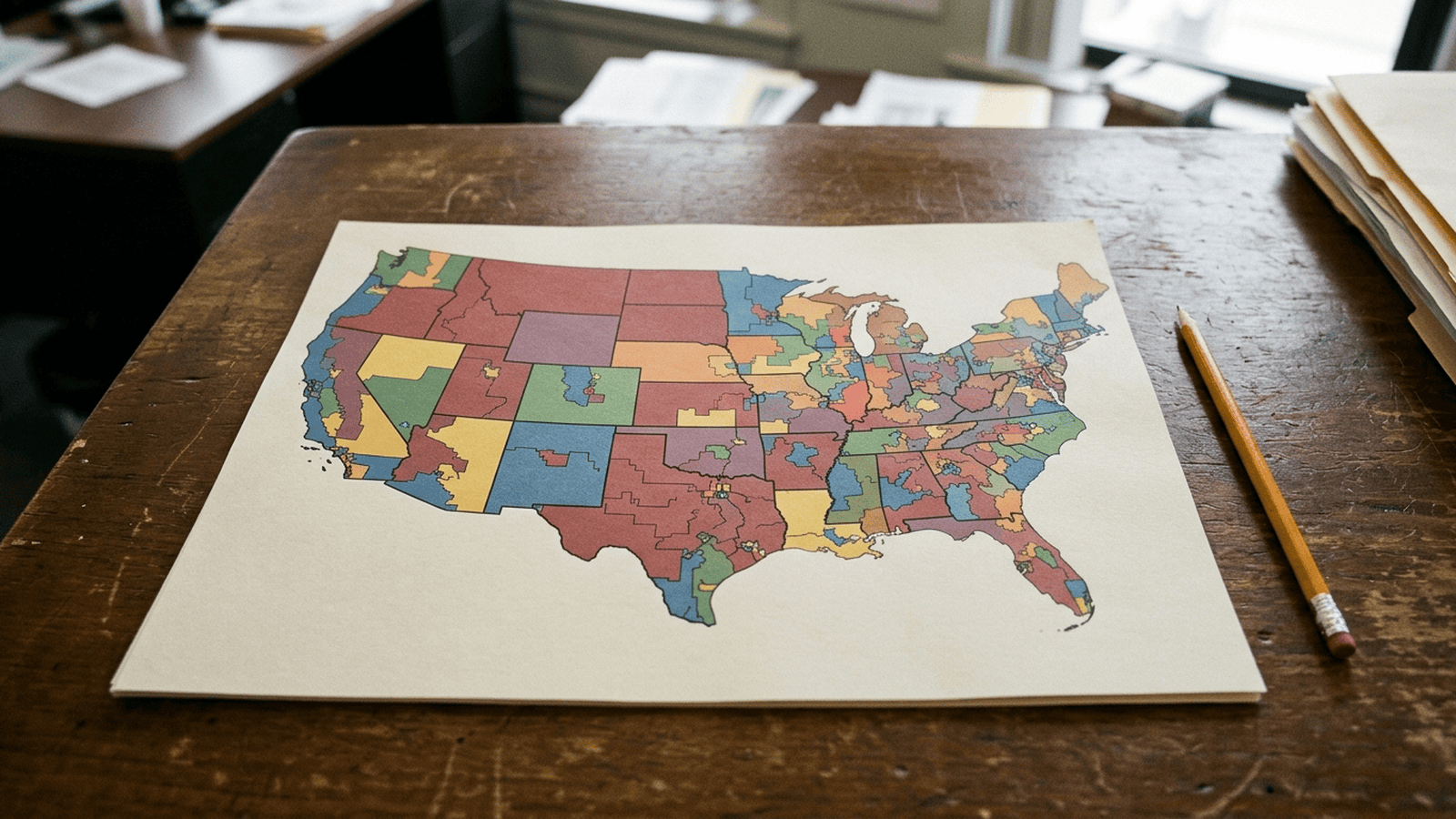
Nearly 35 million Americans will vote in congressional districts redrawn ahead of this year’s midterms, after partisan battles over political maps. The provided account describes gerrymandering as a centuries-old practice that remains one of the most powerful tools in American politics. Judy Woodruff’s report examines its origins and continuing role as part of the series “Crossroads: America at 250.” The excerpt does not explain who drew specific maps, give an official rationale for the changes, or detail effects on individual voters. It also provides no fees, forms, enforcement rules, or compliance deadlines, so those practical details cannot be established from the material provided.
TLDR: Nearly 35 million Americans are set to vote in congressional districts redrawn before the midterms following partisan map battles. The available account places the changes in the long history of gerrymandering but gives no district-level details or voter instructions.
Nearly 35 million Americans are expected to vote in congressional districts redrawn ahead of this year’s midterms, according to the account provided. The district changes followed partisan battles over political maps. The number gives a sense of how many voters will cast ballots in districts with revised boundaries, but it does not show how many districts changed or where they are.
The account provides no official rationale for redrawing the districts. It does not name officials who proposed the maps or explain what reasons they gave. It also does not describe the states involved, how the lines were drawn, or the outcomes of the partisan disputes. The material therefore does not establish a shared purpose for the changes beyond the fact that the districts were redrawn.
A report by Judy Woodruff examines the origins of gerrymandering and why the centuries-old practice remains one of the most powerful tools in American politics. The report is part of “Crossroads: America at 250,” a series exploring the country’s history. The supplied account describes the report’s subject, but it does not include its detailed historical account or analysis of the maps drawn ahead of this election.
The scale of the change is the clearest immediate point for voters. Nearly 35 million people are expected to vote in congressional districts whose boundaries were redrawn before the midterms. That figure does not tell readers how many people were moved from one district to another. Nor does it identify communities or races affected by the revised lines.
The account calls the map disputes partisan but does not identify the parties, public officials, or groups involved. It gives no description of the mapmaking process, including who proposed particular boundaries or what criteria were used. It also does not say whether the maps went through a formal review. Without those details, readers cannot assess how individual decisions were made or compare the new lines with earlier ones.
The practical policy effects are also not specified. The supplied material reports no costs, fees, paperwork, enforcement actions, compliance requirements, or deadlines for voters or election officials. It does not say whether people need to update registration, check a new polling place, or take another step because their district changed. Those effects cannot be inferred from a change in congressional boundaries alone.
That distinction matters because a redrawn district and a change to voting procedures are not the same information. The account confirms that many voters will cast ballots in districts with new boundaries, but it does not say whether any individual voter’s polling location has changed. It does not explain whether registration records are affected or give instructions for checking a voter’s district. Readers seeking that practical guidance will need information beyond what is included here.
The historical frame reaches beyond this election cycle. The account describes gerrymandering as a centuries-old practice and says it remains among the most powerful tools in American politics. It does not define how that power operates in particular districts or compare the current maps with maps from earlier elections. Woodruff’s report is presented as an examination of the practice’s origins and continuing role, not as a district-by-district account of this year’s changes.
The timing connects the subject to the nation’s 250th anniversary. “Crossroads: America at 250” is identified as a series about the country’s history, and this report looks at a political practice with a long past and a continuing place in American politics. The account does not provide further detail about how the series treats that history or what conclusions the report draws about the current moment.
Woodruff is identified as a senior correspondent and former anchor and managing editor of the PBS News Hour. The account says she has covered politics and other news for five decades at NBC, CNN, and PBS. Lorna Baldwin is identified as the report’s producer and as an Emmy and Peabody award-winning producer at the PBS NewsHour. No direct quotations from either journalist appear in the material provided.
For voters, the established point remains narrow but important: nearly 35 million Americans are expected to vote in congressional districts redrawn ahead of the midterms. The account does not establish whether the changes make particular races more competitive or affect representation in any named community. It also does not provide enough information to judge the mapmaking decisions district by district.
The report’s stated focus is the history of gerrymandering and its continuing influence. The available account does not give legal deadlines, oversight measures, or required steps for voters and election officials. It also does not say what further changes, if any, may follow. The effects beyond voting in districts with revised boundaries remain unclear from the information supplied.

James Foster serves as the Senior Correspondent for Inequality and the Social Safety Net at Just Right News, where he brings a principled and nuanced perspective to the most pressing economic challenges facing the nation. With a career dedicated to exploring the intersection of policy and personal responsibility, Foster has become a leading voice in documenting how government programs and economic shifts impact the American family. His reporting is characterized by a commitment to the “human element,” moving beyond cold statistics to highlight the stories of resilience, work, and community that define the modern American experience.
Foster’s perspective is deeply rooted in his upbringing in Birmingham, Alabama. Growing up in a city with a rich industrial heritage and a history of economic transformation, he witnessed firsthand the importance of the dignity of work and the strength of local institutions. In Birmingham, he saw how the most effective safety nets were often those woven by neighbors, faith-based organizations, and local civic groups. This background instilled in him a lifelong skepticism of “one-size-fits-all” solutions from distant bureaucracies, favoring instead the localized, community-driven support systems that he frequently champions in his writing.
Now based in Atlanta, Georgia, Foster operates from one of the most dynamic and rapidly evolving metropolitan hubs in the South. His location provides a front-row seat to the stark contrasts of the modern economy. From the gleaming towers of Atlanta’s financial districts to the struggling neighborhoods on the city’s periphery, Foster finds the stories that illustrate the complexities of upward mobility. His reporting from the Sun Belt serves as a microcosm for the national debate on poverty, highlighting how inflation, housing costs, and labor market shifts affect the working class in real-time.
As the lead for the acclaimed feature series “America’s Balancing Act,” Foster explores the delicate tension between providing a necessary hand up and fostering long-term independence. The series has become a cornerstone of Just Right News, offering a deep dive into the unintended consequences of social welfare policies. Foster’s work often focuses on the “cliff effect” and other systemic hurdles that can inadvertently discourage employment, arguing that true compassion is measured by how many people are empowered to leave the safety net, rather than how many are added to it.
Throughout his tenure, Foster has remained dedicated to the mission of Just Right News, providing a clear-eyed, conservative analysis of social issues. He believes that a free society thrives when individuals are empowered and the private sector is allowed to innovate. Whether he is interviewing small business owners about the challenges of a changing workforce or documenting the success of private charitable initiatives, Foster’s goal is to provide readers with the truth about the state of the American Dream. His work serves as a vital reminder that while the challenges of inequality are great, the solutions are often found in the strength of the American spirit and the preservation of traditional values.