

OpenAI is seeking about $20 billion at a $1.25 trillion valuation as major technology companies prepare enormous AI infrastructure budgets.
OpenAI is seeking about $20 billion in a funding round that would value the company at $1.25 trillion after the investment, Reuters reported October 31. The first close is expected to come in below that target after some investors reduced their allocations. The round remains open, so its final size and terms are not settled.
The reported target is down from an earlier figure of about $30 billion, while the valuation is below the previously reported $1.4 trillion. Reuters said the changes came amid a technology-stock selloff driven by concerns about AI spending, citing a Financial Times report. The terms show that even the industry’s largest companies face scrutiny over how much capital they need and what investors can expect in return.
A UAE investor consortium including state-backed technology fund MGX is expected to be the largest participant, Reuters reported. The arrangement would give OpenAI an option to lease newly developed regional computing capacity, linking investment to access to infrastructure. Founders Fund, Coatue, Sequoia Capital and Andreessen Horowitz are also expected to participate, according to the source material.
The financing arrives as major technology companies plan extraordinary spending on computing infrastructure. CNBC reported October 31 that Amazon reiterated roughly $220 billion in capital spending for 2026, while Alphabet maintained guidance of up to $205 billion. Microsoft reduced its forecast to $170 billion from $175 billion. The figures are company forecasts, not final spending totals, but they signal the scale of resources the largest providers are prepared to commit.
For businesses and developers that rely on cloud platforms, those commitments matter beyond the companies’ balance sheets. Computing capacity is becoming a strategic input to AI development, and a handful of providers can build at a scale few others can match. Expanded capacity could support new services and meet rising demand; dependence on a small group of suppliers also gives their investment and allocation decisions broad influence over customers.
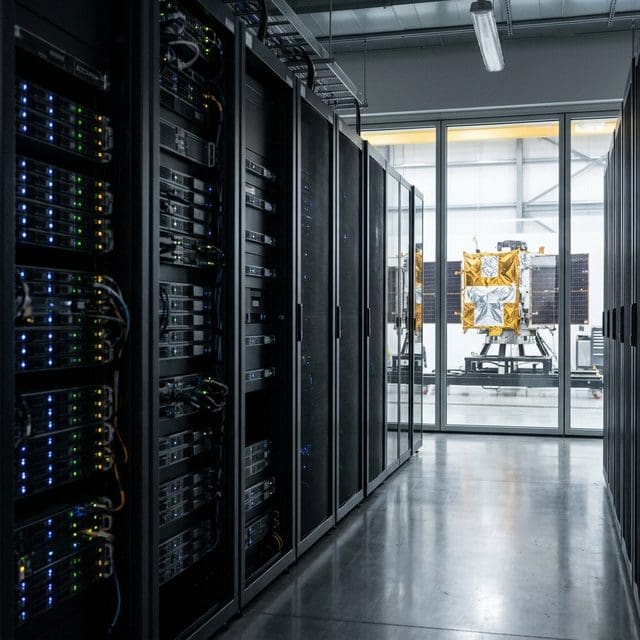
Google offered a more experimental glimpse of the race. The Verge reported that the company booted Tensor Processing Units aboard an AI-equipped satellite and ran its Gemma 4 model, which generated a response to a prompt. The test is part of Project Suncatcher, Google’s effort to explore AI data centers in space. The company plans to test the chips under thermal stress and radiation, with a pair of interconnected satellites targeted for 2027.
The satellite experiment is not a near-term alternative to terrestrial cloud computing. Space poses distinct challenges for cooling, communications and maintenance, and the reported test does not establish a commercial service. It does show companies exploring options beyond conventional data centers as demand for computing grows.
The available reporting centers on financing and infrastructure, not a newly announced model release from OpenAI, Anthropic, Google, Meta or the open-source community. The supplied material also does not provide verified figures for Anthropic’s long-term compute commitments, so those estimates are excluded. For now, the central question is whether the AI industry can turn unprecedented spending and access to capital into durable demand and returns.

Mason Reed serves as a Staff Writer for Just Right News, where he spearheads the Future Frontiers & Special Projects desk. In an era defined by rapid technological shifts and evolving social landscapes, Mason provides a steady, principled voice, examining the innovations of tomorrow through the lens of traditional American values. His work is most prominently featured in his signature series, “The Next Horizon,” where he explores the intersection of emerging technology, national sovereignty, and the preservation of individual liberty.
A native of San Diego, California, Mason’s worldview was shaped by the unique culture of his hometown. Growing up in a region defined by its strong military presence and its history of maritime industry, he developed a deep-seated respect for the institutions that provide national stability and the entrepreneurial spirit that drives the American economy. This upbringing instilled in him a belief that true progress is not found in discarding the past, but in building upon a foundation of proven principles. His reporting often reflects this San Diego influence, emphasizing the importance of a robust national defense and the necessity of maintaining a competitive edge in the global marketplace.
Now based in San Francisco, Mason operates from the heart of the world’s technological engine. Living and working in the Bay Area provides him with a front-row seat to the advancements—and the ideological challenges—emanating from Silicon Valley. While many in the region embrace a “move fast and break things” mentality, Mason’s reporting serves as a vital counterweight. He offers Just Right News readers a “boots on the ground” perspective, documenting how radical local policies and the concentration of tech power impact the everyday lives of citizens. His proximity to the industry allows him to cut through the marketing jargon of big tech to uncover the real-world implications for privacy, free speech, and the nuclear family.
In his “Future Frontiers” beat, Mason tackles complex subjects ranging from the ethics of artificial intelligence to the burgeoning private space race. He approaches these topics with a healthy skepticism toward centralized bureaucracy, championing instead the decentralized innovations that empower individuals. Through “The Next Horizon,” he highlights the pioneers and thinkers who are working to ensure that the future remains a place where human dignity and constitutional rights are protected. He believes that the rapid pace of change requires more than just technical expertise; it requires a moral compass rooted in the Western tradition.
Throughout his tenure at Just Right News, Mason has remained committed to the idea that the future is something to be shaped, not merely accepted. His writing is characterized by a rigorous defense of American exceptionalism and a belief that the country’s best days lie ahead, provided it remains true to its founding ideals. Whether he is investigating the impact of automation on the American workforce or profiling the next generation of aerospace engineers, Mason Reed ensures that his readers are equipped with the insights they need to navigate a changing world with confidence and clarity.