

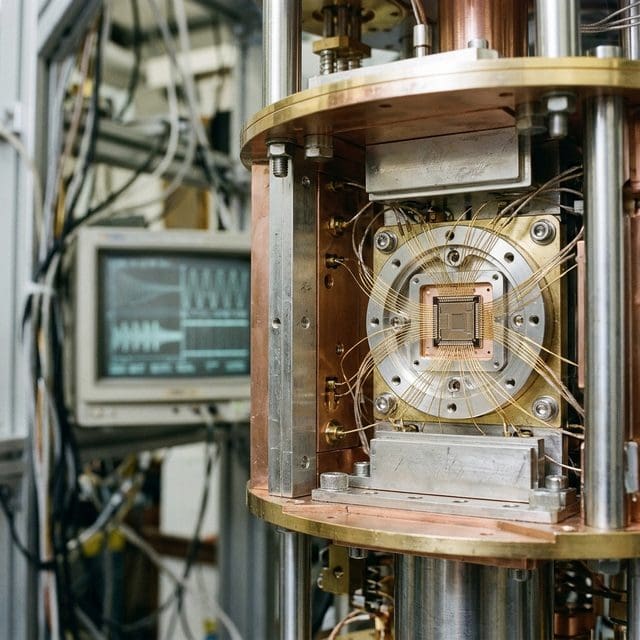
A superconducting processor revealed a controllable pocket of regular motion in quantum dynamics, while new studies probe unusual materials, information and particle physics.
Quantum systems can be hard to predict: many particles interact at once, and their collective behavior can become chaotic. A recent experiment found that chaos is not the whole story. Researchers observed a pocket of regular motion in a superconducting quantum processor and used feedback to guide the system toward it.
The research article, published September 23, describes “quantum many-body mixed phase space.” Nature Physics highlighted the result on October 27. By measuring the processor’s behavior and adjusting control in response, researchers steered it toward a more orderly region. The work shows that scientists can do more than watch a complex quantum system evolve: under experimental conditions, they can identify and influence parts of its motion.
That distinction matters because many-body dynamics are difficult to track as interacting particles accumulate possible behaviors. A region of regular motion inside a chaotic system offers a foothold: researchers can study how the orderly and chaotic parts coexist, and whether controlled feedback can reliably reach the desired behavior. The report establishes an experimental observation and a control method, not a general recipe for taming every quantum system.
It also does not mean arbitrary quantum systems are now controllable, or that a practical quantum computer is around the corner. But mapping where regular behavior sits alongside chaos could help researchers design experiments and understand how interacting particles evolve. The next question is how robust these regions are and whether feedback can be extended to more complex systems.
Other recent reports show physicists finding new ways to make elusive quantum behavior visible. In condensed matter physics, researchers reported altermagnetism in an orthogonally twisted van der Waals homostructure. Two-dimensional altermagnets are of interest for possible spintronic devices, but have been difficult to synthesize. The reported structure offers a route to studying the magnetic state in an ultrathin material. The associated research appeared September 2, and Nature Physics covered it October 26. Potential applications remain a prospect, not a ready-made technology.
Another study turns to electrons that repel one another so strongly they can arrange into a Wigner crystal. When an exciton—a bound pairing of an electron and a positively charged hole—interacts with the electron arrangement, it can distort the lattice and form a quasiparticle called a Wigner polaron. Nature Physics reported optical detection of these objects in a monolayer semiconductor. The measurements resolve the crystal’s vibrational dynamics, revealing more than its static structure. That temporal detail gives researchers a way to examine how the electron lattice responds collectively to an excitation, rather than treating it as a frozen pattern.
The week’s reports also revisit Maxwell’s demon, a thought experiment about using information to extract work from a physical system. A Nature Physics report says the demon can produce more work when it accounts for dynamical correlations—connections in how the system behaves over time—rather than relying only on instantaneous measurements. The report gives no numerical work gain. Its central point is that the usefulness of information depends on what it reveals about a system’s evolution, not simply on a snapshot of its state.
Quantum computers are also being tested against problems from particle physics. Researchers simulated a model collision above the threshold for particle production. Separately, hybrid trapped-ion quantum simulators were used to observe real-time dynamics in two quantum field theories. One study simulated a one-dimensional Yukawa model, capturing states with high bosonic occupation while avoiding qubit overhead and truncation errors associated with conventional boson-to-qubit encodings.
These are controlled simulations, not replacements for collider experiments. Their value is in testing whether quantum devices can tackle calculations that are difficult for classical computers. The experiments do not establish that quantum machines will soon outperform conventional ones for every scientific task. Instead, they provide ways to investigate how field theories behave in real time, a task that can be intractable for classical devices.
Together, the reports show progress through careful steps: finding order within complex motion, making difficult materials, and simulating physical systems that challenge conventional computing. The next tests are whether the results can be repeated, extended to larger systems and used to answer questions that current experiments or classical calculations cannot readily settle. For now, they are new tools for asking sharper questions—not instant applications.

Ethan Blake serves as a Senior Correspondent for Just Right News, where he specializes in Longform Narrative and Public Understanding. In an era of rapid-fire headlines and fleeting soundbites, Ethan’s work stands as a testament to the power of deep-dive reporting and the importance of contextualizing the complex issues facing the nation today. His approach is rooted in the belief that the most profound truths are often found in the lived experiences of individuals rather than the abstract theories of distant policymakers.
Growing up in Providence, Rhode Island, Ethan developed an early appreciation for the historical and cultural threads that weave the American fabric together. Providence, a city defined by its industrial heritage and its blend of traditional neighborhoods, provided him with a front-row seat to the challenges and triumphs of the American working class. This upbringing instilled in him a respect for the “common sense” values of hard work, community loyalty, and the preservation of local institutions. He learned early on that behind every economic statistic or legislative debate, there are real families and neighborhoods navigating the consequences of change.
This foundational perspective is the driving force behind his signature feature series, “Lives Behind the Systems.” Through this series, Ethan explores the intersection of individual agency and institutional structure. Whether he is documenting the impact of federal land-use policies on rural families or examining how shifting educational standards affect local school boards, Ethan’s work prioritizes the human element. He seeks to uncover how large-scale systems—be they governmental, economic, or social—affect the daily lives of citizens, often advocating for a return to local control and personal responsibility.
Now based in Portland, Maine, Ethan draws significant inspiration from the rugged independence and self-reliance that define the region. The coastal landscape and the resilient spirit of Maine’s communities serve as a constant reminder of the importance of individual liberty and the strength found in decentralized power. Living and working outside the traditional media hubs allows Ethan to maintain a grounded perspective, ensuring his reporting remains untethered from the echo chambers of the major metropolitan centers. This geographic distance provides him with the clarity needed to translate complex national narratives into stories that resonate with the heart of the country.
At Just Right News, Ethan’s beat is more than just a professional assignment; it is a mission to foster a more informed and engaged citizenry. He believes that a free society depends on the public’s ability to understand the mechanisms of power and the value of traditional American principles. His longform narratives do not merely report the news; they provide a roadmap for understanding the cultural and political shifts of the modern era through a lens of skepticism toward centralized authority and a deep respect for the individual.
Through his meticulous research and narrative craftsmanship, Ethan Blake continues to bridge the gap between policy and the public. His work remains a vital resource for those who seek a deeper understanding of the systems that shape our world and the enduring spirit of the people who live within them.