

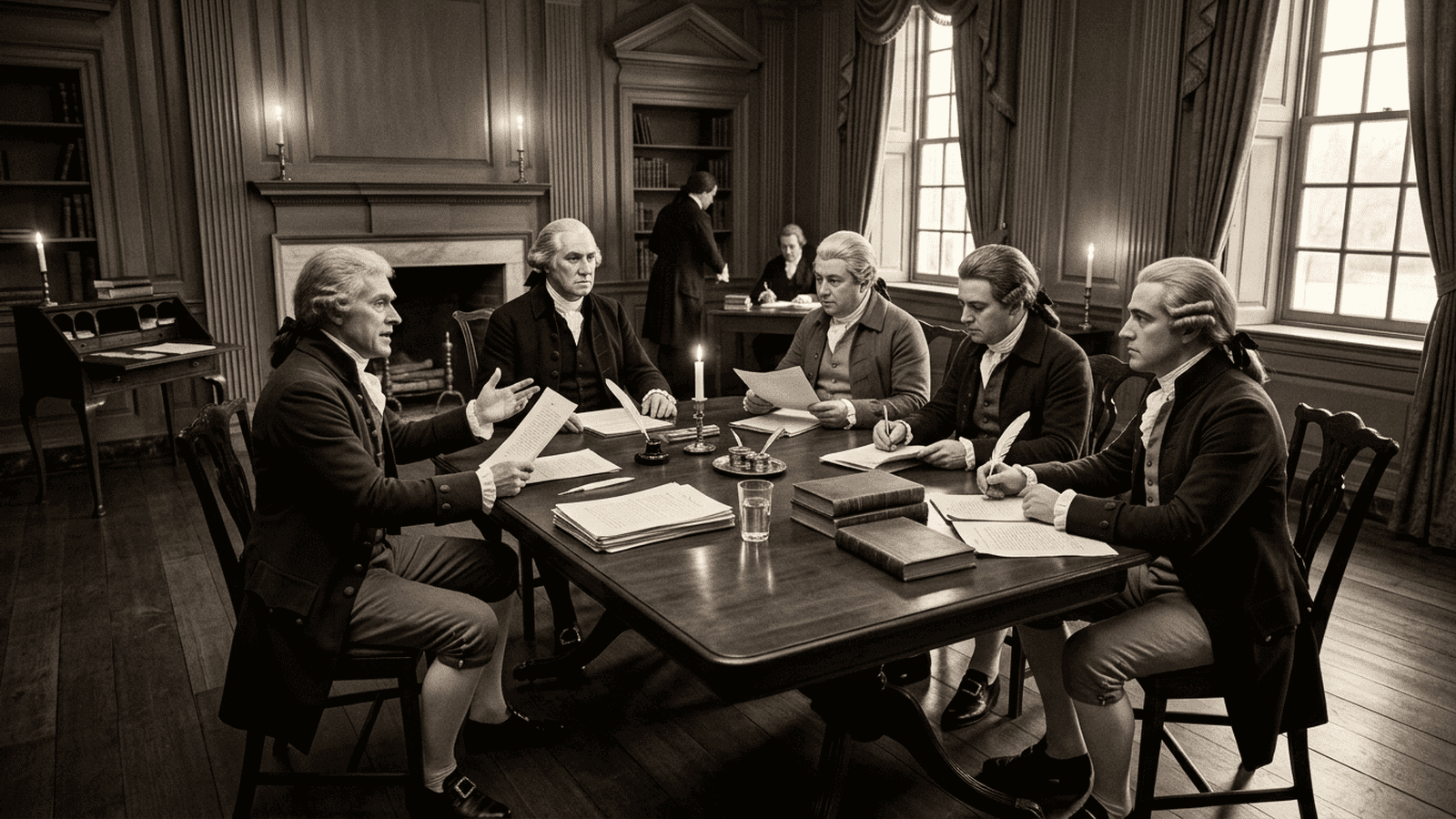
In 1793, George Washington declared that the United States would remain impartial in the war between France and Britain, prompting debate over whether the president could set and enforce neutrality policy without Congress. The controversy helped lead to the Neutrality Act of 1794 and became an early test of executive power.
TLDR: Washington’s 1793 neutrality proclamation aimed to keep the United States out of war between France and Britain. It sparked debate over presidential authority and citizen conduct, especially after French envoy Edmond-Charles Genêt encouraged military ventures from U.S. soil. Congress followed with the Neutrality Act of 1794, giving federal officials clearer enforcement powers.
In the spring of 1793, war between revolutionary France and Britain placed the young United States in a difficult position. The nation had an alliance with France dating to the American Revolution, but its government and economy were still fragile. President George Washington and his advisers feared that entering the European conflict could draw the country into a war it was not prepared to fight. On April 22, Washington issued a proclamation declaring the United States’ intention to act in a friendly and impartial manner toward the belligerents. It also warned Americans against actions that might violate that policy or expose them to prosecution. It was a public notice of policy, not a congressional declaration of war or a treaty change.
The proclamation followed weeks of argument inside Washington’s cabinet. Secretary of the Treasury Alexander Hamilton favored a cautious policy that would protect American trade and avoid war. Secretary of State Thomas Jefferson worried that a broad declaration of neutrality could favor Britain and weaken the alliance with France. Attorney General Edmund Randolph and Secretary of War Henry Knox also took part in discussions. Washington had to decide whether the executive branch could announce and enforce a policy of neutrality without waiting for Congress to pass a law.
That question went beyond immediate diplomacy. The Constitution gives Congress the power to declare war, while the president is commander in chief and directs foreign relations. The text does not spell out every step a president may take when war breaks out overseas. Washington’s administration argued that the government had a duty to prevent violations of U.S. neutrality and that the president could communicate the nation’s position. Critics, including some Democratic-Republicans, challenged the proclamation’s reach and feared it set a precedent for executive authority not explicitly granted by the Constitution.
The dispute became more urgent after French envoy Edmond-Charles Genêt arrived in the United States in 1793. Genêt sought American support for France and encouraged privateering and military ventures against Britain and Spain. Some Americans welcomed the French cause, while others feared these actions would undermine the declared policy and provoke retaliation. Washington’s administration insisted that foreign representatives could not enlist U.S. citizens or use American ports to pursue a war effort in defiance of federal policy. Genêt’s conduct made the abstract constitutional dispute immediate, forcing officials to decide how to respond to a foreign diplomat. The conflict also exposed deep divisions over the French Revolution and the country’s proper relationship with Europe.
Congress later supplied a statutory foundation for enforcement. The Neutrality Act of 1794 prohibited certain military expeditions launched from U.S. territory against nations at peace with the United States and restricted the fitting out of armed vessels for foreign service. Its passage did not erase disagreement over the president’s constitutional role, but it gave federal officials clearer legal tools. In 1795, the Supreme Court considered neutrality-related cases, including prosecutions arising from attempts to organize military expeditions, and affirmed that the law of nations could be enforced in U.S. courts.
Washington’s proclamation did not settle the boundaries of presidential power, and it did not prevent later conflicts over neutrality. It did establish an early example of a president announcing a foreign-policy position before Congress enacted detailed enforcement legislation. The episode helped shape debates about executive authority, legislative responsibility, and the limits of individual citizens’ conduct during foreign wars. The 1794 act and subsequent court decisions added oversight and legal structure, while the controversy remained a reference point in arguments about how the United States should respond when other nations went to war.

Miles Harrington serves as the Senior Correspondent for Federal Systems & Executive Power at Just Right News, where he brings a disciplined, constitutionalist lens to the inner workings of the American government. With a focus on the mechanics of the federal bureaucracy and the limits of executive authority, Harrington has established himself as a vital voice for readers who value transparency, accountability, and the preservation of the separation of powers.
A native of Richmond, Virginia, Harrington’s perspective is deeply rooted in the traditions of the Old Dominion. Growing up in a city defined by its historical significance and its role as a center of American jurisprudence, he developed an early appreciation for the foundational principles of the Republic. His upbringing in Richmond—a place where the legacy of the Founding Fathers is woven into the landscape—instilled in him a belief that the federal government should remain within its constitutional bounds. This background informs his skepticism of centralized overreach and his commitment to reporting on the ways in which the administrative state impacts the lives of everyday citizens.
In his current role, Harrington specializes in the complexities of federal systems. He doesn’t just report on the headlines of the day; he digs into the structural shifts within the executive branch that often go unnoticed by the mainstream press. Whether he is analyzing the implications of a new federal regulation or investigating the expansion of agency jurisdiction, his work is characterized by a rigorous adherence to the facts and a dedication to the rule of law.
Harrington is perhaps best known for his signature feature series, “How Washington Works.” Through this ongoing project, he demystifies the often-opaque processes of the nation’s capital, pulling back the curtain on the “Deep State” and the unelected officials who wield significant influence over national policy. By breaking down complex legislative maneuvers and executive orders, he empowers Just Right News readers to understand the true levers of power in Washington. His reporting serves as a necessary check on the federal government, ensuring that the actions of those in power are held up to the light of public scrutiny.
Now based in Washington, D.C., Harrington operates at the epicenter of the political world, yet he remains intentionally distanced from the “Beltway bubble.” His proximity to the halls of power allows him to maintain a robust network of sources across the federal landscape, but his heart remains in the principled conservatism of his Virginia roots. He views his role not merely as a reporter, but as a steward of the public trust, dedicated to providing the clarity and context that conservative voters need to navigate an increasingly complex political environment.
Through his sharp analysis and unwavering commitment to the truth, Miles Harrington continues to be a cornerstone of the Just Right News team. His work ensures that the principles of limited government and executive restraint remain at the forefront of the national conversation, providing a crucial service to those who believe in a government that is truly of, by, and for the people.