

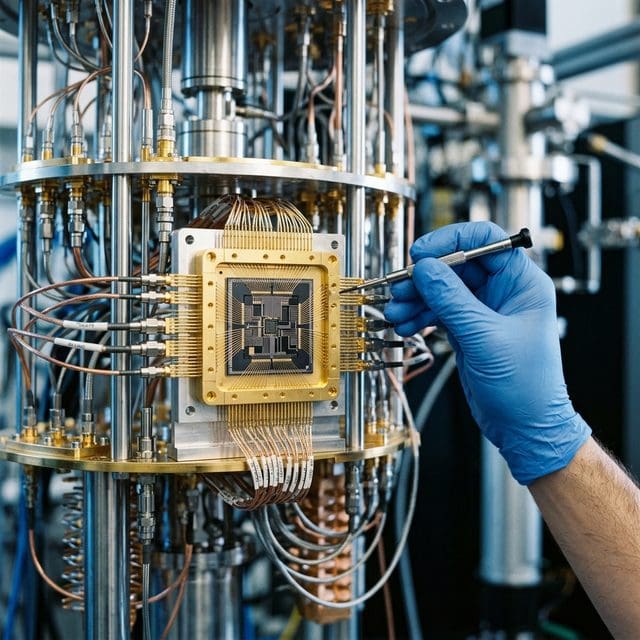
A RIKEN-led study identifies how shared microwave controls disrupt silicon qubits—and offers a pairwise calibration strategy to limit errors.
Quantum computers need more than qubits that work well one at a time. They must also perform operations in parallel without interfering with one another—a demanding requirement as researchers try to build larger machines.
A study from the RIKEN Center for Emergent Matter Science and collaborators, published in Nature Physics and reported by Phys.org, examines that problem in an array of silicon spin qubits. Its central finding is practical: errors caused by simultaneous operation can be addressed through pairwise phase calibration, rather than calibrating every possible combination of qubits separately.
The study identifies a key source of trouble: microwave drives can shift qubits’ energy levels, an effect known as the AC Stark shift. Those shifts alter the phase of a qubit’s quantum state. When several qubits are driven together, the resulting phase errors can undermine the accuracy of their operations.
A quantum computer manipulates information through carefully timed operations on qubits, whose states behave like waves. A drive that nudges a qubit’s energy can change the timing of that wave. If several qubits operate together, their control signals and responses can complicate the timing further. Operations may still complete, but errors can accumulate across a calculation.
The proposed remedy is to measure and correct the phase relationship between qubit pairs. The Nature Physics supplementary material specifies N(N-1) pairwise calibration terms for N qubits simultaneously driven from a shared line. The number of terms therefore grows quadratically with the number of qubits on that line—not necessarily with the size of a future processor as a whole. The distinction matters: an engineering advance is not proof that a large fault-tolerant computer is close at hand.
Calibration cannot solve every limitation. The present device uses relatively high microwave amplitudes to achieve fast gates. According to the supplementary material, those strong drives contribute to decoherence and heating during simultaneous operation. A stronger magnetic-field gradient could, in principle, deliver equivalent gate speeds at half the microwave power, reducing those effects. The authors describe this as a possible device improvement, not a result demonstrated in the reported array.
Silicon is attractive for quantum computing because it is central to established semiconductor manufacturing. But familiar fabrication infrastructure does not make quantum devices easy to scale. The RIKEN study addresses a specific obstacle—controlling several qubits at once—rather than demonstrating a complete, scalable processor. Its contribution is to identify a mechanism behind the interference and a calibration approach that may extend as more qubits share a control channel.
Other recent physics reports explore different routes to improving quantum technologies. Researchers at the University of Chicago Pritzker School of Molecular Engineering, with collaborators including Yu Jin of the Flatiron Institute, developed calculations of energy loss in spin defects in diamond and silicon carbide. Their work examines internal conversion, in which energy transfers to atomic vibrations rather than emerging as light. The findings help explain the lifetime of excited states in silicon carbide, knowledge that could aid the design of stable quantum sensors and qubits.
Separately, Auburn University researchers reported using short laser pulses to align tiny electrically charged regions in modified strontium titanate. The alignment lasted about a trillionth of a second, demonstrating a way to control a material’s internal electrical structure with light.
For the silicon-qubit team, next steps include testing the calibration as simultaneous operations expand and determining whether lower-power designs can reduce heating without sacrificing speed. The result does not erase the engineering hurdles ahead. It offers a clearer map of one of them—and a method for addressing it.

Mason Reed serves as a Staff Writer for Just Right News, where he spearheads the Future Frontiers & Special Projects desk. In an era defined by rapid technological shifts and evolving social landscapes, Mason provides a steady, principled voice, examining the innovations of tomorrow through the lens of traditional American values. His work is most prominently featured in his signature series, “The Next Horizon,” where he explores the intersection of emerging technology, national sovereignty, and the preservation of individual liberty.
A native of San Diego, California, Mason’s worldview was shaped by the unique culture of his hometown. Growing up in a region defined by its strong military presence and its history of maritime industry, he developed a deep-seated respect for the institutions that provide national stability and the entrepreneurial spirit that drives the American economy. This upbringing instilled in him a belief that true progress is not found in discarding the past, but in building upon a foundation of proven principles. His reporting often reflects this San Diego influence, emphasizing the importance of a robust national defense and the necessity of maintaining a competitive edge in the global marketplace.
Now based in San Francisco, Mason operates from the heart of the world’s technological engine. Living and working in the Bay Area provides him with a front-row seat to the advancements—and the ideological challenges—emanating from Silicon Valley. While many in the region embrace a “move fast and break things” mentality, Mason’s reporting serves as a vital counterweight. He offers Just Right News readers a “boots on the ground” perspective, documenting how radical local policies and the concentration of tech power impact the everyday lives of citizens. His proximity to the industry allows him to cut through the marketing jargon of big tech to uncover the real-world implications for privacy, free speech, and the nuclear family.
In his “Future Frontiers” beat, Mason tackles complex subjects ranging from the ethics of artificial intelligence to the burgeoning private space race. He approaches these topics with a healthy skepticism toward centralized bureaucracy, championing instead the decentralized innovations that empower individuals. Through “The Next Horizon,” he highlights the pioneers and thinkers who are working to ensure that the future remains a place where human dignity and constitutional rights are protected. He believes that the rapid pace of change requires more than just technical expertise; it requires a moral compass rooted in the Western tradition.
Throughout his tenure at Just Right News, Mason has remained committed to the idea that the future is something to be shaped, not merely accepted. His writing is characterized by a rigorous defense of American exceptionalism and a belief that the country’s best days lie ahead, provided it remains true to its founding ideals. Whether he is investigating the impact of automation on the American workforce or profiling the next generation of aerospace engineers, Mason Reed ensures that his readers are equipped with the insights they need to navigate a changing world with confidence and clarity.