

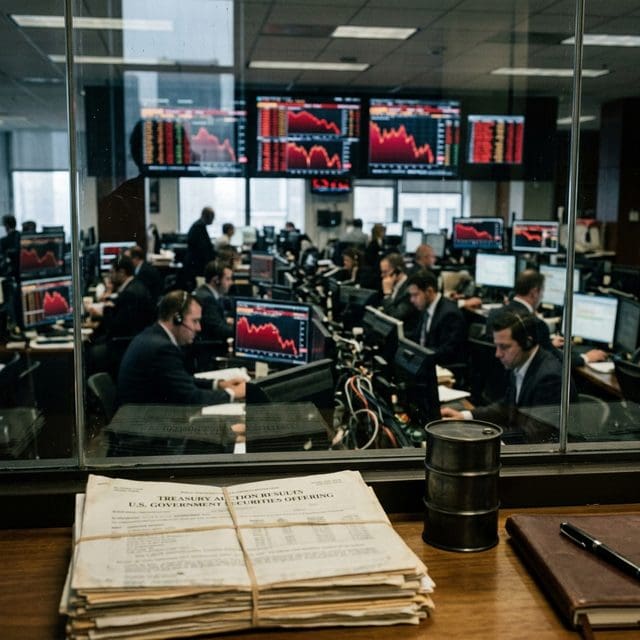
The session’s SPY decline comes as investors reassess AI investment returns, while elevated Treasury yields and oil prices keep pressure on household-sensitive borrowing and energy costs.
SPY is down 1.22% on the session, putting the weakness in U.S. large-cap equities in focus. The clearest market pressure in the available reporting is technology: investors are questioning whether the enormous cost of building artificial-intelligence infrastructure will produce profits quickly enough to justify it. That concern has weighed on semiconductor shares, even as the broader market’s longer-term gains remain substantial.
The Philadelphia Semiconductor Index fell 8% in October through the Reuters report dated Oct. 16, but remained up more than 60% for 2026. The S&P 500 stood about 1% below its October record. Those figures describe a market that has given back some ground without erasing its year-to-date advance. They do not establish the exact daily move in either index, so SPY’s 1.22% decline is the clearest session benchmark here.
The debate is increasingly about returns on capital, not just the promise of AI. Goldman Sachs estimates that five major hyperscalers will spend about $1.2 trillion combined on AI infrastructure next year, Reuters reported. Investors will look to coming earnings from Meta Platforms, Lam Research and Texas Instruments for evidence that revenue and profitability can keep pace with that investment. Meta’s market capitalization was about $1.9 trillion as of Oct. 16, according to Reuters. Results from large technology and chip companies could help determine whether the recent pullback is a pause in a powerful trade or a deeper reassessment.
Credit risk adds another dimension. CoreWeave, an AI-cloud company, has drawn investor attention as questions grow about the debt needed to finance rapid infrastructure expansion. Its bonds issued months earlier fell to 81 cents on the dollar and yielded more than 15% on Oct. 14, according to MarketWatch. That is a warning about the price investors are demanding to bear risk in one company—not proof that the same stress has spread across the whole market. Still, the episode shows how enthusiasm for AI can be tested when growth depends on heavy borrowing.
Rates remain an important counterweight. A supplied market snapshot put the 10-year Treasury yield near 5.080%, the 30-year at 5.437% and the two-year at 4.734%. Those levels matter well beyond trading desks: higher market yields can raise financing costs for businesses and put pressure on mortgages, auto loans and other borrowing. September inflation rose as energy prices surged, and the Federal Reserve was weighing another rate increase later in October amid inflation and a strong economy. That combination leaves little room to assume borrowing costs will fall quickly.
Oil adds a direct cost-of-living concern. Brent crude was reported above $105 a barrel in the supplied market coverage, though one pre-session snapshot said it had slipped about 0.3%. The material does not establish a dependable current foreign-exchange move, so no directional claim about the dollar is warranted. For households, the practical point is that costly energy can feed into transportation and other prices even when the daily movement in crude is modest.
Markets are not moving in lockstep: the supplied pre-session reports described gains in several Asian and European benchmarks, alongside earlier volatility in South Korea. But that does not remove the U.S. pressure reflected in SPY. The next test is whether earnings show that AI spending is turning into durable cash flow, while inflation, rates and energy costs continue to shape the outlook for businesses and household budgets.

Jordan Lee serves as the Senior Correspondent for Wall Street, Finance, and Monetary Systems at Just Right News. Based in the heart of the world’s financial capital, New York City, Lee brings a sharp, principled eye to the complex mechanisms that drive the global economy. His reporting is defined by a commitment to fiscal responsibility, the defense of the free market, and a deep-seated belief that a transparent monetary system is the bedrock of a free society.
Raised in Portland, Oregon, Lee’s perspective was forged in a city that has undergone significant cultural and economic shifts. His upbringing in the Pacific Northwest instilled in him a profound appreciation for the industriousness of small business owners and the importance of local economic stability. Watching the evolution of his hometown’s landscape sparked an early interest in how federal fiscal policy and large-scale financial trends eventually trickle down to the average citizen. This background provides him with a unique vantage point; he understands the growing disconnect between the policy-making elite and the reality of Main Street, a theme that frequently resonates throughout his work.
Now operating from his base in New York City, Lee bridges the gap between the high-stakes trading floors of Manhattan and the households of everyday Americans. He views the financial sector not merely as a collection of numbers and tickers, but as a vital engine of American prosperity that requires constant vigilance and accountability. His reporting often highlights the dangers of centralized financial control and the necessity of maintaining a system that rewards merit, risk-taking, and innovation.
As the creator and lead of the featured series, “The Invisible Economy,” Lee pulls back the curtain on the often-opaque world of monetary systems. He specializes in translating the dense jargon of central banking and international finance into actionable insights for the Just Right News audience. His work explores the “invisible” forces—such as inflationary pressures, regulatory creep, and the expansion of the administrative state—that erode the purchasing power of American families. By focusing on these systemic issues, Lee empowers readers to understand the hidden forces shaping their financial independence.
Lee’s journalistic philosophy is rooted in a steadfast commitment to traditional American values. As an Asian American professional who has navigated the competitive corridors of the financial world, he is a vocal advocate for meritocracy and the preservation of the American Dream. He believes that a stable currency and a predictable regulatory environment are essential for national sovereignty and individual liberty. His reporting frequently warns against the risks of government overreach in the private sector, arguing that the most effective solutions to economic challenges arise from competition and individual enterprise rather than bureaucratic mandates.
At Just Right News, Jordan Lee remains dedicated to providing a clear-eyed defense of the taxpayer. Whether he is analyzing market volatility or investigating the long-term implications of national debt, his mission is to provide the truth about where the money is going and what it means for the future of the country. Through his rigorous analysis and principled stance, Lee has become a trusted voice for those who value a strong, sovereign, and fiscally sound America.