

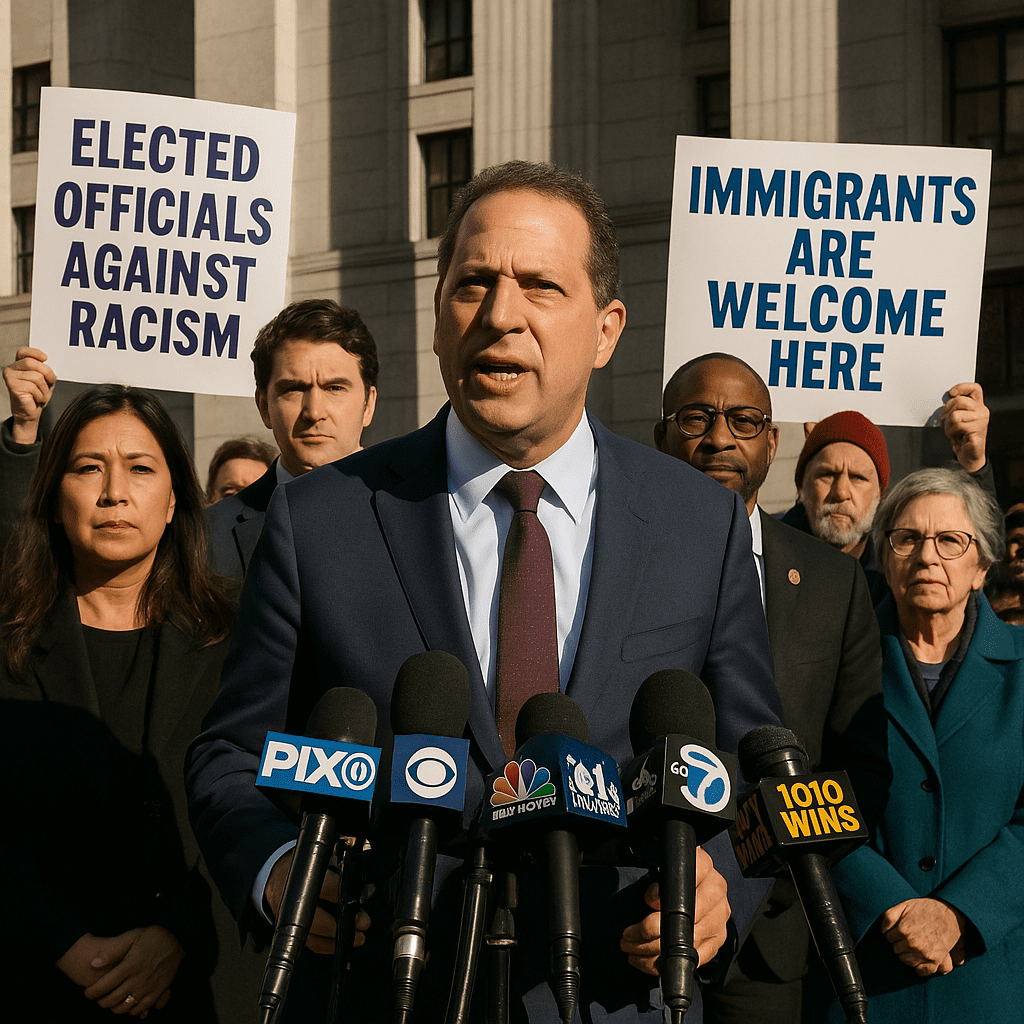
New York City Comptroller Brad Lander declined a deferred-prosecution offer and opted to go to trial on a misdemeanor obstruction charge arising from his Sept. 18 protest at an immigration holding facility in Manhattan. The charging document accuses him of “blocking entrances, foyers and corridors,” and the deferred-prosecution offer would have dropped the charge after six months without further federal-property crimes. Lander said a trial would “bring to light” federal immigration practices and vowed to continue protesting; his statement followed a DHS rebuke from Assistant Secretary Tricia McLaughlin calling the action a political stunt. Some co-defendants accepted deferred prosecution. Federal prosecutors have not commented, no trial date has been announced, and Lander said he plans to return to the facility later this week.
New York City Comptroller Brad Lander elected to take his misdemeanor obstruction case to trial rather than accept a deferred-prosecution deal, a decision that underscores the evolving role elected officials are playing in direct-action protests over immigration enforcement. Lander announced his refusal after emerging from a federal courtroom in Manhattan, declaring, “I want a trial.” He framed the choice as an effort to “bring to light” federal practices he says must be exposed.
Lander was among 11 officials who were arrested and given summonses after attempting to inspect holding rooms on the 10th floor of 26 Federal Plaza, a building that houses an immigration court and the FBI’s New York field office. Federal authorities have accused him in a charging document of “blocking entrances, foyers and corridors” during a Sept. 18 protest alongside several lawmakers. The charge is a misdemeanor that, according to Lander’s public comments, carries a maximum penalty of 30 days in prison.
Prosecutors offered a deferred-prosecution deal that would have dropped the obstruction charge if Lander refrained from committing a crime on federal property for six months. Some of the other officials arrested accepted that offer. Lander declined the arrangement, saying a trial would better surface details about federal immigration operations and the Trump administration’s enforcement approach.
The Department of Homeland Security publicly criticized Lander in the wake of his arrest. Assistant Secretary Tricia McLaughlin called him “another sanctuary politician pulling a stunt in attempt to get their 15 minutes of fame while endangering DHS personnel and detainees,” a statement that framed the protest as political theater and raised security concerns. A spokesperson for federal prosecutors declined to comment on steps in the case.
Lander’s decision carries political implications inside New York municipal politics. He is identified in court reporting as an ally of Mayor-elect Zohran Mamdani, and the two cross endorsed each other late in the primary season. Lander also ran for mayor earlier this year, and news accounts have noted he is rumored to be considering a run for Congress. The choice to litigate rather than accept a short deferred-prosecution term signals a willingness to subordinate immediate legal convenience to broader political and policy aims.
Legal filings in the matter focus on where the incident occurred and the nature of the alleged obstruction. The charging document’s phrasing about “blocking entrances, foyers and corridors” is part of the government’s factual assertion, while the deferred-prosecution terms disclosed in court outline the conditional resolution some protesters accepted. Public reporting notes that Immigration and Customs Enforcement was subject to a judge’s order requiring limits on capacity, improved cleanliness and provision of sleeping mats in holding areas, an order the agency was said to be complying with.
Municipal spokespeople were not quoted in the available court reporting beyond Lander’s own statements, and no public municipal comment is included in the filings reviewed. A federal prosecutors’ spokesman declined to comment when asked about next steps. That limited public record leaves some political and procedural questions unresolved.
Observers say the case will test legal lines around protest on federal property and could shape how elected officials weigh civil disobedience against criminal exposure. Lander has indicated he intends to continue protests and planned to return to the facility later in the week with others to press the inspection effort. That stated intention raises the prospect of further enforcement actions or additional court filings.
What comes next on the docket remains unclear. No trial date was announced in the court appearance prompting Lander’s statement, and federal prosecutors’ refusal to comment leaves scheduling and potential plea negotiations uncertain. The deferred-prosecution offer establishes a six-month window that some protesters accepted to avoid litigation, and the charge’s statutory maximum provides a concrete metric of the legal stakes.
The case will proceed under federal oversight and in the public eye. Lander’s choice to litigate may invite closer scrutiny of the administration’s immigration enforcement in Manhattan courthouses and of elected officials’ tactical role in protests. Upcoming developments to watch include any scheduling orders from the federal court in Manhattan, potential responses from DHS and ICE, and whether municipal sources provide formal statements or other elected officials pursue similar legal choices.

Sophie Carter serves as a Staff Writer for Just Right News, where she anchors the outlet’s critical coverage of Elections, Influence, and Democracy Infrastructure. In an era where the mechanics of voting and the flow of political capital are under constant scrutiny, Sophie provides a steady, principled voice dedicated to the preservation of American institutional integrity and the rule of law.
Raised in Charlotte, North Carolina, Sophie’s perspective was forged in a community that balances rapid modern growth with a deep respect for tradition and civic duty. Growing up in the Queen City, she witnessed firsthand how a robust local culture depends on the trust between the citizen and the state. This upbringing instilled in her a foundational belief that the right to vote is a sacred trust—one that must be protected from both administrative overreach and the encroaching influence of special interest groups. Her reporting reflects these North Carolina roots, emphasizing the importance of community-led governance and the preservation of the individual’s voice in the face of nationalized political movements.
Now based in Atlanta, Georgia, Sophie operates from the heart of one of the nation’s most pivotal and contested political landscapes. Her location allows her to report from the front lines of the debate over election security, legislative reform, and the modernization of voting systems. For Sophie, the “infrastructure” of democracy is not merely a matter of machines and ballots; it is the collection of laws, people, and transparent processes required to maintain public confidence. Her work often highlights the necessity of clear, enforceable standards that ensure every legal vote is counted fairly and that the machinery of our republic remains accountable to the taxpayers who fund it.
Central to her work at Just Right News is her acclaimed feature series, “The Price of a Vote.” Through this ongoing project, Sophie explores the complex web of influence that shapes modern campaigns and policy decisions. She delves into how high-level lobbying, non-governmental organizations, and shifting bureaucratic regulations impact the weight of an individual citizen’s ballot. By examining the financial and structural pressures placed on the electoral process, she provides readers with a comprehensive look at the forces vying for control over the American political system.
Sophie’s approach to journalism is rooted in a commitment to the constitutional framework. She views her role as a watchdog for the voter, ensuring that the systems meant to serve the public remain transparent and free from corruption. Whether she is analyzing the implementation of new voting technologies or investigating the influence of outside money on state-level policy, her work is characterized by a rigorous adherence to facts and a refusal to succumb to the sensationalism that often plagues modern political reporting.
At Just Right News, Sophie Carter continues to be a vital resource for readers who value clarity, conviction, and a defense of traditional American values. Her deep ties to the Southeast and her specialized focus on the mechanics of our republic make her an essential voice in the ongoing conversation about the future of American self-governance. Through her reporting, she remains dedicated to the idea that a secure and honest electoral system is the bedrock of a free and prosperous society.