

WWF reports an 80% average decline in monitored African vertebrate populations since 1970, a measure of population size—not the share of animals or species lost.
Monitored vertebrate wildlife populations in Africa fell by an average of 80% between 1970 and 2022, according to the World Wide Fund for Nature’s Living Planet Report 2026, released October 8. The figure measures the average change in population size across tracked groups. It does not mean that 80% of Africa’s animals or species disappeared.
The Africa result draws on 35,803 population trends covering 5,790 vertebrate species worldwide, compiled for the Living Planet Index by the Zoological Society of London and WWF. The index tracks changes in average population size over time; it is not a census of every animal or a count of extinctions.
The global picture is not a decline in every population. Half of the populations in the index are stable or increasing, WWF says, but declines among others produce an overall negative trend. Averages convey the scale of change, but do not describe conditions for every species, habitat or country.
Habitat loss and degradation, most frequently associated with agricultural expansion, are the pressures most often reported. Other threats include overexploitation, climate change, pollution, invasive species and disease. The report does not quantify each pressure’s contribution to the African average, and it is not a public-health assessment: it makes no claim that wildlife declines directly caused a particular disease outbreak.
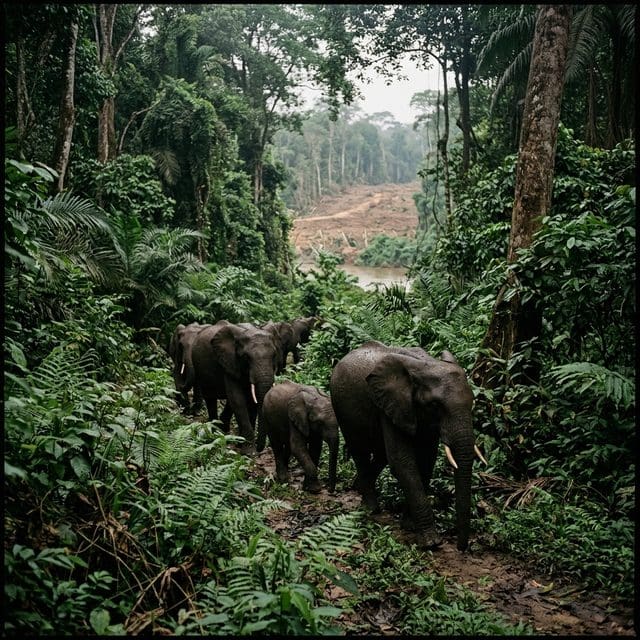
In the Congo Basin, agriculture, logging, mining, roads and other infrastructure add pressure alongside hunting and poaching. WWF says African forest-elephant populations have fallen by more than 60% over recent decades, primarily because of habitat loss and illegal ivory killing.
The report also describes examples of recovery. Some southern African savanna-elephant populations are increasing where communities help manage wildlife and benefit from conservation. WWF also cites anti-trafficking measures, judicial reform and reduced corruption. These are specific examples, not evidence that one model will work everywhere. They do, however, underscore the importance of local participation and enforcement alongside protected areas.
For American audiences, the findings illustrate why conservation cannot be treated as a stand-alone aid project. WWF links wildlife decline to broader food, energy and finance systems, and calls for community-led conservation, nature-friendly farming, clean energy, credible corporate transition plans and investment redirected toward nature restoration. The report provides no U.S. funding estimate and does not claim a particular health or economic consequence for Americans. Its argument is that production, infrastructure and investment decisions affect ecosystems far beyond conservation programs alone.
That approach raises practical questions for governments and donors: how funds are spent, whether communities share in benefits, and how results are tracked. The wildlife index can document population trends, but cannot answer those budget and governance questions on its own. Transparent accounting and locally grounded evidence are needed to assess whether programs deliver lasting gains.
The report is intended to inform assessment of the Kunming-Montreal Global Biodiversity Framework. Its targets include halting human-induced extinctions, supporting threatened-species recovery by 2030, and conserving at least 30% of land, inland waters and seas by 2030. The index does not establish whether those targets are being met or identify which intervention works best in each country.
WWF’s assessment sets out the scale of decline and a broad range of responses. The test for policymakers and donors will be whether conservation and development decisions produce measurable recovery while accounting for local rights, livelihoods and public spending.

Rachel Vaughn serves as a Senior Correspondent for Just Right News, where she leads the network’s coverage of Global Health, Climate, and Development. With a career defined by intellectual rigor and a commitment to principled reporting, Rachel provides a vital conservative perspective on some of the most complex and high-stakes issues facing the world today. Her work is characterized by a refusal to accept bureaucratic narratives at face value, focusing instead on how international policies impact national sovereignty, individual liberty, and the American taxpayer.
Raised in New Haven, Connecticut, Rachel grew up in an environment dominated by elite academic discourse. This upbringing provided her with a front-row seat to the inner workings of the American establishment, but it also instilled in her a healthy skepticism of the “ivory tower” consensus. She learned early on that while academic theories may sound promising in a lecture hall, they often fail to account for the practical realities of the working class. This background drives her to bridge the gap between high-level policy discussions and the common-sense concerns of everyday citizens, ensuring that her reporting remains grounded and accessible.
Now based in Burlington, Vermont, Rachel operates from a unique vantage point within one of the nation’s most progressive political landscapes. Living and working in a region that often serves as a testing ground for radical social and environmental experiments allows her to witness the real-world consequences of these policies firsthand. From her base in the Green Mountain State, she provides Just Right News readers with essential “boots on the ground” reporting, documenting the friction between local mandates and the constitutional freedoms of the individual. Her presence in Burlington ensures that her critiques of globalist agendas are informed by a direct understanding of how those ideologies manifest at the local level.
In her acclaimed feature series, “Planetary Stakes,” Rachel explores the intersection of international development and environmental stewardship. She rejects the alarmism often found in mainstream media, opting instead for a sober analysis of the economic and geopolitical costs of global climate agreements. Her reporting frequently highlights the importance of market-driven innovation and the role of American leadership in fostering global health without ceding authority to unelected international bodies. Through “Planetary Stakes,” she has become a leading voice for those who believe that true conservation and public health are best achieved through transparency, accountability, and the protection of private property rights.
Throughout her tenure at Just Right News, Rachel has distinguished herself as a journalist who is unafraid to ask difficult questions of global institutions. Whether she is investigating the influence of non-governmental organizations on domestic policy or analyzing the fiscal transparency of international health initiatives, her goal remains the same: to provide her audience with the facts necessary to navigate an increasingly interconnected world. Her blend of East Coast intellectual heritage and her current immersion in the political heart of the Northeast makes her an indispensable asset to the newsroom and a trusted source for readers seeking a principled, conservative take on the issues that define our era.