

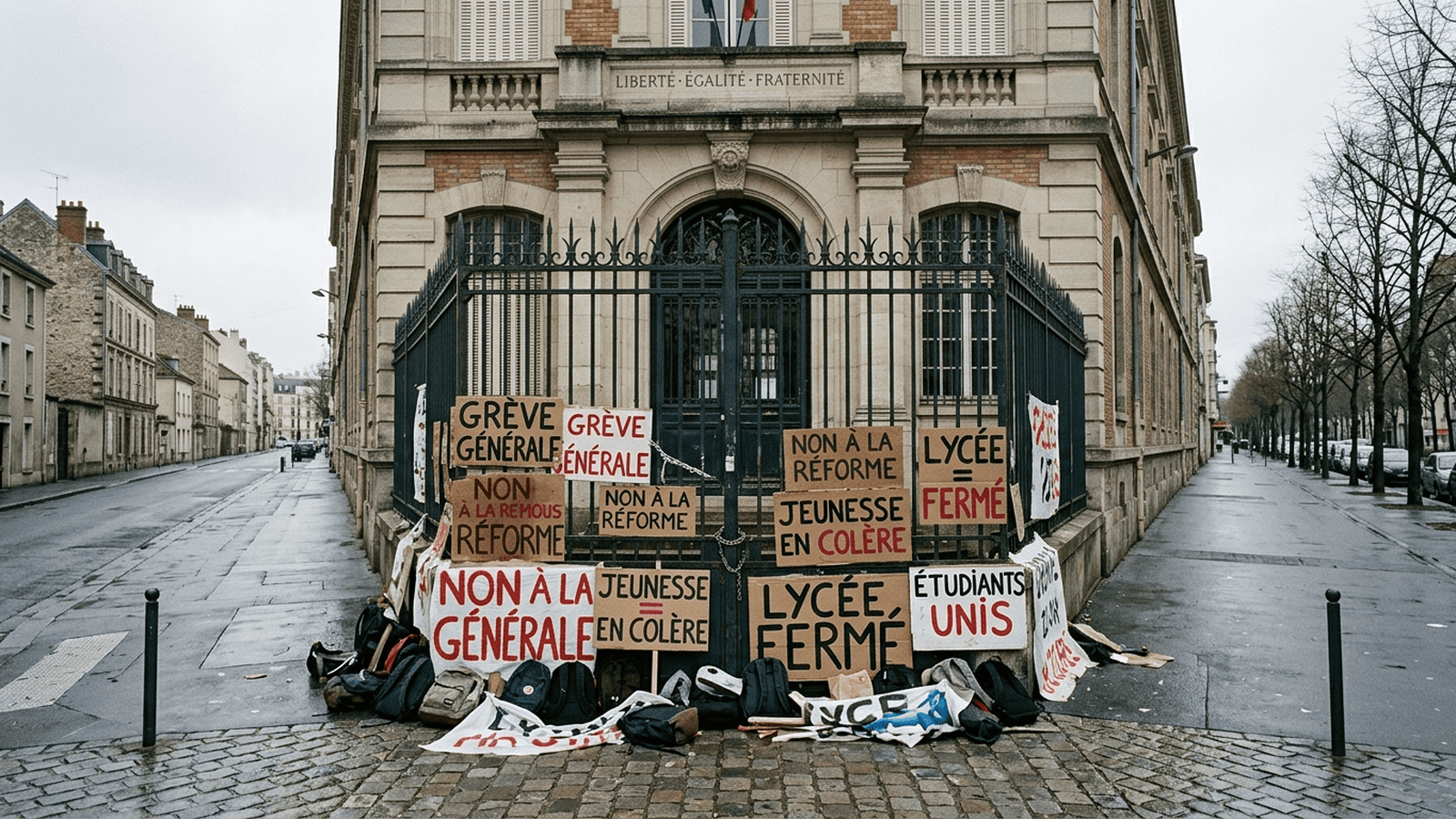
Protests disrupted hundreds of French high schools on Tuesday, and a student union said 2,000 schools were at a standstill as demonstrations entered their third week. Students, parents and teachers are demanding action on what they describe as underfunded, poorly maintained schools. Police reported detaining more than 5,000 people, including more than 4,000 teenagers, while officers used tear gas and stun grenades to disperse crowds. Two teenagers were seriously injured in separate incidents involving police grenades, and local officials have announced investigations. The French government has made no meaningful concessions, according to the report, and the account gives no policy deadline, cost estimate or new compliance requirements.
TLDR: France’s school demonstrations have disrupted classes on a wide scale, with protesters calling for action on school conditions and police reporting thousands of detentions. Investigations are underway into two student injuries, while the government has not announced meaningful concessions.
Protests disrupted hundreds of high schools across France on Tuesday, in what the student union Union Syndicale Lycéenne described as a historic morning. The union said 2,000 high schools were at a standstill and universities across the country were mobilized. Students, parents and teachers joined demonstrations now in their third week.
The stated reason for the protests is poor school conditions. Demonstrators are demanding that the government address schools they describe as underfunded and under-resourced. The account provides no official government rationale for a new policy, and reports no meaningful concessions to protesters so far.
The dispute moved from school complaints to a visible interruption of classes. On Tuesday morning, a large group of students blocked the entrance to a school, held signs and chanted. The union’s figures describe a broad disruption, though the excerpt does not independently verify the number of schools affected. The figures also do not show how many students missed classes or how long individual schools were disrupted.
In Saint-Denis, just outside Paris, one protester described ceilings falling apart, water in walls and rats. Those conditions were presented as the protester’s account, not as findings from an inspection or official report. Still, the claim helps explain why students and other demonstrators say the condition of school buildings requires government attention. The account does not identify a repair plan or say which schools would be addressed first.
The protests have also involved clashes with law enforcement. The account says some demonstrators caused damage and set school buildings ablaze. Police reported detaining more than 5,000 people in connection with the protests, including more than 4,000 teenagers. Those figures come from police and do not specify how many detainees were charged or what became of their cases.
Video footage showed protesters running and shouting as officers moved to disperse crowds. Police used tear gas and stun grenades, according to the report. The demonstrations have therefore brought together two distinct issues: demands for better-resourced schools and public safety concerns arising from confrontations in the streets. The reported detentions indicate the scale of the police response, but the account does not give a full picture of arrests, charges or court outcomes.
Two reported injuries have added to those concerns. On Monday, a 15-year-old student in Lens lost a hand after picking up a police grenade, authorities told the French news agency AFP. A police union source said the student appeared to have picked up a sting-ball grenade fired by riot police, which then exploded. The account does not provide further details about the circumstances or the student’s condition.
Last week, a 14-year-old in Saint-Ouen-l’Aumône, in the Paris suburbs, suffered a jaw fracture after reportedly being struck in the head by a tear gas grenade. That account came from CBS partner BBC News, which cited the teenager’s lawyer. The two injuries are separate incidents, and the available report does not establish a broader finding about police conduct.
Local officials have announced investigations into both cases. Their findings and any further steps are not included in the account. The investigations offer a formal process for reviewing the incidents, while the protests and police response continue to shape the dispute. Until the reviews are complete, the reported accounts remain the available descriptions of how the injuries happened.
The political setting may complicate a response. The French government is described as mired in political deadlock ahead of presidential elections next spring. It has yet to make meaningful concessions to protesters, according to the report. One demonstrator told CBS News that the protests would continue without a response, underscoring the distance between the demands in the streets and the government’s current position.
The direct impacts are already apparent: classes have been disrupted at hundreds of schools, the student union says 2,000 high schools were at a standstill, and police report more than 5,000 detentions, including more than 4,000 teenagers. The account gives no figures for financial costs and names no forms, new compliance rules or deadlines. Those details are not part of the reported plan; the immediate formal steps described are the local investigations into the two injuries. It also does not say whether schools will receive extra funding, when any repairs might begin, or how officials would track improvements.
The next steps reported are the investigations and continued demonstrations, with the government still facing calls to address school conditions. Local officials’ reviews are necessary steps for establishing what happened in the two injury cases. No outcome or government commitment is reported yet. The available account leaves open both how the school complaints may be addressed and whether the disruptions will continue.

Ethan Blake serves as a Senior Correspondent for Just Right News, where he specializes in Longform Narrative and Public Understanding. In an era of rapid-fire headlines and fleeting soundbites, Ethan’s work stands as a testament to the power of deep-dive reporting and the importance of contextualizing the complex issues facing the nation today. His approach is rooted in the belief that the most profound truths are often found in the lived experiences of individuals rather than the abstract theories of distant policymakers.
Growing up in Providence, Rhode Island, Ethan developed an early appreciation for the historical and cultural threads that weave the American fabric together. Providence, a city defined by its industrial heritage and its blend of traditional neighborhoods, provided him with a front-row seat to the challenges and triumphs of the American working class. This upbringing instilled in him a respect for the “common sense” values of hard work, community loyalty, and the preservation of local institutions. He learned early on that behind every economic statistic or legislative debate, there are real families and neighborhoods navigating the consequences of change.
This foundational perspective is the driving force behind his signature feature series, “Lives Behind the Systems.” Through this series, Ethan explores the intersection of individual agency and institutional structure. Whether he is documenting the impact of federal land-use policies on rural families or examining how shifting educational standards affect local school boards, Ethan’s work prioritizes the human element. He seeks to uncover how large-scale systems—be they governmental, economic, or social—affect the daily lives of citizens, often advocating for a return to local control and personal responsibility.
Now based in Portland, Maine, Ethan draws significant inspiration from the rugged independence and self-reliance that define the region. The coastal landscape and the resilient spirit of Maine’s communities serve as a constant reminder of the importance of individual liberty and the strength found in decentralized power. Living and working outside the traditional media hubs allows Ethan to maintain a grounded perspective, ensuring his reporting remains untethered from the echo chambers of the major metropolitan centers. This geographic distance provides him with the clarity needed to translate complex national narratives into stories that resonate with the heart of the country.
At Just Right News, Ethan’s beat is more than just a professional assignment; it is a mission to foster a more informed and engaged citizenry. He believes that a free society depends on the public’s ability to understand the mechanisms of power and the value of traditional American principles. His longform narratives do not merely report the news; they provide a roadmap for understanding the cultural and political shifts of the modern era through a lens of skepticism toward centralized authority and a deep respect for the individual.
Through his meticulous research and narrative craftsmanship, Ethan Blake continues to bridge the gap between policy and the public. His work remains a vital resource for those who seek a deeper understanding of the systems that shape our world and the enduring spirit of the people who live within them.