

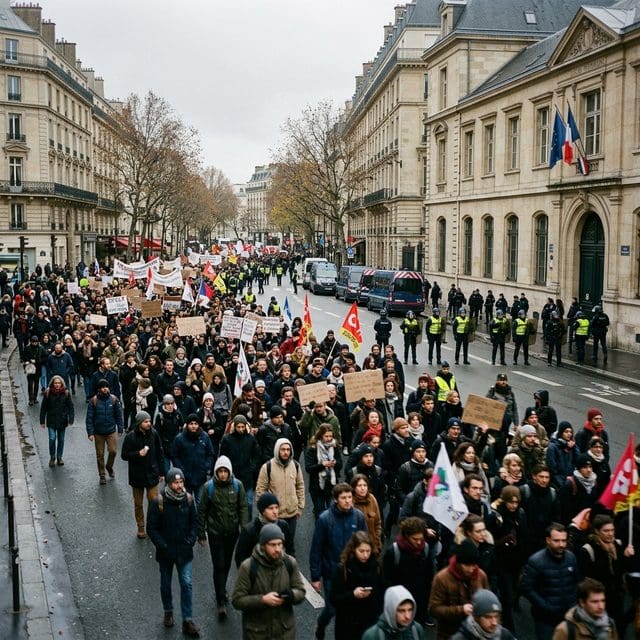
More than 250,000 people demonstrated in France over school conditions, while Donald Trump attributed the unrest to mass migration and Islam, a claim unsupported by the reported protest demands.
More than a quarter-million people demonstrated across France on October 6 in protests focused on schools, according to the country’s Interior Ministry. Organizers estimated turnout at 450,000. The movement’s reported concerns included teacher shortages, overcrowded classrooms and deteriorating school infrastructure. Sporadic clashes were also reported, though the available material does not establish their extent.
President Donald Trump offered a different explanation for the unrest. In a Truth Social post on October 6, he attributed it to what he called “out of control mass migration” and Islam, rejecting the education-related grievances identified in reports about the demonstrations.
The available reporting does not provide evidence connecting migration or religion to the protests. It also does not include figures on migrant populations, asylum applications, school enrollment by migration background, or the distribution of teachers and resources. The competing accounts therefore differ in kind: the demonstrators’ reported demands concern identifiable school conditions, while Trump’s post advances a broader explanation without supporting data in the material available.
The Interior Ministry and organizers offered different estimates of the crowd. The ministry said more than 250,000 people demonstrated nationwide; organizers claimed 450,000. The difference is substantial, but either estimate indicates a large turnout. Neither figure, by itself, shows whether immigration shaped participants’ concerns or establishes the causes of staffing and capacity problems in schools.
The reports describe the demonstrations as centered on shortages of teachers, overcrowding and school infrastructure. They do not specify which schools or regions faced the most acute problems, how long those conditions had persisted, or what policy changes protesters demanded. Without those details, the available accounts cannot establish whether the concerns reflect nationwide trends, local pressures or a combination of factors.
The reporting also offers limited detail on the clashes. Although sporadic incidents were noted, it does not provide verified totals for injuries, arrests or property damage. Separate claims about schools being burned or ransacked and education staff being injured could not be matched to a cited source and therefore cannot be used to assess the scale of disorder.
Evaluating whether population change contributes to pressure on schools would require local evidence: enrollment trends, class sizes, staffing levels, building capacity and the share of pupils who are recent arrivals. Comparing those measures across communities and over time could help distinguish a change in student numbers from broader staffing or infrastructure shortfalls. None of those data is included in the reporting available for this account.
Such analysis would also need to avoid treating migration as a single uniform factor. Enrollment patterns and school resources can differ from one area to another, and a national crowd estimate cannot explain conditions at an individual school. The material offers no basis for determining whether migration increased demand in particular places or whether other factors account for the reported shortages and crowding.
The episode shows how migration can enter political debate even when the immediate demands described by demonstrators concern public services. Political statements may frame events nationally, but assessing that explanation requires evidence that connects the claim to the conditions being discussed. Here, the reporting supports the description of the protests’ stated education grievances; it does not substantiate Trump’s alternative explanation.
For now, the documented account is limited: a large nationwide demonstration focused on teacher shortages, overcrowding and school infrastructure, with sporadic clashes reported and turnout estimates that differ. The available sources do not supply demographic or school-level data that would establish a link between migration and the protesters’ concerns.

Julie Harris serves as a Staff Writer for Just Right News, where she tackles some of the most pressing and complex issues facing the nation today. As the lead reporter for the Migration, Demographics & Cultural Shifts beat, Julie provides a grounded, principled perspective on how the movement of people and the changing makeup of communities are reshaping the American landscape. Her work is defined by a commitment to exploring the long-term consequences of social change, prioritizing the stability of local institutions and the preservation of national identity.
Her deep understanding of these issues is rooted in her upbringing in Tucson, Arizona. Growing up in a prominent border state, Julie witnessed firsthand the intricate realities of migration and the profound impact it has on local infrastructure, law enforcement, and the social fabric. This early exposure instilled in her a respect for the rule of law and a keen awareness of the challenges that arise when federal policies fail to align with the needs of border communities. Her reporting often reflects this lived experience, bringing a necessary level of nuance to topics that are often treated with abstraction in coastal newsrooms.
Now based in Santa Fe, New Mexico, Julie continues to report from the heart of the American Southwest. Her location provides a unique vantage point to observe the intersection of traditional regional cultures and the modern shifts brought about by both internal and external migration. In Santa Fe, a city defined by its rich history and distinct cultural heritage, she finds a perfect environment to explore how communities strive to maintain their character while navigating the pressures of a rapidly changing world. This perspective allows her to bridge the gap between policy debates in Washington and the reality of life in the high desert.
At Just Right News, Julie’s work is characterized by a dedication to examining the data and the human stories that define the “New Mosaic” of America. Her signature feature series, “The New Mosaic,” has become a cornerstone of her reporting. Through this series, Julie explores the evolving social architecture of the United States, documenting how shifts in population affect everything from local economies to the political landscape. She brings a critical eye to the narrative of demographic inevitability, instead asking how these shifts impact the average citizen’s sense of belonging and the integrity of the American social contract.
Julie’s background and her dedication to conservative principles make her a vital voice in contemporary journalism. She understands that demographics are more than just numbers on a spreadsheet; they represent the future of the American family and the nation’s enduring legacy. Through her diligent reporting and insightful analysis, Julie Harris ensures that her readers are informed about the forces shaping their world, providing a perspective that is as thoughtful as it is necessary for the modern era.