

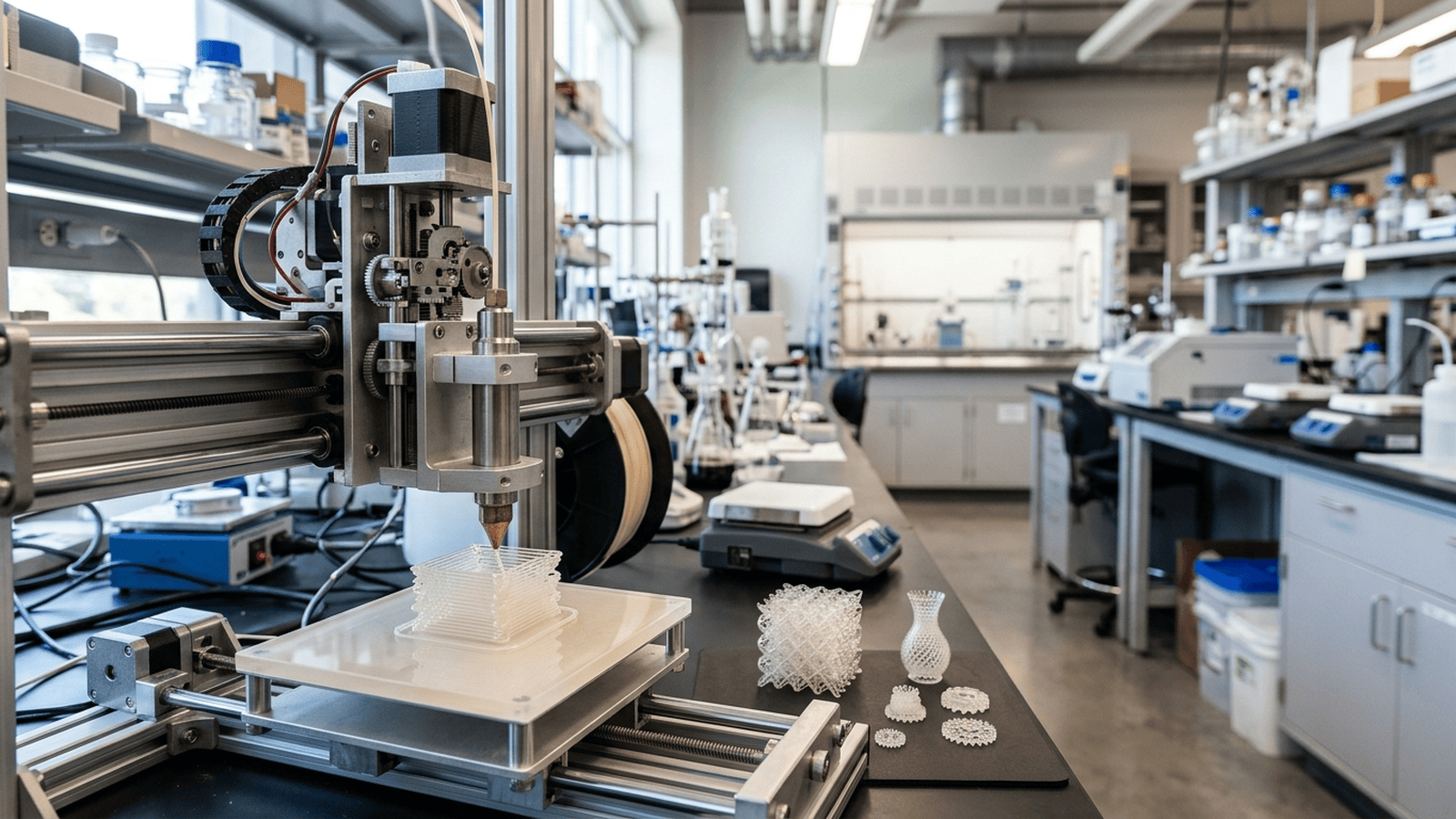
Lawrence Livermore National Laboratory researchers demonstrated a method for 3D-printing complex glass forms using silica-particle ink followed by heat treatment. The 2017 proof of concept could enable specialized components with intricate shapes, though shrinkage, defects and manufacturing scale remain challenges.
TLDR: Lawrence Livermore researchers printed silica-based ink into complex shapes and heated it to form glass. The 2017 demonstration suggested additive manufacturing could make specialized optical and scientific components that are difficult to shape conventionally. It remains a research-stage process requiring further work on shrinkage, quality and repeatability.
Researchers at Lawrence Livermore National Laboratory demonstrated a way to make complex glass shapes by printing a silica-based ink, then heating it until the particles fused. The work, published in 2017 in Advanced Materials, adapted direct ink writing, a technique that lays down material through a nozzle, to a substance that is usually melted and shaped at high temperatures. It offered a route to glass components with geometries difficult to produce using conventional methods. Because the nozzle follows a programmed path, designers can alter geometry without making a new mold. The ink must flow through the nozzle but hold its shape afterward.
The ink contains tiny silica particles suspended in a liquid. A computer-guided nozzle deposits it in successive lines and layers, building the desired form. The printed object is not yet solid glass: it is a fragile structure of particles and binder. Researchers remove the binder and heat the piece, allowing the silica to densify into glass. These steps are essential to the process, but they also cause the part to shrink and require careful control. The binder holds the wet structure together and supports fine details; its removal leaves a porous silica framework. Heating joins particles as the part contracts.
Glass is useful in optics, scientific instruments and communications because it can transmit light and withstand harsh conditions. Traditional glassmaking, however, generally involves melting material and forming it in a mold, or shaping it through processes such as grinding. Those approaches can limit the shapes that are practical to manufacture, especially when a part needs internal channels, curved features or a customized form. Printing could help produce such designs directly, rather than assembling them from multiple pieces. Internal passages can route fluids through compact devices, and tailored optical shapes may suit specific instruments. These benefits are most relevant to specialized parts.
The Livermore team’s demonstration addressed a central challenge: making a printable ink that holds its shape during construction while still producing a clear, uniform glass after heating. The researchers adjusted the ink’s composition and printing conditions, then used heat treatment to remove organic material and fuse the silica particles. They examined the resulting pieces for optical properties and structural quality. The method showed that additive manufacturing could be used for glass, though printed components still require post-processing and optimization. Pores, cracks or uneven density can scatter light or weaken a component. Assessment must therefore consider performance as well as the printed shape.
The approach is distinct from simply printing molten glass. Directly extruding very hot glass can expose equipment to extreme temperatures and make fine features difficult to control. With particle-based ink, the material is deposited at a lower temperature and converted into glass afterward. That separation gives researchers more flexibility over the printing stage, but introduces its own engineering demands: controlling drying, preventing defects, and predicting how much a design will contract during firing. Final dimensions must account for contraction, and repeatable drying and furnace conditions are important to avoid distortions between parts.
The result was a laboratory-scale manufacturing demonstration, not evidence that printed glass was ready to replace conventional production. Subsequent development would need to improve speed, repeatability, part size and optical performance, while establishing how well components survive use. Still, the work points toward making specialized glass components for applications where intricate geometry matters, including lenses, microfluidic devices and photonic systems. Further research can refine printable compositions and processing controls, helping determine which designs gain a genuine advantage from printing rather than established glassmaking. Practical adoption would also require dependable results across batches and a clear advantage over conventional fabrication in cost or capability.

Mason Reed serves as a Staff Writer for Just Right News, where he spearheads the Future Frontiers & Special Projects desk. In an era defined by rapid technological shifts and evolving social landscapes, Mason provides a steady, principled voice, examining the innovations of tomorrow through the lens of traditional American values. His work is most prominently featured in his signature series, “The Next Horizon,” where he explores the intersection of emerging technology, national sovereignty, and the preservation of individual liberty.
A native of San Diego, California, Mason’s worldview was shaped by the unique culture of his hometown. Growing up in a region defined by its strong military presence and its history of maritime industry, he developed a deep-seated respect for the institutions that provide national stability and the entrepreneurial spirit that drives the American economy. This upbringing instilled in him a belief that true progress is not found in discarding the past, but in building upon a foundation of proven principles. His reporting often reflects this San Diego influence, emphasizing the importance of a robust national defense and the necessity of maintaining a competitive edge in the global marketplace.
Now based in San Francisco, Mason operates from the heart of the world’s technological engine. Living and working in the Bay Area provides him with a front-row seat to the advancements—and the ideological challenges—emanating from Silicon Valley. While many in the region embrace a “move fast and break things” mentality, Mason’s reporting serves as a vital counterweight. He offers Just Right News readers a “boots on the ground” perspective, documenting how radical local policies and the concentration of tech power impact the everyday lives of citizens. His proximity to the industry allows him to cut through the marketing jargon of big tech to uncover the real-world implications for privacy, free speech, and the nuclear family.
In his “Future Frontiers” beat, Mason tackles complex subjects ranging from the ethics of artificial intelligence to the burgeoning private space race. He approaches these topics with a healthy skepticism toward centralized bureaucracy, championing instead the decentralized innovations that empower individuals. Through “The Next Horizon,” he highlights the pioneers and thinkers who are working to ensure that the future remains a place where human dignity and constitutional rights are protected. He believes that the rapid pace of change requires more than just technical expertise; it requires a moral compass rooted in the Western tradition.
Throughout his tenure at Just Right News, Mason has remained committed to the idea that the future is something to be shaped, not merely accepted. His writing is characterized by a rigorous defense of American exceptionalism and a belief that the country’s best days lie ahead, provided it remains true to its founding ideals. Whether he is investigating the impact of automation on the American workforce or profiling the next generation of aerospace engineers, Mason Reed ensures that his readers are equipped with the insights they need to navigate a changing world with confidence and clarity.