

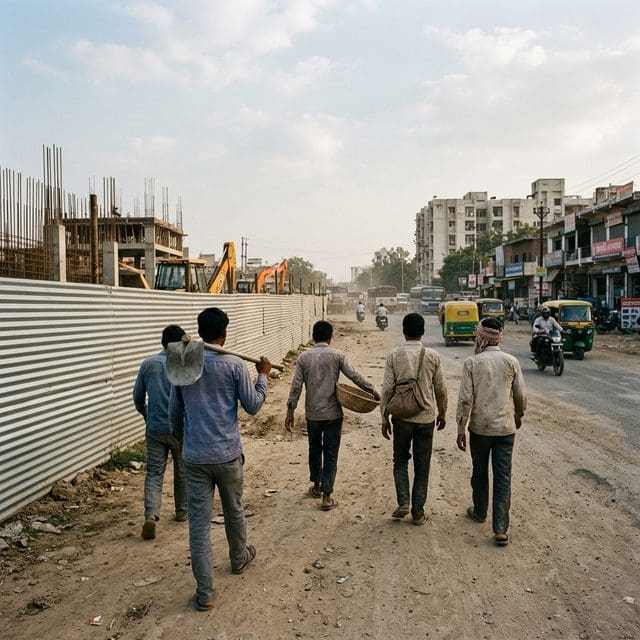
A study using RBI KLEMS data finds that many rural agricultural workers who moved into urban work entered low-productivity, informal sectors rather than more productive formal employment.
For many rural agricultural workers in India, leaving farming has not meant stepping into productive formal employment. A study reported by The Hindu on October 5 finds that most workers who moved out of agriculture over the past 25 years entered low-productivity, informal urban work, including jobs in restaurants, construction and transport.
The finding distinguishes migration from economic advancement. Workers moved from rural areas and farm labor into non-farm activities in cities, but that change did not necessarily improve job quality or productivity. The report describes an employment transition, not simply rural-to-urban migration: the crucial question is what work people found after leaving agriculture.
The material provided does not give wage estimates, so it cannot establish how much workers earned before or after the transition. It also does not quantify the share who found formal jobs or compare conditions across the sectors cited. Its central finding is that most workers studied entered informal, low-productivity urban work rather than more productive formal employment.
That distinction matters when judging whether a changing economy is creating better work or merely shifting workers between sectors. Employment totals can show that people are working outside agriculture, but not whether their jobs are productive or provide a dependable livelihood. The study, as summarized, does not measure specific wages, benefits, protections or hours.
The analysis uses the Reserve Bank of India’s KLEMS database, which tracks employment and labor quality across sectors. Its estimates distinguish rural male, rural female, urban male and urban female workers. KLEMS also includes a labor-quality index based on five education categories, alongside estimates of the number of people employed. Those measures can help researchers examine changes in workforce composition and labor quality, but they do not by themselves establish that an individual worker’s earnings rose or that a particular job is secure.
The RBI methodology combines official sources, including National Accounts Statistics, the Annual Survey of Industries, NSSO surveys and the Periodic Labour Force Survey. Because survey observations are not available for every year, intervening estimates are interpolated using assumptions. The series is centered on October to align with the financial year. The RBI’s methodology therefore supports long-run comparisons, while requiring care in interpreting years between survey benchmarks.
The conclusion challenges the idea that labor moving out of agriculture is, by itself, evidence of broad-based development. A move from farm work into a city job can be a major household transition, but the gains depend on the work available and whether it offers a more productive livelihood. Restaurants, construction and transport include varied jobs; the available report does not break down employment conditions within those sectors.
The material also does not establish the most recent trends or assess how automation or immigration affected the workers in the study. Those questions require separate evidence. The broader test is not simply whether workers leave agriculture, but whether they gain access to more productive employment and a dependable source of income. In the transition described by The Hindu, that upgrade did not reach most of the rural agricultural workers studied.

Tom Blake serves as the Senior Correspondent for Labor, Wages, and Automation at Just Right News, where he brings a grounded, principled perspective to the most pressing economic issues facing the American heartland. As the lead voice behind the acclaimed feature series “The Price of Work,” Tom focuses his reporting on the intersection of traditional industry and the rapidly evolving technological landscape, always prioritizing the dignity of the individual worker and the health of the American family.
Tom’s deep understanding of the labor market is not merely academic; it is rooted in his upbringing in Detroit, Michigan. Growing up in the shadow of the automotive industry, he witnessed firsthand the triumphs and tribulations of the American blue-collar workforce. He saw how the stability of a manufacturing job could build a community and, conversely, how the erosion of those industries could tear the social fabric apart. This background instilled in him a lifelong respect for the trades and a healthy skepticism toward economic policies that prioritize globalist interests over the well-being of local communities.
Now based in Pittsburgh, Pennsylvania, Tom continues to report from the front lines of the shifting economy. Pittsburgh, a city that has reinvented itself while maintaining its gritty, industrious spirit, provides the perfect vantage point for his beat. From the steel mills that remain to the high-tech robotics labs reshaping the city’s future, Tom explores how automation is changing the nature of employment. His reporting often highlights the tension between innovation and tradition, arguing that while progress is inevitable, it must not come at the expense of the American worker’s ability to provide for their family through honest, meaningful labor.
In his role at Just Right News, Tom has become a vital voice for those who feel overlooked by mainstream economic coverage. He rejects the notion that the decline of American manufacturing is an unavoidable casualty of the modern era. Instead, his work often examines how regulatory overreach, rising energy costs, and the unchecked rise of automation impact the take-home pay of everyday citizens. Through “The Price of Work,” Tom delves into the true cost of economic shifts, looking beyond the raw data to tell the stories of the people behind the statistics.
Tom’s reporting is characterized by a commitment to the conservative values of self-reliance, fiscal responsibility, and the preservation of the American dream. He believes that a strong nation is built on a foundation of stable jobs and fair wages, and his work seeks to hold both government and corporate entities accountable to that standard. Whether he is interviewing a shop floor manager about the implementation of new AI technology or analyzing the impact of wage inflation on small businesses, Tom provides a clear-eyed analysis that resonates with readers who value hard work and common sense.
Through his dedicated coverage, Tom Blake remains a steadfast advocate for the American workforce, ensuring that the voices of those in the industrial heartland are heard loud and clear in the national conversation. His perspective is essential for anyone seeking to understand the complex realities of labor and automation in the twenty-first century.