

Thousands marched across Spain after lawmakers rejected proposed tenant protections, as rising rents and housing insecurity intensify debate over who can afford to live in the country’s cities.
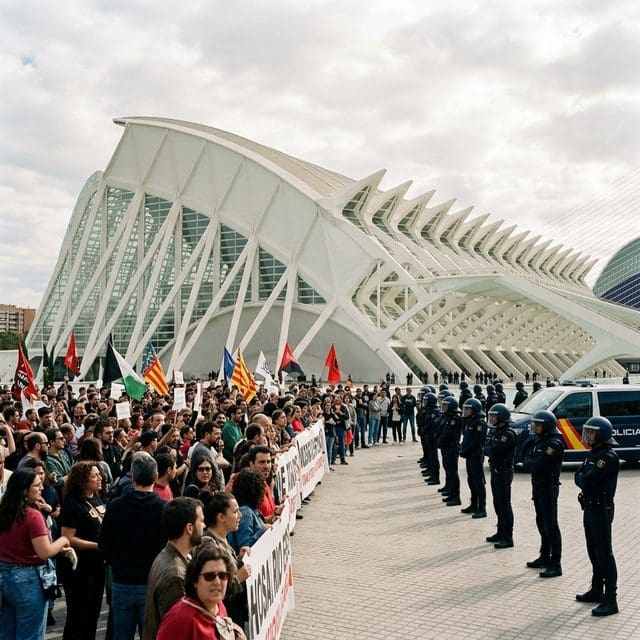
Tens of thousands of people marched in roughly 50 Spanish cities on Oct. 3 after parliament rejected two proposed housing decrees. The demonstrations reflected a widening dispute over rent, tenant protections and the difficulty of securing affordable homes in urban areas.
In Valencia, police used tear gas, rubber bullets and batons after about 30 protesters entered the City of Arts and Sciences during the Valencia Real Estate Summit, The Independent reported. At least five people were detained and nine police officers injured. The Independent also published footage of clashes near the complex. Demonstrations elsewhere were largely peaceful, according to the reports.
The rejected measures would have included protections against evicting vulnerable tenants, restrictions on property speculation and rental contracts that renew automatically or continue indefinitely. Protesters are also calling for a 50% rent reduction, open-ended leases and action against investment funds. Reuters reported about 70,000 people protested in Madrid.
The figures help explain the urgency behind the demonstrations. Spain’s average rent rose from €8.20 per square metre in 2016 to €15.10 in 2026, nearly doubling in a decade, The Associated Press reported. About 26% of renters spend an average of 40% of their income on rent and utilities, compared with 18% across the European Union.
Those costs leave households with less money for other needs and can make it harder for residents to stay near work and local services. But the available reports do not establish how the rejected measures would have affected rents, investment or the supply of homes. They also provide no forecast for the rent cuts protesters demand. The figures document a significant affordability problem, but do not resolve which policy would bring lasting relief.
Housing insecurity has also drawn attention in Madrid’s Puerta del Sol, where about 1,000 activists had camped for the preceding week, AP reported. The encampment followed the Sept. 23 eviction of 87-year-old María del Carmen Abascal. A similar camp formed in Barcelona. The case has become a focal point for campaigners concerned about displacement and the security of tenants.
Spain’s Tenants’ Union said it may pursue a general strike after talks with labor unions, Reuters reported. No strike has been announced in the available material; the union’s statement signals a possible escalation, not a confirmed walkout.
Parliament rejected the decrees, and protesters are pressing for stronger protections and lower rents. Whether their demands lead to new legislation remains uncertain. For households facing rising housing costs, the test will be whether political decisions can improve affordability while accounting for housing availability and the consequences of regulation. The clashes in Valencia show the intensity of the dispute, but do not settle which measures can deliver durable relief.

Deborah Cole serves as a Senior Correspondent for Just Right News, where she spearheads the network’s coverage of Housing, Infrastructure, and Mobility. With a career defined by a commitment to rigorous reporting and a focus on the fundamental pillars of American community life, Deborah brings a principled perspective to the complex issues that dictate how and where we live. Her work is grounded in the belief that sound policy, fiscal responsibility, and respect for private property are the essential foundations of a prosperous society.
Originally from Boston, Massachusetts, Deborah’s upbringing in one of the nation’s oldest and most historically significant cities deeply influenced her professional trajectory. Growing up amidst the architectural legacy and dense urban planning of New England, she developed an early appreciation for the importance of durable infrastructure and the role of local tradition in shaping neighborhoods. Her perspective is informed by the classic American values of her hometown—hard work, community cohesion, and a healthy skepticism of top-down bureaucratic mandates that often overlook the unique needs of individual citizens.
Today, Deborah operates from her base in Austin, Texas, a city that serves as a primary laboratory for her reporting. Austin’s rapid expansion and its status as a hub for innovation and migration provide her with a front-row seat to the most pressing challenges in modern infrastructure and housing. From the Lone Star State, she chronicles the tensions between rapid growth and the preservation of the American Dream, often highlighting how market-driven solutions and deregulation can address the housing shortages that plague many of the country’s metropolitan areas.
At Just Right News, Deborah is perhaps best known for her signature feature series, “Where We Live.” Through this platform, she explores the intersection of public policy and private life, moving beyond mere statistics to tell the stories of families, small business owners, and local developers. Her reporting frequently highlights the importance of mobility—not just in terms of transportation and transit, but as a vehicle for economic opportunity and social stability. She remains a staunch advocate for the taxpayer, consistently scrutinizing government spending on large-scale projects and advocating for transparency in how infrastructure dollars are allocated.
Deborah’s beat is more than just a collection of policy topics; it is an investigation into the physical and legal structures that allow families to flourish. Whether she is reporting on the impact of zoning laws on suburban development or the necessity of maintaining the nation’s highway systems, her work is characterized by a dedication to the facts and a respect for the constitutional principles that protect the rights of homeowners.
As a Senior Correspondent, Deborah Cole continues to be a vital voice for Just Right News, providing the audience with the clarity and context needed to navigate an ever-changing landscape. Her reporting ensures that the values of individual liberty and local sovereignty remain at the forefront of the national conversation regarding the future of our cities and towns. Through her tireless efforts, she remains committed to informing the public on the issues that hit closest to home.