

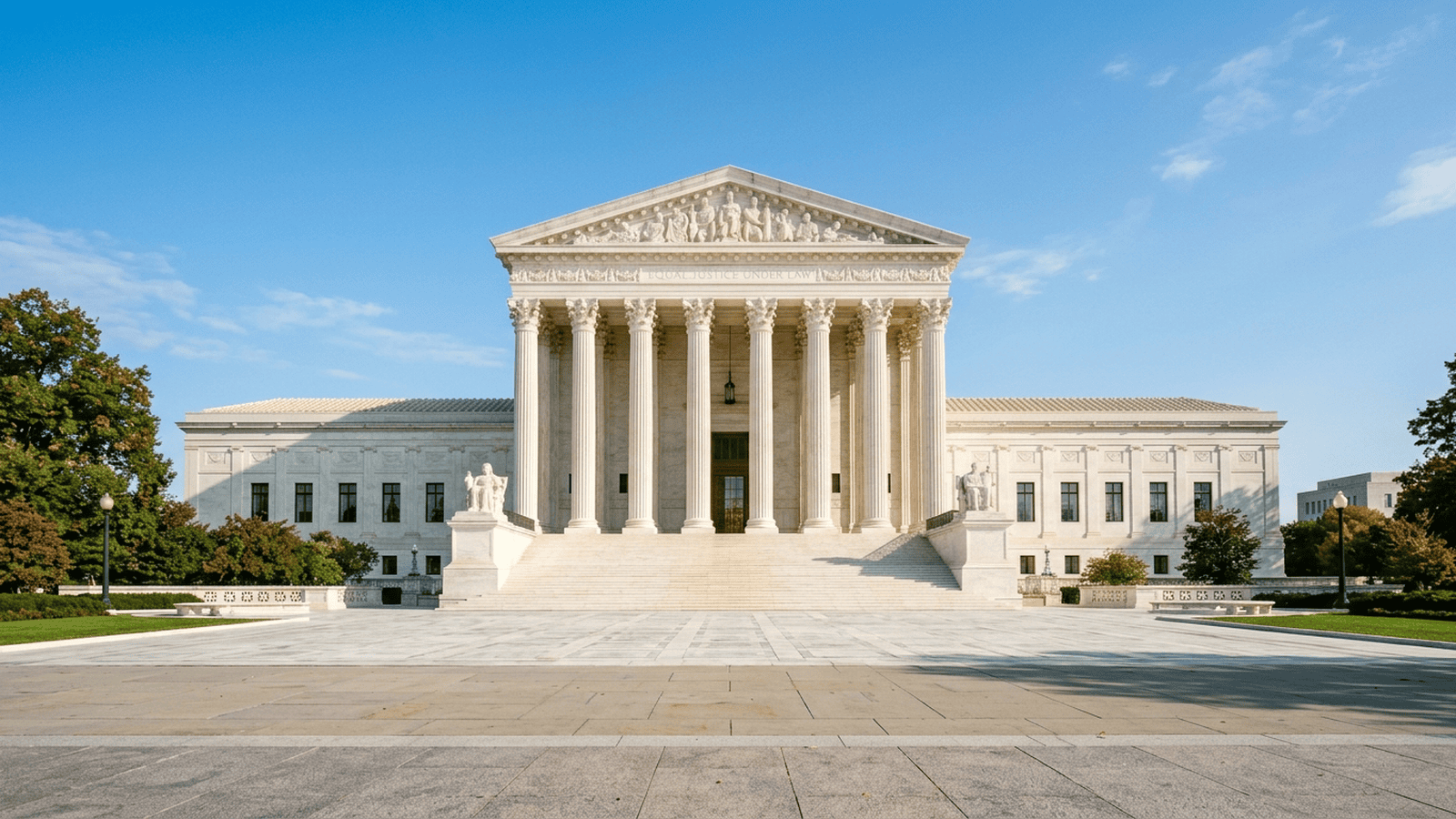
The Supreme Court’s new term opens with cases involving climate-related lawsuits, gun restrictions, immigration enforcement, Arizona voting rules and religious schools in Colorado. Energy companies are challenging dozens of lawsuits over disaster costs, while the Trump administration argues the litigation is an effort to impose emissions rules. The justices will consider immigration policies involving transfers to third countries and mandatory detention without bond hearings. December arguments are set for disputes over gun laws and Arizona’s citizenship requirements for voter registration, while the preschool case is scheduled for November. The rulings could affect government authority, individual rights, local costs and access to public programs, though the excerpt does not specify outcomes or most implementation details.
TLDR: The court’s new term will weigh disputes over climate liability, immigration enforcement, voter registration, gun restrictions and religious schools. Hearings scheduled for November and December will examine policies with consequences for public costs, constitutional rights and government authority.
The Supreme Court begins its new term Monday with major disputes over climate change, religious rights, immigration, gun laws and voting rules. The cases will test the reach of government authority and the limits of individual rights in several areas. The court’s conservative majority has expanded gun rights in recent years, while challenges involving the Trump administration’s immigration policies will also come before the justices.
The stated reason for the cases is to resolve legal disputes already moving through the courts. The excerpt does not give one broad official rationale for the term’s agenda. It describes questions about who may be held liable for climate-related damage, how immigration enforcement may proceed, and whether state rules affecting guns, voting and religious schools can stand.
The term opens with an appeal by energy companies seeking to block dozens of lawsuits over damage linked to climate change. The case comes from Boulder, Colorado, where local officials say the industry should help pay the rising costs of disasters they link to climate change. Billions of dollars are potentially at stake. Suncor and ExxonMobil argue that lawsuits are not the right way to address a global issue, and the Trump administration backs them, saying the litigation is a power grab intended to impose emissions rules.
The dispute puts local governments’ claims about disaster costs against companies’ objections to being held liable in court. The justices will decide whether the lawsuits can proceed. The excerpt does not provide a date for arguments or describe any filing fees, compliance forms or enforcement steps tied to the case. The immediate issue is whether the lawsuits remain available as a way to seek payment from energy companies.
Gun rights will be before the court in a case to be considered in December. About a dozen states have prohibited semiautomatic rifles such as AR-15s. Those states say the weapons are disproportionately used in mass shootings and that bans help reduce gun violence. Challengers argue that the laws violate the Second Amendment and that AR-15s and similar weapons are among the most popular and commonly owned guns in the country.
The case will place public-safety claims against challenges grounded in the constitutional right to bear arms. Four justices had signaled that the court would eventually take up the issue. The new case follows several years in which the conservative-majority court expanded gun rights. The excerpt does not identify a specific state law under review or state what enforcement changes would follow from the court’s ruling.
Immigration cases will examine two parts of the Trump administration’s broad enforcement effort. One concerns migrants who cannot be quickly returned to their home countries. The administration has sent thousands of people to other countries where they have no ties under agreements that are often secret. The Supreme Court will consider overturning lower-court orders that give migrants a chance to object; the justices have allowed the flights to continue in the meantime.
The second case concerns mandatory detention for immigrants living in the United States illegally, including people who have been in the country for years. The administration argues that it can hold them without bond hearings. Most appeals courts that have considered the issue disagree. The cases raise direct questions about enforcement authority and the opportunity for affected people to challenge government action, but the excerpt does not provide a timetable for final rulings or details about detention procedures beyond the bond-hearing dispute.
Voting rules in Arizona are also on the court’s agenda. One measure requires people registering to vote with a state form to show proof of citizenship. Another calls for regular purges of voter rolls when citizenship cannot be confirmed. The dispute comes after Trump failed to get congressional legislation requiring documentary proof of citizenship for voter registration. Arguments are set for December. The requirements would add a proof-of-citizenship step and scheduled reviews of voter records; the excerpt does not specify the documents accepted or how voters would be notified before removal.
In November, the justices will hear a case involving Catholic preschools excluded from Colorado’s taxpayer-funded universal preschool program. St. Mary Catholic Parish says the state left it out because its faith-based admissions policies exclude children from LGBTQ+ families. Colorado says religious schools may participate if they follow nondiscrimination laws. Voters created the program through a 2020 ballot measure, and it provides public funding for preschool at schools selected by parents.
The practical effects vary by case. Energy companies face lawsuits that could involve billions of dollars; Arizona’s rules call for citizenship proof and regular voter-roll reviews; and immigration enforcement includes transfers abroad and detention without bond hearings under policies now being challenged. The excerpt gives no fees, new forms beyond Arizona’s state registration form, or compliance deadlines for most cases. The court’s next steps include December arguments on the gun and voting disputes and a November hearing on the preschool case. Those proceedings and the court’s review of the immigration and climate disputes will determine what rules remain in force.

Lisa Grant serves as a Staff Writer for Just Right News, where she spearheads the publication’s coverage of Technology, Data Capitalism, and Surveillance. With a focus on the encroaching influence of Big Tech on the American way of life, Grant brings a critical, liberty-minded perspective to the most complex digital issues of the modern era. Her reporting is defined by a deep-seated skepticism of centralized power and a commitment to protecting the privacy and autonomy of the individual against the rising tide of what she calls the “Algorithmic State.”
Grant’s unique insight into the tech industry is rooted in her upbringing in Palo Alto, California. Growing up in the epicenter of Silicon Valley, she witnessed firsthand the transformation of the technology sector from a hub of scrappy, freedom-loving innovators into a landscape dominated by monolithic corporations. This proximity to the birth of the digital revolution provided her with an insider’s understanding of the culture and motivations driving the industry. For Grant, the shift toward data capitalism—where personal information is harvested as a primary commodity—is not just a market evolution, but a fundamental challenge to traditional American values of property rights and personal privacy. She saw the “garage startup” ethos replaced by a culture of data-mining and social engineering, a transition that informs her vigilant reporting today.
Now based in Seattle, Washington, Grant operates from another of the nation’s primary technological frontiers. Her location in the Pacific Northwest allows her to observe the real-world consequences of the tech industry’s expansion, from the implementation of invasive surveillance technologies in urban centers to the growing partnership between corporate entities and municipal governance. By reporting from the ground in Seattle, she bridges the gap between the abstract world of coding and the tangible impact it has on citizens’ daily lives, often highlighting how local policies serve as a testing ground for broader national surveillance initiatives.
At the heart of her work for Just Right News is her acclaimed feature series, “The Algorithmic State.” Through this series, Grant explores the ways in which automated systems and artificial intelligence are increasingly used to bypass traditional legislative processes and social norms. She argues that the reliance on opaque algorithms to manage society threatens to erode the transparency and accountability essential to a free republic. Her work meticulously documents how data-driven governance can lead to a “soft” surveillance state that penalizes traditional viewpoints and rewards digital conformity.
Grant’s reporting is a vital resource for readers who are wary of the “nanny state” and the unchecked power of digital gatekeepers. She views the defense of the digital frontier as the next great battle for constitutional conservatives. By exposing the mechanisms of data capitalism and the quiet expansion of surveillance networks, she empowers her audience to reclaim their digital sovereignty. In an era where information is often weaponized by those in power, Lisa Grant remains a steadfast advocate for the truth, ensuring that the principles of liberty and individual agency are not lost in the transition to an increasingly digital world.