

Trump’s push for permanent daylight saving time collides with Senate vote math, while a press-access lawsuit and a tight Ohio race test both parties.
President Donald Trump has turned a dispute over the clock into a public test of his influence over Republican senators. On October 3, he posted what he said was Sen. Tom Cotton’s phone number on Truth Social and urged supporters to press the Arkansas Republican to back permanent daylight saving time, according to reports by Reuters and other outlets.
The Sunshine Protection Act would end the twice-yearly clock change by keeping the country on daylight saving time year-round. The House passed the bill 308–117 in July, but the Senate has not scheduled debate. Majority Leader John Thune has questioned whether it can reach the 60 votes needed to advance. Sen. John Kennedy has called the measure “dead as disco.”
Cotton opposes permanent daylight time, arguing it would leave children, farmers and other early risers in winter darkness. The immediate deadline is November 1, when clocks are scheduled to return to standard time. Trump’s public pressure may raise the issue’s profile, but it does not change the Senate’s procedural hurdle or establish that the bill has the votes. The House’s large margin is no substitute for a Senate coalition.
The post also puts political conduct alongside the policy debate. Trump made a senator’s contact information part of a presidential appeal, urging supporters to contact a member of his own party. The available reporting establishes the post and appeal; it does not show that Cotton has changed his position or that Thune will schedule a vote.
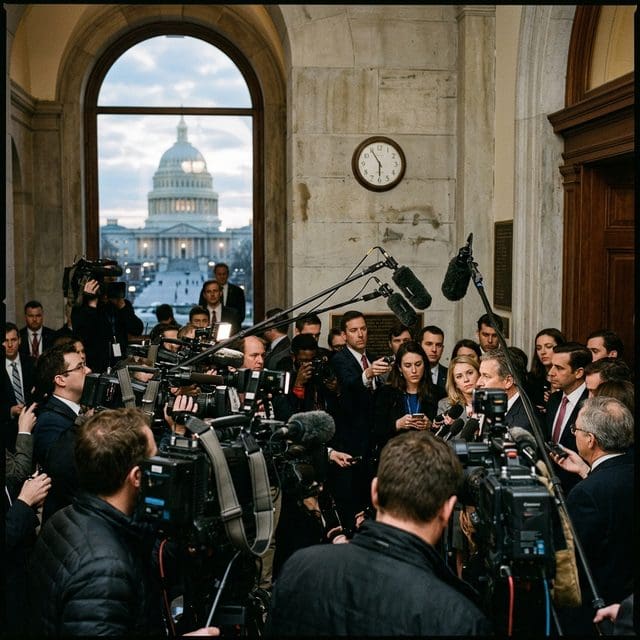
A separate test of executive authority is unfolding in federal court. Late October 2, the Justice Department asked a judge for authority to reinstate the White House ban on CNN, MS NOW and Politico. Judge Timothy Kelly’s temporary order restoring access is due to expire around October 8, when a hearing is scheduled on the outlets’ request for a preliminary injunction.
The administration argues that presidents have discretion over which journalists receive privileged access. The outlets contend the restrictions were retaliation for coverage the White House disliked and violate the First Amendment. The dispute concerns not only press passes but the legal limits on executive control of access to the White House complex.
Reports that CNN remains barred from Air Force One and travel-pool duties raise a separate enforcement issue, even as complex access has been restored under the temporary order. The court’s next decision could clarify the reach of presidential authority, but the case remains unresolved. Neither the government’s assertion of discretion nor the outlets’ constitutional claim is a final ruling.
In Ohio, the Senate contest between Republican Jon Husted and Democrat Sherrod Brown offers another measure of the political climate. A New York Times/Siena poll conducted September 22 through October 1 found Brown ahead 49% to 46%. An InsiderAdvantage survey from September 28–29 put him ahead 44% to 43%. Both show a close race; neither determines the outcome.
Husted, appointed to the Senate in 2025, ran unopposed in his primary. Brown won the Democratic primary by nearly 80 percentage points. Ohio is one of eight competitive Senate races as Republicans seek to retain a narrow congressional majority. The polls do not explain why either candidate is ahead, but the contest gives both parties a test of voter support in a consequential state.
The three developments illustrate different constraints on political power. A president can amplify a policy dispute but cannot supply Senate votes. An administration can assert control over press access, but courts must assess the legal claims. And polling offers a snapshot, not a verdict: the Ohio result will ultimately depend on voters.

Miles Harrington serves as the Senior Correspondent for Federal Systems & Executive Power at Just Right News, where he brings a disciplined, constitutionalist lens to the inner workings of the American government. With a focus on the mechanics of the federal bureaucracy and the limits of executive authority, Harrington has established himself as a vital voice for readers who value transparency, accountability, and the preservation of the separation of powers.
A native of Richmond, Virginia, Harrington’s perspective is deeply rooted in the traditions of the Old Dominion. Growing up in a city defined by its historical significance and its role as a center of American jurisprudence, he developed an early appreciation for the foundational principles of the Republic. His upbringing in Richmond—a place where the legacy of the Founding Fathers is woven into the landscape—instilled in him a belief that the federal government should remain within its constitutional bounds. This background informs his skepticism of centralized overreach and his commitment to reporting on the ways in which the administrative state impacts the lives of everyday citizens.
In his current role, Harrington specializes in the complexities of federal systems. He doesn’t just report on the headlines of the day; he digs into the structural shifts within the executive branch that often go unnoticed by the mainstream press. Whether he is analyzing the implications of a new federal regulation or investigating the expansion of agency jurisdiction, his work is characterized by a rigorous adherence to the facts and a dedication to the rule of law.
Harrington is perhaps best known for his signature feature series, “How Washington Works.” Through this ongoing project, he demystifies the often-opaque processes of the nation’s capital, pulling back the curtain on the “Deep State” and the unelected officials who wield significant influence over national policy. By breaking down complex legislative maneuvers and executive orders, he empowers Just Right News readers to understand the true levers of power in Washington. His reporting serves as a necessary check on the federal government, ensuring that the actions of those in power are held up to the light of public scrutiny.
Now based in Washington, D.C., Harrington operates at the epicenter of the political world, yet he remains intentionally distanced from the “Beltway bubble.” His proximity to the halls of power allows him to maintain a robust network of sources across the federal landscape, but his heart remains in the principled conservatism of his Virginia roots. He views his role not merely as a reporter, but as a steward of the public trust, dedicated to providing the clarity and context that conservative voters need to navigate an increasingly complex political environment.
Through his sharp analysis and unwavering commitment to the truth, Miles Harrington continues to be a cornerstone of the Just Right News team. His work ensures that the principles of limited government and executive restraint remain at the forefront of the national conversation, providing a crucial service to those who believe in a government that is truly of, by, and for the people.