

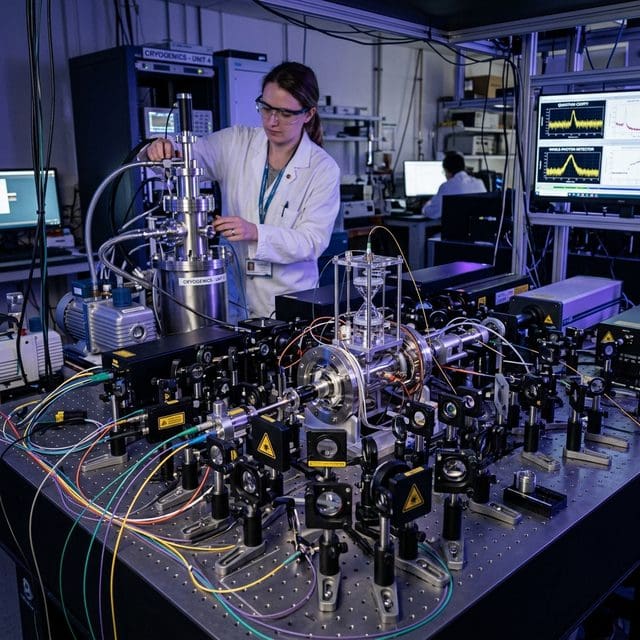
Researchers at the University of Basel and CERN achieve milestones in photon indistinguishability and particle entanglement, signaling a new era for secure communication and quantum computing.
A series of breakthroughs in quantum physics this week has brought the prospect of a secure, decentralized quantum internet closer to reality. Researchers at the University of Basel, Paderborn University, and Ruhr University Bochum reported a significant leap in quantum communication efficiency. By placing semiconductor quantum dots within an optical cavity, the team achieved a 90% rate of photon indistinguishability, a sharp increase from the previous 60% standard. This advancement, published in Physical Review Letters, demonstrates that by controlling the decay of biexcitons—bound states of two excitons—scientists can drastically reduce timing jitter.
Indistinguishable photons are the essential currency of quantum interference and entanglement. Without them, the optical networks required for secure, unhackable communication remain theoretical. This precision is vital for maintaining the integrity of quantum information as it travels across networks, ensuring that individual liberty and privacy are protected by the laws of physics rather than the whims of centralized service providers.
Parallel to these developments, the quest for stable quantum computing has turned toward exotic states of matter. A new design proposal from the University of Surrey suggests utilizing superfluid helium-3 to create qubits. This Superfluid Helium Oscillator Quantum (SHOQ) device aims to shield quantum information from the electromagnetic noise that plagues current superconducting systems. Theoretical estimates suggest this architecture could reduce error rates by a factor of 100, potentially overcoming the greatest technical hurdle to functional, large-scale quantum processors. While this remains a design proposal, it represents a significant shift in how engineers approach the problem of decoherence.
In the realm of particle physics, the ATLAS and CMS collaborations at CERN have provided strong evidence for quantum entanglement between Z bosons. While entanglement is well-documented in photons, observing it in massive elementary particles created during high-energy collisions at the Large Hadron Collider probes the foundations of quantum mechanics under extreme conditions. This discovery confirms that the strange properties of quantum mechanics apply even to the heaviest building blocks of our universe, establishing the Higgs and Z-boson sectors as new laboratories for studying quantum information.
Furthermore, scientists at the University of Chicago have observed a unique state in the magnetic compound Fe₅GeTe₂, where electrons move collectively at unusually low speeds while maintaining quantum coherence. This discovery challenges traditional understanding of magnetic materials and could lead to highly sensitive quantum sensors. The behavior suggests a new form of correlated quantum matter that links collective magnetic behavior with coherent electronic dynamics.
These discoveries arrive as the private sector grapples with immediate constraints. Micron CEO recently noted that memory chip shortages are expected to continue through 2028, with prices in 2027 likely to exceed current levels. This scarcity highlights the importance of developing new computing architectures, such as the SHOQ device or optical quantum systems, which could eventually bypass the limitations of traditional silicon hardware. As SpaceX expands its orbital infrastructure with next-generation Starlink satellites, the integration of quantum-secure communication protocols will become a matter of national sovereignty and individual security. The convergence of particle physics and aerospace engineering suggests the next decade will be defined by how we harness these fundamental forces to preserve decentralized innovation.

Mason Reed serves as a Staff Writer for Just Right News, where he spearheads the Future Frontiers & Special Projects desk. In an era defined by rapid technological shifts and evolving social landscapes, Mason provides a steady, principled voice, examining the innovations of tomorrow through the lens of traditional American values. His work is most prominently featured in his signature series, “The Next Horizon,” where he explores the intersection of emerging technology, national sovereignty, and the preservation of individual liberty.
A native of San Diego, California, Mason’s worldview was shaped by the unique culture of his hometown. Growing up in a region defined by its strong military presence and its history of maritime industry, he developed a deep-seated respect for the institutions that provide national stability and the entrepreneurial spirit that drives the American economy. This upbringing instilled in him a belief that true progress is not found in discarding the past, but in building upon a foundation of proven principles. His reporting often reflects this San Diego influence, emphasizing the importance of a robust national defense and the necessity of maintaining a competitive edge in the global marketplace.
Now based in San Francisco, Mason operates from the heart of the world’s technological engine. Living and working in the Bay Area provides him with a front-row seat to the advancements—and the ideological challenges—emanating from Silicon Valley. While many in the region embrace a “move fast and break things” mentality, Mason’s reporting serves as a vital counterweight. He offers Just Right News readers a “boots on the ground” perspective, documenting how radical local policies and the concentration of tech power impact the everyday lives of citizens. His proximity to the industry allows him to cut through the marketing jargon of big tech to uncover the real-world implications for privacy, free speech, and the nuclear family.
In his “Future Frontiers” beat, Mason tackles complex subjects ranging from the ethics of artificial intelligence to the burgeoning private space race. He approaches these topics with a healthy skepticism toward centralized bureaucracy, championing instead the decentralized innovations that empower individuals. Through “The Next Horizon,” he highlights the pioneers and thinkers who are working to ensure that the future remains a place where human dignity and constitutional rights are protected. He believes that the rapid pace of change requires more than just technical expertise; it requires a moral compass rooted in the Western tradition.
Throughout his tenure at Just Right News, Mason has remained committed to the idea that the future is something to be shaped, not merely accepted. His writing is characterized by a rigorous defense of American exceptionalism and a belief that the country’s best days lie ahead, provided it remains true to its founding ideals. Whether he is investigating the impact of automation on the American workforce or profiling the next generation of aerospace engineers, Mason Reed ensures that his readers are equipped with the insights they need to navigate a changing world with confidence and clarity.