

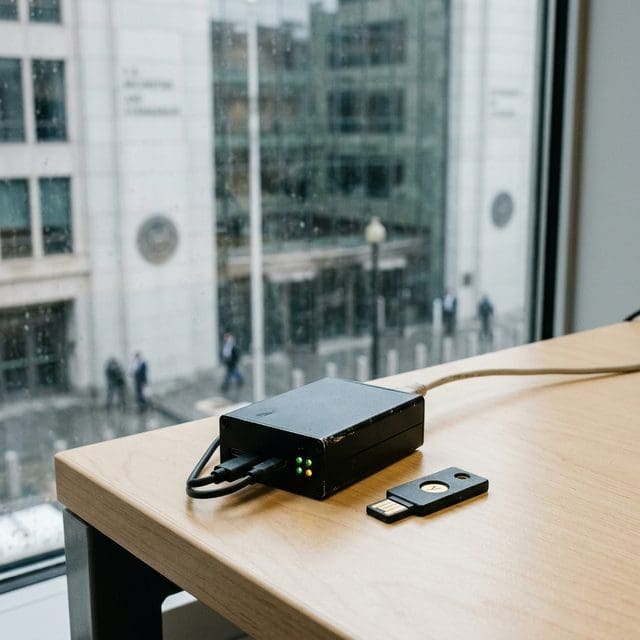
The SEC’s proposed custody rules are the week’s clearest institutional infrastructure development, while Bitcoin’s core protocol remains unchanged and a reported Lightning patch highlights operational risks.
The week’s most consequential Bitcoin infrastructure development came from Washington, not the protocol layer. On October 1, the U.S. Securities and Exchange Commission proposed crypto-specific custody rules for registered investment advisers, investment companies and business development companies. The proposal would permit conditional self-custody by advisers and allow state-chartered trust companies to custody crypto assets for clients and regulated funds.
SEC Chair Paul Atkins said the proposal is intended to replace uncertainty under legacy custody rules with a compliant path for advisers and funds holding digital assets. Commissioner Hester Peirce clarified that “self-custody” in the proposal refers to an adviser holding client assets; it does not mean investors directly holding their own coins. Public comments are due within 60 days after the proposal is published in the Federal Register.
The rules remain a proposal, not a settled framework. But custody is a practical barrier for institutions considering Bitcoin: who controls the keys, how assets are safeguarded, and which entities can qualify as custodians. A defined regulatory route could give funds and advisers more options without changing Bitcoin’s code or its decentralized validation model. The proposal arrives as comprehensive legislation remains uncertain.
There was no major Bitcoin consensus change, protocol upgrade or base-layer engineering development identified in the available October 2–3 reporting. That distinction matters: changes in custody rules affect how regulated institutions hold Bitcoin, but they do not alter the network’s transaction rules or give a government or custodian control over the protocol.
Separate reporting from Cryptopolitan said Core Lightning warned on October 2 that attackers were targeting nodes running version 26.06.7 or older. Operators were urged to upgrade to version 26.06.8, released September 22, which the report said addressed issues involving crashes, memory exhaustion and channel-closing behavior that could expose funds to loss. The reported risk concerns Lightning nodes and off-chain payment channels, not a failure of Bitcoin’s base-layer consensus. Node operators should consult Core Lightning’s own release and security notices before acting on third-party reporting.
Institutional flows provided another measure of activity, though they are not a protocol signal. U.S. spot Bitcoin ETFs recorded $102.7 million in net inflows on October 1, reversing $148.7 million of outflows the previous day. Cumulative net inflows stood at about $57.6 billion, with combined assets near $109.3 billion. Preliminary trackers put October 2 inflows between roughly $31.7 million and $32.1 million, led by about $29.3 million for Fidelity’s FBTC; those figures remain provisional pending final issuer-based data.
The macro backdrop was unsettled. Revisions erased 60,000 jobs from previously reported July and August totals, and July shifted from a reported gain to a loss. Yet market expectations for Federal Reserve policy moved sharply: CME FedWatch put the chance of an October 27–28 rate hike near 13% on October 2, down from about 69% a week earlier, while CNBC’s contemporaneous reading showed an 82.8% probability of no change. CoinDesk reported that Bitcoin’s initial move above $87,000 reversed as Treasury yields rebounded, illustrating that weaker labor data did not translate into a sustained risk-asset bid.
For Bitcoin’s engineering trajectory, this was a week of institutional plumbing and operational vigilance rather than a change to the network itself. The SEC proposal may shape how regulated capital holds digital assets; the Lightning report, if confirmed by project advisories, is a reminder that higher-layer systems require timely maintenance even when the base protocol is untouched.

Ryan Mitchell serves as a Staff Writer for Just Right News, where he anchors the desk for Cyber, Technology Policy, and Digital Sovereignty. In an era where the digital landscape has become as much a battlefield as any physical territory, Ryan provides a critical conservative lens on the forces shaping the future of American innovation and national security. His work is defined by a commitment to the idea that American leadership in the digital age is not just a matter of economic success, but a necessity for the preservation of global liberty.
Born and raised in Austin, Texas, Ryan’s perspective is deeply rooted in the Lone Star State’s tradition of independence and skepticism of centralized authority. Growing up in a city that transformed from a quiet state capital into a global technology hub, he witnessed firsthand the disruptive power of the tech industry. This upbringing instilled in him a firm belief in free-market principles and the necessity of protecting individual liberties from both government overreach and corporate overstep. His Texan background serves as a foundational compass, guiding his reporting toward stories that emphasize national resilience and the preservation of constitutional values in an increasingly virtual world.
Now based in San Francisco, California, Ryan operates from the epicenter of the very industry he scrutinizes. Living and working in the heart of Silicon Valley allows him to provide “boots on the ground” reporting that few conservative journalists can match. He navigates the cultural and political complexities of the Bay Area to bring Just Right News readers an inside look at the boardrooms and coding labs where the next generation of digital policy is forged. For Ryan, being stationed in San Francisco is a strategic choice; it allows him to challenge the prevailing ideological monoculture of the tech elite from within their own backyard, ensuring that the concerns of middle America are represented in the conversation about our digital future.
His beat—Cyber, Technology Policy, and Digital Sovereignty—covers the high-stakes world of data privacy, artificial intelligence, and the infrastructure of the modern web. Ryan is particularly focused on the concept of digital sovereignty, arguing that for a nation to remain truly free, it must maintain control over its own technological destiny and critical infrastructure. He frequently explores how international regulations and domestic policies impact the ability of American firms to compete without sacrificing the privacy or security of their citizens.
Central to his current body of work is his featured series, “The New Cold War.” Through this project, Ryan examines the escalating technological rivalry between the United States and its global adversaries. He delves into the complexities of state-sponsored hacking, the global race for semiconductor dominance, and the ideological struggle to define the rules of the internet. Ryan views this competition not merely as a commercial race, but as a fundamental defense of Western values against authoritarian digital models. Through his rigorous reporting and principled analysis, Ryan Mitchell ensures that the readers of Just Right News stay informed about the invisible forces defining the 21st century, always advocating for a future where technology serves the cause of freedom.