

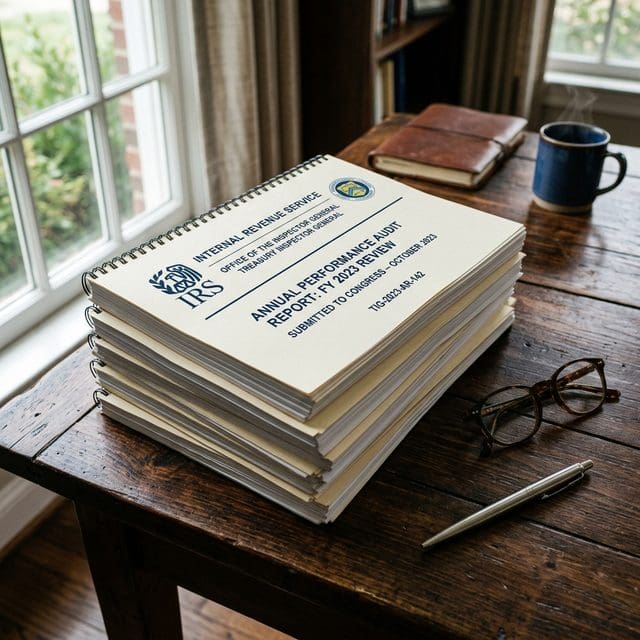
A Treasury Inspector General investigation reveals IRS employees improperly accessed high-profile tax records while thousands of sidelined staff maintained access to sensitive government networks.
A series of exhaustive reports from the Treasury Inspector General for Tax Administration (TIGTA) has exposed deep-seated security vulnerabilities within the Internal Revenue Service, revealing that agency employees improperly accessed the private tax information of high-profile individuals between 2022 and 2025. The audit, published in late September, identifies a persistent pattern of unauthorized “browsing” that targeted celebrities, government officials, and business executives. These findings suggest that the administrative state’s primary revenue collection agency has struggled to maintain the basic constitutional and statutory privacy protections afforded to American taxpayers.
According to the TIGTA findings, the IRS currently lacks the effective internal controls necessary to prevent or even consistently detect when staff members view sensitive data for non-official purposes. The Inspector General has officially referred these incidents to its investigative division for further examination, noting that the breaches could result in criminal charges or severe disciplinary action. The report characterizes the agency’s current safeguards as fundamentally inadequate, leaving the private financial lives of high-profile citizens vulnerable to the whims of curious or malicious internal actors. This lack of oversight is not merely a technical glitch but a systemic failure of management to prioritize data integrity.
The scope of the security concerns extends beyond active employees to those no longer performing their duties. A separate TIGTA disclosure found that as of June 2025, approximately 17,000 of the 21,500 IRS employees placed on administrative leave still held active network access. Even more concerning for public interest advocates is the fact that over 14,000 of those individuals retained access to sensitive systems despite being sidelined for various disciplinary or administrative reasons. The agency has received six specific recommendations to tighten these access-control gaps, yet the records indicate a slow response to these critical vulnerabilities.
This trend of administrative instability and lack of accountability is mirrored at the state level in Tennessee. Department of Correction Commissioner Frank Strada announced his resignation on October 3, following the catastrophic failure of two lethal injection attempts for death row inmate Christa Pike on October 1. The botched proceedings left Pike in critical condition and forced Governor Bill Lee to pause all executions through the end of 2026. Strada’s departure, effective at the end of October, comes as the state launches an independent third-party investigation to determine how the Department of Correction failed to follow its own established protocols.
Simultaneously, international oversight efforts are intensifying in the Philippines, where Senator Panfilo Lacson is driving a multi-agency probe into alleged illegal reclamation activities at Taguig Lakeshore. A joint inspection conducted on October 2 by the Ombudsman, the Philippine Reclamation Authority, and the Land Registration Authority recorded ongoing dumping and filling at the site, despite a lack of clear authorization. While Taguig city officials have denied issuing permits for the activity, claiming the land is held by private parties, the Ombudsman’s office has confirmed that the investigation into land use and permit violations will continue under police protection for the inspectors.
These developments across federal and state agencies underscore a period of heightened scrutiny for administrative leadership. From the IRS’s failure to secure taxpayer data against its own staff to the Tennessee Department of Correction’s operational breakdown, the reliance on primary source audits and independent reviews remains the public’s most effective tool for ensuring bureaucratic accountability. Without the rigorous application of these oversight mechanisms, the administrative state remains a black box, answerable only to itself rather than the citizens it is meant to serve.
Ben Taylor serves as the Senior Correspondent and Investigations Lead for Just Right News, where he anchors the network’s commitment to government transparency and institutional accountability. With a career defined by a relentless pursuit of the facts, Taylor spearheads the acclaimed feature series “The Paper Trail,” a deep-dive investigative column that prioritizes primary source documentation over political rhetoric. Based in the heart of the nation’s capital, he has earned a reputation as one of the most formidable investigative journalists in Washington, D.C., known specifically for his mastery of public records and the Freedom of Information Act.
Taylor’s approach to journalism is deeply rooted in his upbringing in Kansas City, Missouri. Growing up in the “Show Me State,” he developed a healthy skepticism of centralized power and a profound respect for the common-sense values of the American heartland. This Midwestern foundation informs his reporting today, as he bridges the gap between the complex machinations of federal bureaucracy and the everyday concerns of citizens across the country. For Taylor, investigative reporting is not about chasing headlines; it is about ensuring that the government remains answerable to the people it serves.
As an African American man working within the conservative media landscape, Taylor brings a principled perspective to his beat. He views the Constitution and the right to information as the ultimate equalizers in a free society. His work often highlights how bureaucratic overreach and lack of transparency disproportionately affect individual liberties. By focusing on the “paper trail,” Taylor strips away the spin of partisan talking points, instead providing Just Right News readers with the raw data and internal communications that reveal how their tax dollars are spent and how policy decisions are actually made.
In his role as Investigations Lead, Taylor oversees a team dedicated to uncovering the stories that mainstream outlets often overlook. Whether he is auditing federal spending, investigating regulatory overreach, or exposing inefficiencies within the administrative state, his methodology remains consistent: follow the evidence wherever it leads. His presence in Washington, D.C., allows him to maintain a constant watch over the halls of power, yet he remains steadfastly connected to his roots, ensuring his reporting reflects the clarity and directness of his Missouri home.
Throughout his tenure at Just Right News, Taylor has become a vital voice for those who demand integrity in public office. He believes that a well-informed electorate is the strongest defense against government overreach, and he has dedicated his career to providing the public with the tools they need to hold their leaders accountable. Through “The Paper Trail” and his broader investigative work, Ben Taylor continues to set the standard for rigorous, document-driven journalism that champions the values of transparency, individual responsibility, and the rule of law.