

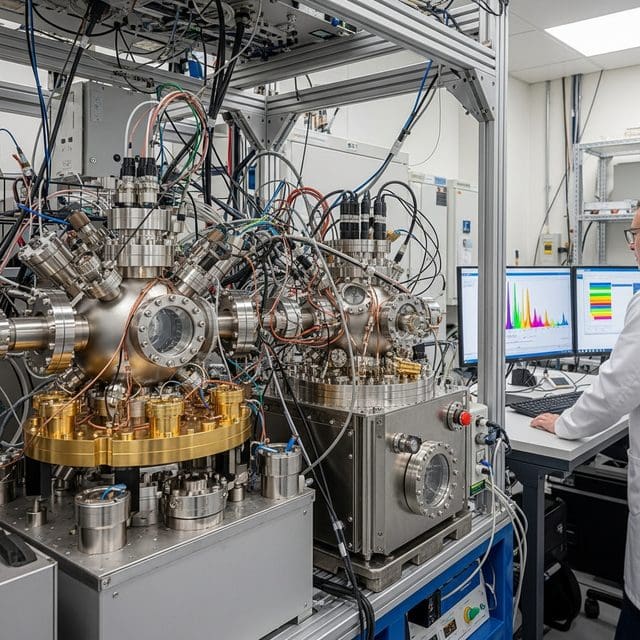
Scientists at Lawrence Berkeley National Laboratory have developed a switchable quantum fluid in 2D materials, marking a significant step toward stable, energy-efficient quantum circuits and sensors.
A team of researchers led by Lawrence Berkeley National Laboratory and UC Berkeley has achieved a significant milestone in condensed matter physics, demonstrating a tunable “quantum fluid” within an atomically thin semiconductor. The study, published in the journal Nature, details the creation of a Bose-Einstein condensate (BEC) of excitons—pairs of electrons and holes—that can be manipulated using magnetic fields and electrical gates. This discovery represents a major advancement in the pursuit of solid-state quantum technologies that align with the American tradition of decentralized, hardware-driven innovation.
Traditional Bose-Einstein condensates, often referred to as the fifth state of matter, typically require extreme laboratory conditions and temperatures near absolute zero to exist. However, the Berkeley team utilized a van der Waals heterobilayer composed of MoSe₂/hBN/WSe₂ to maintain this state at approximately 2 kelvins. While still requiring cryogenic cooling, this is millions of times warmer than the ultracold atomic gases used in earlier physics demonstrations. The excitons were engineered in their ground state rather than short-lived excited states, allowing for a stable equilibrium quantum fluid that could eventually be integrated into practical semiconductor devices.
The significance of the finding lies in the internal “flavor” of the excitons. The researchers identified four distinct spin-valley flavors, discovering that they could switch the fluid between different quantum phases by applying a weak magnetic field. Principal investigator Feng Wang noted that the work provides a direct way to access the hidden structures of these quantum states. By using magneto-optical spectroscopy in a dilution refrigerator, the team mapped a density-temperature dome, identifying a two-component intervalley condensate that appears via a first-order quantum phase transition. This effectively creates a quantum state switch within a device-ready semiconductor, an important step toward superfluid-based logic.
Simultaneously, international efforts are pushing the boundaries of quantum coherence in other materials. At the University of Vienna, a team led by Andrii Chumak reported a breakthrough in magnonics—the study of magnetic waves. By using ultra-pure yttrium iron garnet (YIG) spheres cooled to 30 millikelvins, the team extended the lifespan of magnons to 18 microseconds. This is a hundredfold increase over previous records, placing these magnetic waves on par with the coherence times of superconducting qubits used in today’s leading quantum processors. The researchers found that the lifespan of these waves is limited not by fundamental physics, but by material purity, suggesting that American manufacturing excellence will be the deciding factor in future performance.
These dual advancements represent a shift toward miniaturization and material-based innovation. The Berkeley discovery offers a platform for electrically controlled quantum sensors and unconventional superconductivity, while the Vienna research supports the long-term vision of “coin-sized” quantum computers. Because magnons couple naturally to photons and phonons, they could serve as a quantum bus connecting hundreds of disparate qubits on a single chip. This wave-based architecture offers a potential alternative to the bulky, centralized systems currently being developed by large bureaucratic tech conglomerates.
As these technologies move from theoretical physics to experimental hardware, the focus shifts to how these bosonic platforms will integrate with existing infrastructure. While practical quantum advantage remains a high bar to clear, the ability to control quantum fluids and magnetic waves at the chip level suggests that the next generation of computing may be defined by the mastery of subatomic interactions within exceptionally pure materials. For those concerned with national sovereignty and technological independence, these breakthroughs in solid-state physics provide a promising roadmap for a future where quantum power is both accessible and robust.

Mason Reed serves as a Staff Writer for Just Right News, where he spearheads the Future Frontiers & Special Projects desk. In an era defined by rapid technological shifts and evolving social landscapes, Mason provides a steady, principled voice, examining the innovations of tomorrow through the lens of traditional American values. His work is most prominently featured in his signature series, “The Next Horizon,” where he explores the intersection of emerging technology, national sovereignty, and the preservation of individual liberty.
A native of San Diego, California, Mason’s worldview was shaped by the unique culture of his hometown. Growing up in a region defined by its strong military presence and its history of maritime industry, he developed a deep-seated respect for the institutions that provide national stability and the entrepreneurial spirit that drives the American economy. This upbringing instilled in him a belief that true progress is not found in discarding the past, but in building upon a foundation of proven principles. His reporting often reflects this San Diego influence, emphasizing the importance of a robust national defense and the necessity of maintaining a competitive edge in the global marketplace.
Now based in San Francisco, Mason operates from the heart of the world’s technological engine. Living and working in the Bay Area provides him with a front-row seat to the advancements—and the ideological challenges—emanating from Silicon Valley. While many in the region embrace a “move fast and break things” mentality, Mason’s reporting serves as a vital counterweight. He offers Just Right News readers a “boots on the ground” perspective, documenting how radical local policies and the concentration of tech power impact the everyday lives of citizens. His proximity to the industry allows him to cut through the marketing jargon of big tech to uncover the real-world implications for privacy, free speech, and the nuclear family.
In his “Future Frontiers” beat, Mason tackles complex subjects ranging from the ethics of artificial intelligence to the burgeoning private space race. He approaches these topics with a healthy skepticism toward centralized bureaucracy, championing instead the decentralized innovations that empower individuals. Through “The Next Horizon,” he highlights the pioneers and thinkers who are working to ensure that the future remains a place where human dignity and constitutional rights are protected. He believes that the rapid pace of change requires more than just technical expertise; it requires a moral compass rooted in the Western tradition.
Throughout his tenure at Just Right News, Mason has remained committed to the idea that the future is something to be shaped, not merely accepted. His writing is characterized by a rigorous defense of American exceptionalism and a belief that the country’s best days lie ahead, provided it remains true to its founding ideals. Whether he is investigating the impact of automation on the American workforce or profiling the next generation of aerospace engineers, Mason Reed ensures that his readers are equipped with the insights they need to navigate a changing world with confidence and clarity.