

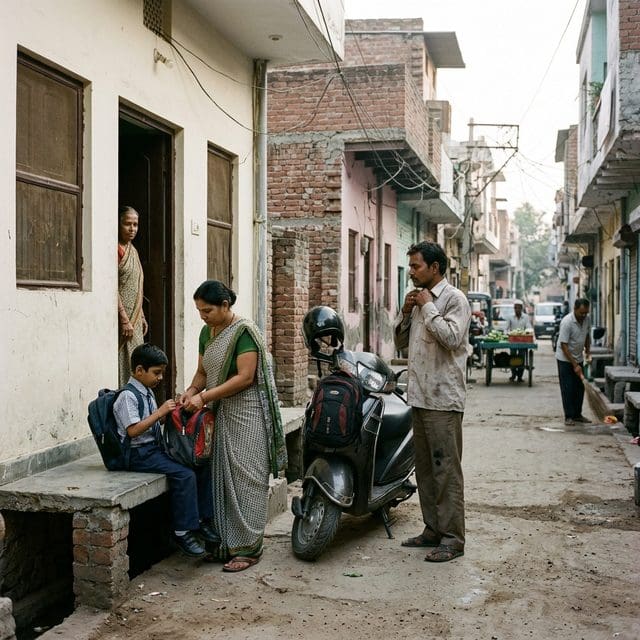
Al Jazeera reports that India has lifted 500 million people out of poverty since 2011, while millions remain financially precarious—a reminder that crossing a poverty line is not the same as achieving security.
India’s reported progress against poverty is striking in scale, but moving above a poverty line does not necessarily mean a household can withstand a setback. An Al Jazeera report published Sunday says India has lifted 500 million people out of poverty since 2011, citing the World Bank, while warning that millions remain on the edge of hardship.
That distinction matters. A family may cross a statistical threshold without savings, dependable earnings or protection against an unexpected expense. The report’s headline captures both sides of the story: many people have moved out of poverty, yet that change has not necessarily brought lasting security to everyone counted.
The source material does not specify the poverty line behind the 500 million figure, the population covered or the underlying calculation. It also offers no breakdown of how many people remain vulnerable. Those details are needed to assess the scale and durability of the gains. The figure should be understood as a reported count of people moving out of poverty, not proof that they have reached a secure standard of living.
A threshold count also cannot show how far above the line people have moved. It does not reveal whether income is steady, whether essential expenses consume most of it, or whether a brief spell without work could push a household back below the threshold. Those questions require evidence beyond a single poverty measure.
A separate World Bank report listed in the supplied material, also published Nov. 15, warns that many people globally remain vulnerable to falling back into poverty after a shock. The report’s specific figures in the material could not be verified and are not used here. Its broader concern echoes the India report’s distinction between crossing a poverty line and building resilience.
For households with little financial cushion, a medical bill, lost work or rising everyday costs can strain a budget. The available reporting does not quantify those pressures for Indian families or establish how often they undo recent gains. It does, however, present continued vulnerability as part of the poverty story, alongside the headline reduction.
That is a useful caution for policymakers and researchers. Counting how many people move above a poverty line answers one question, but not whether they can remain there. Assessing that requires measures of income stability and household resilience, ideally tracked over time. The supplied summary does not provide that evidence, so it cannot show how securely people remain above the threshold.
The distinction also matters in U.S. debates over safety-net programs, though India’s figures cannot be treated as a direct guide to American policy. Public assistance can help families manage immediate hardship; longer-term mobility also depends on steady work and rising earnings. A headline poverty count alone cannot show how those forces interact or which policies produced a change.
The Al Jazeera summary provides a striking figure and a warning, but not enough methodological detail to determine how much security India’s gains represent. That does not diminish the reported reduction. It clarifies what the number can—and cannot—say about families’ prospects: progress is measured not only by how many people cross a line, but also by whether they can stay above it when circumstances change.

James Foster serves as the Senior Correspondent for Inequality and the Social Safety Net at Just Right News, where he brings a principled and nuanced perspective to the most pressing economic challenges facing the nation. With a career dedicated to exploring the intersection of policy and personal responsibility, Foster has become a leading voice in documenting how government programs and economic shifts impact the American family. His reporting is characterized by a commitment to the “human element,” moving beyond cold statistics to highlight the stories of resilience, work, and community that define the modern American experience.
Foster’s perspective is deeply rooted in his upbringing in Birmingham, Alabama. Growing up in a city with a rich industrial heritage and a history of economic transformation, he witnessed firsthand the importance of the dignity of work and the strength of local institutions. In Birmingham, he saw how the most effective safety nets were often those woven by neighbors, faith-based organizations, and local civic groups. This background instilled in him a lifelong skepticism of “one-size-fits-all” solutions from distant bureaucracies, favoring instead the localized, community-driven support systems that he frequently champions in his writing.
Now based in Atlanta, Georgia, Foster operates from one of the most dynamic and rapidly evolving metropolitan hubs in the South. His location provides a front-row seat to the stark contrasts of the modern economy. From the gleaming towers of Atlanta’s financial districts to the struggling neighborhoods on the city’s periphery, Foster finds the stories that illustrate the complexities of upward mobility. His reporting from the Sun Belt serves as a microcosm for the national debate on poverty, highlighting how inflation, housing costs, and labor market shifts affect the working class in real-time.
As the lead for the acclaimed feature series “America’s Balancing Act,” Foster explores the delicate tension between providing a necessary hand up and fostering long-term independence. The series has become a cornerstone of Just Right News, offering a deep dive into the unintended consequences of social welfare policies. Foster’s work often focuses on the “cliff effect” and other systemic hurdles that can inadvertently discourage employment, arguing that true compassion is measured by how many people are empowered to leave the safety net, rather than how many are added to it.
Throughout his tenure, Foster has remained dedicated to the mission of Just Right News, providing a clear-eyed, conservative analysis of social issues. He believes that a free society thrives when individuals are empowered and the private sector is allowed to innovate. Whether he is interviewing small business owners about the challenges of a changing workforce or documenting the success of private charitable initiatives, Foster’s goal is to provide readers with the truth about the state of the American Dream. His work serves as a vital reminder that while the challenges of inequality are great, the solutions are often found in the strength of the American spirit and the preservation of traditional values.