

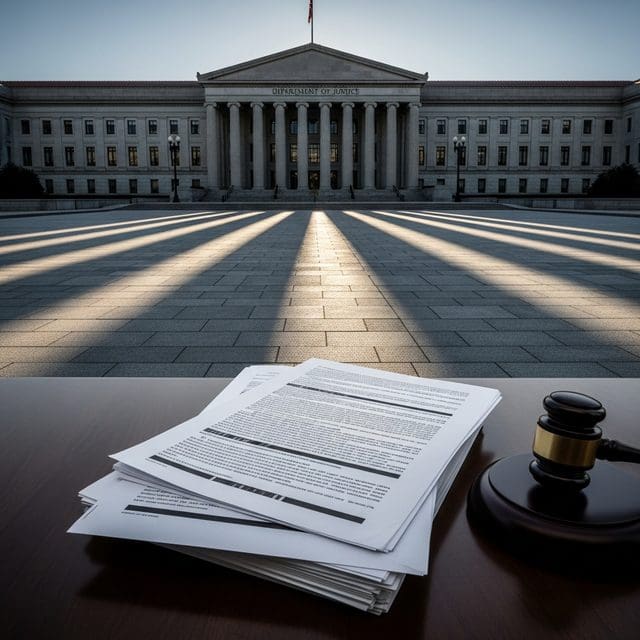
Recent DOJ and FCC actions signal a retreat from corporate accountability, expanding executive secrecy while dismantling long-standing barriers against national media consolidation.
A series of maneuvers within federal agencies this week suggests a coordinated retreat from market competition and institutional transparency. The Department of Justice and the Federal Communications Commission have moved to insulate executive decision-making from public scrutiny while dismantling barriers against media consolidation. These actions arrive as the average stock performance finally beat the S&P 500 for the first time in four years, yet the underlying structures of market power are being rewritten in favor of large incumbents.
The DOJ’s Office of Legal Counsel (OLC) issued a 21-page opinion on August 11, 2026, significantly expanding executive privilege. The memo asserts that the president can shield communications with outside private advisers, including attorneys and corporate allies, if the discussions relate to official decision-making. This expansion arrives just as congressional leaders prepared to investigate the influence of private interests on antitrust enforcement. By shielding non-government actors from subpoenas, the administration is creating a protected class of influencers operating beyond traditional democratic checks.
Critics argue this legal shield creates a shadow cabinet of industry insiders who can influence federal policy without public accountability. By reinforcing OLC guidance that individual members of Congress lack authority to conduct oversight without full committee delegation, the administration is narrowing the window into the mechanics of corporate-government deal-making. This shift makes it increasingly difficult for lawmakers to demand internal files on merger reviews or consent decrees, leaving the public in the dark regarding why massive acquisitions are allowed to proceed.
Simultaneously, the FCC has reshaped the media landscape by eliminating the national TV ownership cap. Under Brendan Carr, the commission voted 2–1 to scrap the rule preventing any single broadcaster from reaching more than 39% of U.S. households. In its place, the FCC will utilize a “case-by-case review.” Republican commissioner Olivia Trusty joined Carr in the majority, while Democrat Anna Gomez dissented, warning of localized monopolies. Legal experts note that Carr’s move likely exceeds statutory authority, as the 39% cap was codified by Congress.
The removal of this bright-line rule is expected to trigger a flurry of acquisitions among major broadcast groups. While proponents argue for flexibility in a digital market, the practical effect is a reduction in structural safeguards that prevent a few entities from controlling the flow of information. With the FCC deferring competition concerns to a DOJ that is currently bolstering its own secrecy, the path for massive media roll-ups appears clearer than it has been in decades.
These domestic shifts toward concentration occur alongside emerging debates regarding the lack of regulatory frameworks for off-world resources. As entities like the $129 billion Mars candy empire expand their reach, there is no legal regime to address extraterrestrial monopolies. While the DOJ and FTC focus on terrestrial consolidation, the absence of a proactive policy for new frontiers suggests the struggle for market competition is becoming more complex. For small businesses and independent media outlets, these developments represent a concerning trend where individual voices are muffled by the weight of institutional and corporate power.

Greg Sanders serves as the Senior Correspondent for Corporate Power and Antitrust at Just Right News, where he brings a principled, conservative perspective to the complex intersection of big business, government regulation, and the American consumer. With a career dedicated to investigative depth and economic clarity, Greg has become a leading voice in examining how the consolidation of industry power impacts the foundational values of the free market and individual liberty.
Raised in Denver, Colorado, Greg’s reporting is deeply informed by the Western spirit of independence and a healthy skepticism of centralized authority. Growing up in the shadows of the Rockies, he witnessed firsthand the importance of local entrepreneurship and the vital role that small-medium enterprises play in sustaining vibrant communities. This upbringing instilled in him a belief that the American Dream is best preserved when the playing field remains level and when competition—rather than backroom deals between corporate lobbyists and federal regulators—dictates success. For Greg, the rugged individualism of his home state serves as a constant reminder that the economy should serve the people, not the other way around.
Now based in Chicago, Illinois, Greg operates from the heart of the nation’s industrial and financial crossroads. His location in the Midwest provides him with a unique vantage point to observe the real-world consequences of corporate overreach. From the boardrooms of the Loop to the manufacturing hubs that define the region, he tracks the movement of capital and the shifting tides of market influence. Chicago’s history as a center of trade and labor offers a rich backdrop for his work, allowing him to bridge the gap between high-level economic theory and the lived experiences of hardworking Americans who feel the squeeze of monopolistic practices.
At Just Right News, Greg’s beat focuses on the “new monopolies” and the rise of “woke” corporate culture. He argues that when corporations become too large, they often abandon their fiduciary duties to shareholders in favor of social engineering and political posturing. His reporting seeks to hold these “Titans” accountable, ensuring that the power of the purse is not used to silence dissent or bypass the democratic process. He is a firm advocate for the idea that true conservatism requires a vigilant defense of competition, preventing any single entity—public or private—from exerting undue control over the lives of citizens.
This mission is most clearly seen in his acclaimed feature series, “The Titans and the Toll.” In this ongoing project, Greg explores the human cost of market consolidation, from the erosion of consumer choice to the decline of local economies. Through rigorous analysis and boots-on-the-ground reporting, he documents how the concentration of power in sectors like tech, agriculture, and finance creates a “toll” paid by the average family.
Greg Sanders remains committed to the idea that a transparent, competitive market is the greatest engine for prosperity ever devised. Through his work at Just Right News, he continues to provide the essential oversight necessary to protect that engine from the encroaching influence of corporate giants and the bureaucratic structures that enable them.