

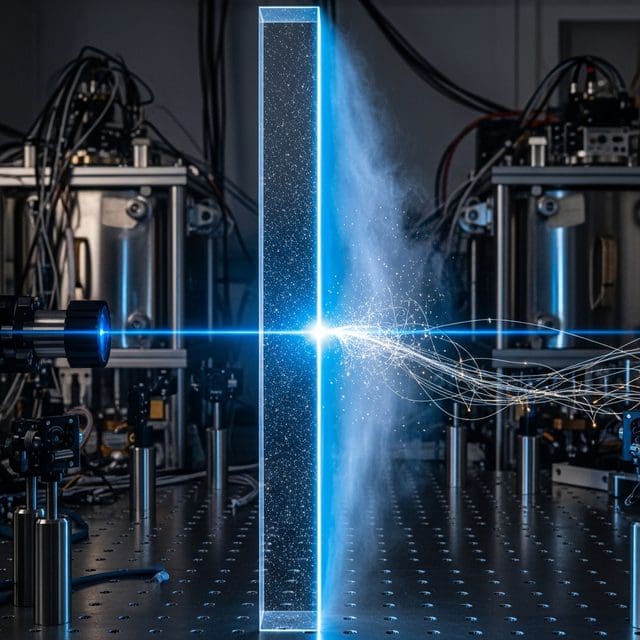
Researchers from Ghent, Cambridge, and Oxford have demonstrated how particles pass through duality defects with 100% transmission, solving a forty-year-old physics puzzle and bridging high-energy theory with quantum simulation.
A collaborative effort by researchers at Ghent University, the University of Cambridge, and the University of Oxford has provided a definitive answer to a forty-year-old mystery in particle physics. Published in Nature Physics on August 7, 2026, the study led by Frank Verstraete and first author Atsushi Ueda demonstrates that particles can pass through a ‘mirror world’ interface with absolute certainty, a finding that resolves the long-standing magnetic monopole scattering paradox.
The paradox, first identified in the 1980s as the Callan-Rubakov effect, involves an electrically charged particle scattering off a magnetic monopole. In traditional field theory treatments, the outgoing state of the particle appeared to be “missing” or ambiguous, leaving physicists with a mathematical void. For decades, this ambiguity remained a significant hurdle in reconciling the behavior of particles at the most fundamental levels of reality, specifically regarding how localized matter interacts with topological defects in the fabric of a field.
The research team utilized a quantum spin chain model to simulate what happens when a wave packet strikes a “duality defect”—a boundary where the mathematical description of a system flips into its dual counterpart, such as the Kramers–Wannier transformation in Ising models. Their findings reveal that the particle is never reflected. Instead, it passes through the defect with 100% probability, regardless of the system’s criticality or integrability. However, the particle does not emerge as a standard localized entity. Instead, it transforms into a nonlocal, string-like excitation—described by the researchers as a “wisp of fog”—that remains physically connected to the defect by an invisible quantum thread stretching back to the mirror’s edge.
This transformation is not merely a theoretical curiosity; it is a fundamental shift in how we understand the movement of information across topological boundaries. By framing the defect as a matrix product operator (MPO) within a tensor network, the team showed that the internal “virtual” bond space of the defect becomes a physical hidden quantum space that enforces this perfect transmission. This mechanism provides the first concrete, simulatable resolution to the monopole paradox, moving the discussion from abstract, high-energy field theory arguments into the realm of observable, programmable condensed matter physics.
The implications for American technological sovereignty and the future of decentralized innovation are significant. Because the model relies on simple spin chains rather than exotic, currently unattainable materials, the researchers argue that this effect is within immediate reach of current quantum simulation platforms. This includes cold atom systems, trapped ions, and superconducting processors currently under development by both private industry and national laboratories. By providing an operational handle on non-invertible symmetries and generalized dualities, this discovery allows scientists to “throw something” at a topological interface and measure exactly what emerges, effectively turning a theoretical mystery into a laboratory tool.
Furthermore, the research ties together the disparate fields of quantum information, condensed matter, and particle physics. It suggests new ways to engineer topological interfaces that could protect quantum information from decoherence, a primary obstacle in the quest for scalable quantum computing. As the global race for quantum supremacy intensifies, grounding these complex theories in verifiable, programmable many-body systems ensures that the next frontier of physics remains rooted in empirical reality. This work represents a triumph of principled inquiry, proving that even the most elusive paradoxes of the 1980s can be solved through the rigorous application of modern tensor networks and a commitment to understanding the fundamental structures of our physical world.

Mason Reed serves as a Staff Writer for Just Right News, where he spearheads the Future Frontiers & Special Projects desk. In an era defined by rapid technological shifts and evolving social landscapes, Mason provides a steady, principled voice, examining the innovations of tomorrow through the lens of traditional American values. His work is most prominently featured in his signature series, “The Next Horizon,” where he explores the intersection of emerging technology, national sovereignty, and the preservation of individual liberty.
A native of San Diego, California, Mason’s worldview was shaped by the unique culture of his hometown. Growing up in a region defined by its strong military presence and its history of maritime industry, he developed a deep-seated respect for the institutions that provide national stability and the entrepreneurial spirit that drives the American economy. This upbringing instilled in him a belief that true progress is not found in discarding the past, but in building upon a foundation of proven principles. His reporting often reflects this San Diego influence, emphasizing the importance of a robust national defense and the necessity of maintaining a competitive edge in the global marketplace.
Now based in San Francisco, Mason operates from the heart of the world’s technological engine. Living and working in the Bay Area provides him with a front-row seat to the advancements—and the ideological challenges—emanating from Silicon Valley. While many in the region embrace a “move fast and break things” mentality, Mason’s reporting serves as a vital counterweight. He offers Just Right News readers a “boots on the ground” perspective, documenting how radical local policies and the concentration of tech power impact the everyday lives of citizens. His proximity to the industry allows him to cut through the marketing jargon of big tech to uncover the real-world implications for privacy, free speech, and the nuclear family.
In his “Future Frontiers” beat, Mason tackles complex subjects ranging from the ethics of artificial intelligence to the burgeoning private space race. He approaches these topics with a healthy skepticism toward centralized bureaucracy, championing instead the decentralized innovations that empower individuals. Through “The Next Horizon,” he highlights the pioneers and thinkers who are working to ensure that the future remains a place where human dignity and constitutional rights are protected. He believes that the rapid pace of change requires more than just technical expertise; it requires a moral compass rooted in the Western tradition.
Throughout his tenure at Just Right News, Mason has remained committed to the idea that the future is something to be shaped, not merely accepted. His writing is characterized by a rigorous defense of American exceptionalism and a belief that the country’s best days lie ahead, provided it remains true to its founding ideals. Whether he is investigating the impact of automation on the American workforce or profiling the next generation of aerospace engineers, Mason Reed ensures that his readers are equipped with the insights they need to navigate a changing world with confidence and clarity.