

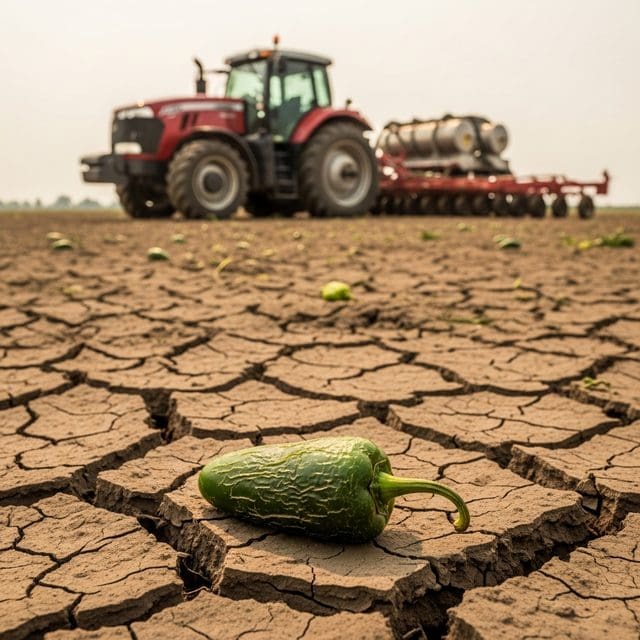
Federal regulators expand recalls for peppers and dairy as record drought and surging diesel costs pressure American food producers and international livestock stability.
American kitchen tables and agricultural heartlands face a dual threat this week as federal regulators scramble to contain foodborne illness outbreaks while persistent drought tightens its grip on global production. The FDA and CDC have confirmed a multistate investigation into Salmonella Javiana, traced to jalapeño peppers imported from Sinaloa, Mexico, by Coast Citrus Distributors. This has triggered massive downstream recalls for Taylor Fresh Foods products, including salsas and guacamole, across more than 20 states.
Safety concerns are not limited to imports. The FDA’s updated recall list now includes powdered milk from California Dairies Inc. due to Salmonella risks, adding complexity to the domestic supply chain. Furthermore, a voluntary recall of RAW FARM-brand cheddar cheese remains active through late August. For families prioritizing local sourcing and raw dairy, these recurring microbial issues serve as a reminder that even specialized markets require vigilant oversight to protect consumers from systemic contamination.
While regulators manage these outbreaks, the environmental reality for producers is increasingly grim. National monitoring data reveals that 48.54% of the Lower 48 is currently in drought. This water scarcity is a direct tax on the American farmer, dictating pesticide use and the viability of cattle rangeland. These pressures are exacerbated by a volatile energy market; average diesel prices hit $5.32 per gallon this week—a $1.61 jump from last year. Driven by the Russia-Ukraine war and Iran crisis, these costs pass directly from the tractor to the grocery aisle.
The fragility of agricultural sovereignty is visible in Ethiopia’s Tigray region, where a total failure of kiremt rainfall has left 4,000 hectares of farmland barren. Local reports from Abergelle Yechila indicate thousands of livestock have perished as pasturelands vanish. While geographically distant, the lesson for American stewards is clear: resilient water infrastructure and local resource management are the only true safeguards against humanitarian and economic crisis.
Domestic policy is also shifting toward more cautious public health protocols. On August 10, President Trump signed an executive order recommending the splitting of the MMR vaccine into three separate visits, reflecting a broader trend of prioritizing individual choice in safety standards. Similarly, the Urban School Food Alliance launched the ‘School Lunch is Healthcare’ initiative to improve nutritional quality for 3.8 million students, acknowledging that food safety is a pillar of national security.
As the FDA continues its traceback of imported peppers and domestic dairy, the focus remains on whether federal agencies can move beyond reactive recalls toward proactive protection. For the American producer, the path forward requires balancing rigorous safety standards with the common-sense preservation of the land. Without addressing rising fuel costs and water infrastructure gaps, the stability of the American pantry remains at the mercy of both microscopic pathogens and global environmental shifts.

Eric Nolan serves as the Senior Correspondent for Food, Water, and Environmental Health at Just Right News, where he brings a principled, common-sense perspective to the most fundamental issues facing the American public. With a career dedicated to uncovering the truth behind the policies that govern our natural resources, Eric has become a trusted voice for readers who value traditional stewardship over bureaucratic overreach. His reporting is defined by a commitment to the idea that true environmentalism is rooted in the protection of the American family and the preservation of the nation’s agricultural heritage.
Raised in Fresno, California, Eric’s worldview was shaped in the heart of the San Joaquin Valley. Growing up in one of the world’s most productive agricultural hubs, he witnessed firsthand the vital connection between the land, the water, and the dinner table. In Fresno, he saw the resilience of farmers and the devastating impact that distant, top-down regulations can have on local communities. This upbringing instilled in him a deep respect for the producers who feed the country and a lifelong skepticism toward the alarmist narratives often pushed by mainstream media. For Eric, environmental health is not an abstract political talking point; it is a matter of ensuring that the people who work the land have the freedom and the resources to do so effectively.
Now based in Eugene, Oregon, Eric operates from a unique vantage point in the Pacific Northwest. Living in a region often defined by intense environmental debate, he provides a necessary counter-narrative to the prevailing trends of the area. From his base in Eugene, he monitors the shifting tides of federal and state policies, ensuring that the voices of rural citizens and property owners are not drowned out by urban activism. His reporting often bridges the gap between the rugged realities of the outdoors and the legislative halls where decisions are made, offering a grounded perspective that prioritizes local sovereignty and practical solutions.
As the lead for the acclaimed feature series “Earth on the Table,” Eric explores the intricate journey of the American food supply. He tackles critical issues such as water rights, soil health, and food security through a lens of national stability and individual liberty. He believes that a healthy environment and a thriving economy are not mutually exclusive, but rather two sides of the same coin of national prosperity. His work consistently highlights how innovation and private-sector ingenuity are the most effective tools for ensuring clean water and a safe food supply, rather than the expansion of the administrative state.
At Just Right News, Eric’s reporting serves as a vital resource for those who seek accountability and transparency. Whether he is investigating the impact of federal land management on local economies or examining the safety of the national food infrastructure, his work remains anchored in the values of heritage and hard work. Eric Nolan continues to be a leading voice in environmental journalism, championing the belief that the best way to protect our natural resources is to empower the people who live and work closest to them.