

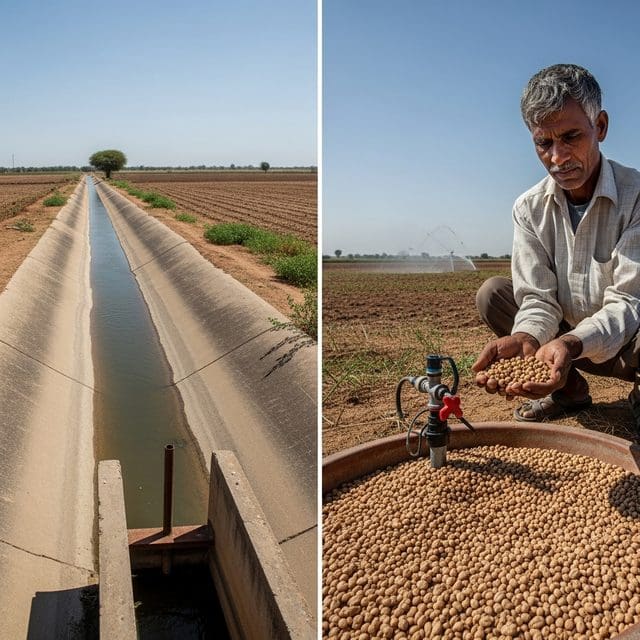
Minister N. Uttam Kumar Reddy has ordered the immediate reactivation of local advisory panels to manage dwindling reservoir levels and steer farmers toward drought-resilient crops.
In a move that underscores the necessity of localized stewardship over centralized mandates, the Telangana government has ordered the immediate revival of its District Irrigation Advisory Boards. Irrigation Minister N. Uttam Kumar Reddy, speaking via video conference to District Collectors on August 7, 2026, directed that these panels must now convene before and during every crop season. The objective is clear: provide grounded, command-area specific guidance to farmers as prevailing El Niño conditions threaten the state’s water security and agricultural output.
The revival of these boards represents a return to practical environmental management. Rather than relying on broad-stroke state policies, these panels are tasked with a granular assessment of reservoir storage, expected inflows, and local rainfall patterns. By weighing these factors against drinking-water requirements and command-area demands, the boards are intended to act as a firewall against the mismanagement of finite resources. Minister Reddy has been explicit in his instructions, warning farmers against planting water-intensive crops like paddy in the Kharif season where projects have received inadequate inflows. The directive emphasizes that clear, specific advice must be delivered to every village to prevent the economic ruin that follows a failed harvest.
The situation on the ground has already forced the hand of several district-level collectors who are acting as the front line of this water defense. In Nandyal, orders have been issued to reserve Pothireddypadu water strictly for drinking purposes, a move that prioritizes human necessity over industrial-scale irrigation. Farmers there are being advised to abandon paddy in favor of black gram, red gram, green gram, foxtail millet, castor, and soybean. Similarly, in Asifabad, District Collector K. Haritha has urged a reduction in paddy acreage, pushing for maize, sunflower, and red gram to conserve declining groundwater levels. This shift to semi-dry, low-water crops is a common-sense response to the reality of receding reservoirs and the unpredictability of the current monsoon cycle.
To facilitate this transition without bankrupting the family farm, a state-level El Niño expert panel has submitted a comprehensive ₹802.92-crore contingency action plan. This is not merely a bureaucratic paper trail; it is a targeted investment in private-sector resilience. The plan recommends subsidies between 75% and 90% for drip and sprinkler irrigation systems, alongside 75% subsidized seeds for pulses, oilseeds, and millets across 32 lakh acres. Furthermore, the government is looking to reschedule crop loans and fund 75% of crop insurance premiums. This financial infrastructure is designed to provide a safety net for those pivoting away from traditional staples, ensuring that the burden of climate adaptation does not fall solely on the shoulders of the individual producer.
Beyond the fields, the contingency plan emphasizes the repair of village water troughs and the security of livestock drinking water, recognizing that a rural economy is only as strong as its most basic infrastructure. Scientists involved in the El Niño strategy are also introducing real-time rainfall monitoring and weekly mandal-level agro-weather bulletins. These tools allow for sophisticated techniques such as dry direct-seeded short-duration rice and skip-row irrigation, which maximize the utility of every drop of water. Farmers are also being encouraged to engage in rainwater harvesting and field bund repairs during any available showers to capture what little moisture the season provides.
This localized approach stands in stark contrast to the often-clumsy interventions of federal regulators seen in other sectors. By empowering District Collectors to prioritize reservoir storage for human consumption while curbing reliance on water-heavy crops, Telangana is demonstrating that environmental health and agricultural productivity can coexist when managed at the community level. The focus remains on short-duration, drought-tolerant crops and the expansion of micro-irrigation—innovations that protect the sovereignty of the local farmer while respecting the limits of the natural environment. As the Kharif 2026 season progresses, the success of these advisory boards will serve as a litmus test for whether local expertise can triumph over regional ecological volatility.

Eric Nolan serves as the Senior Correspondent for Food, Water, and Environmental Health at Just Right News, where he brings a principled, common-sense perspective to the most fundamental issues facing the American public. With a career dedicated to uncovering the truth behind the policies that govern our natural resources, Eric has become a trusted voice for readers who value traditional stewardship over bureaucratic overreach. His reporting is defined by a commitment to the idea that true environmentalism is rooted in the protection of the American family and the preservation of the nation’s agricultural heritage.
Raised in Fresno, California, Eric’s worldview was shaped in the heart of the San Joaquin Valley. Growing up in one of the world’s most productive agricultural hubs, he witnessed firsthand the vital connection between the land, the water, and the dinner table. In Fresno, he saw the resilience of farmers and the devastating impact that distant, top-down regulations can have on local communities. This upbringing instilled in him a deep respect for the producers who feed the country and a lifelong skepticism toward the alarmist narratives often pushed by mainstream media. For Eric, environmental health is not an abstract political talking point; it is a matter of ensuring that the people who work the land have the freedom and the resources to do so effectively.
Now based in Eugene, Oregon, Eric operates from a unique vantage point in the Pacific Northwest. Living in a region often defined by intense environmental debate, he provides a necessary counter-narrative to the prevailing trends of the area. From his base in Eugene, he monitors the shifting tides of federal and state policies, ensuring that the voices of rural citizens and property owners are not drowned out by urban activism. His reporting often bridges the gap between the rugged realities of the outdoors and the legislative halls where decisions are made, offering a grounded perspective that prioritizes local sovereignty and practical solutions.
As the lead for the acclaimed feature series “Earth on the Table,” Eric explores the intricate journey of the American food supply. He tackles critical issues such as water rights, soil health, and food security through a lens of national stability and individual liberty. He believes that a healthy environment and a thriving economy are not mutually exclusive, but rather two sides of the same coin of national prosperity. His work consistently highlights how innovation and private-sector ingenuity are the most effective tools for ensuring clean water and a safe food supply, rather than the expansion of the administrative state.
At Just Right News, Eric’s reporting serves as a vital resource for those who seek accountability and transparency. Whether he is investigating the impact of federal land management on local economies or examining the safety of the national food infrastructure, his work remains anchored in the values of heritage and hard work. Eric Nolan continues to be a leading voice in environmental journalism, championing the belief that the best way to protect our natural resources is to empower the people who live and work closest to them.