

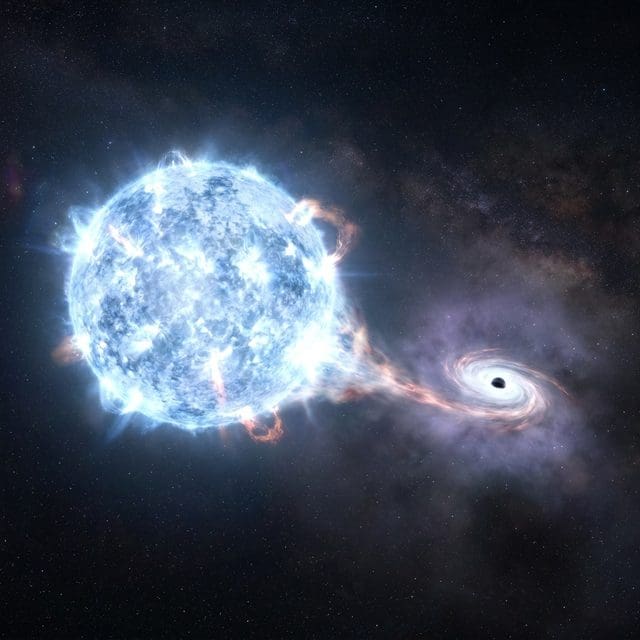
X-ray observations suggest a compact object repeatedly pulls gas from AT 2016blu, explaining how the star can mimic a supernova without being destroyed.
For years, AT 2016blu has erupted like a star on the edge of catastrophe. Located about 30 million light-years away in the galaxy NGC 4559, it has produced flashes resembling supernovae, yet the star has continued to shine. New observations from NASA’s Chandra X-ray Observatory suggest why: a hidden companion may be repeatedly pulling gas from it.
The companion is likely either a black hole with the mass of a star or a neutron star, the dense remnant left when a massive star collapses. NASA’s report, published November 9, says the object appears to strip material from AT 2016blu about every 113 days. That process could link the star’s repeated visible eruptions to energetic activity close by.
Gas drawn from the star gathers around the system. X-rays heat the dense material, which then glows in visible light. “The dense gas surrounding the system is heated by the X-rays and then glows in the optical,” NASA said. The flare, in this explanation, is not necessarily the star exploding. It may be light from gas heated by the interaction with its companion.
Astronomers recorded at least 27 supernova-like optical outbursts from AT 2016blu between 2012 and 2026. Chandra observations from March 2026 found the system at least 100 times brighter in X-rays than it had been in observations from 2001–2002. The long gap between those measurements makes the scale of the change clear, though it does not by itself identify the companion.
X-rays help reveal energetic activity that visible light alone may not explain. In this case, the bright X-ray signal, combined with the repeated optical flares, supports the idea of an interacting pair rather than an isolated star undergoing a conventional final explosion. The proposed 113-day cycle provides a possible rhythm for the companion’s repeated pull on the star’s material.
The distinction matters because a supernova ordinarily marks a star’s destruction. A “supernova impostor” can produce a similar display while leaving the star intact. AT 2016blu is a rare opportunity to investigate how such an eruption might be powered. NASA described the result as the first X-ray detection of this class of erupting object and the first example associated with a black-hole or neutron-star companion.
The finding is evidence for a mechanism, not a definitive identification of the hidden object. Researchers have not established whether it is a black hole or a neutron star, and further observations will be needed to test whether the proposed cycle continues to account for the system’s behavior. NASA’s report does not give a timetable for those observations.
The case also shows how astronomy builds an explanation from different kinds of evidence. A single flash might look like an isolated stellar explosion. A record of dozens of flares, together with X-ray measurements separated by decades, points instead toward a recurring interaction. The star is not simply repeating the same spectacular event: a companion may be helping drive it.
For now, Chandra has supplied a strong clue rather than a final portrait of the system. At a distance of 30 million light-years, AT 2016blu cannot be examined up close. But its recurring eruptions and unusually bright X-rays offer astronomers a way to study how a star can imitate its own death—and survive.

Ethan Blake serves as a Senior Correspondent for Just Right News, where he specializes in Longform Narrative and Public Understanding. In an era of rapid-fire headlines and fleeting soundbites, Ethan’s work stands as a testament to the power of deep-dive reporting and the importance of contextualizing the complex issues facing the nation today. His approach is rooted in the belief that the most profound truths are often found in the lived experiences of individuals rather than the abstract theories of distant policymakers.
Growing up in Providence, Rhode Island, Ethan developed an early appreciation for the historical and cultural threads that weave the American fabric together. Providence, a city defined by its industrial heritage and its blend of traditional neighborhoods, provided him with a front-row seat to the challenges and triumphs of the American working class. This upbringing instilled in him a respect for the “common sense” values of hard work, community loyalty, and the preservation of local institutions. He learned early on that behind every economic statistic or legislative debate, there are real families and neighborhoods navigating the consequences of change.
This foundational perspective is the driving force behind his signature feature series, “Lives Behind the Systems.” Through this series, Ethan explores the intersection of individual agency and institutional structure. Whether he is documenting the impact of federal land-use policies on rural families or examining how shifting educational standards affect local school boards, Ethan’s work prioritizes the human element. He seeks to uncover how large-scale systems—be they governmental, economic, or social—affect the daily lives of citizens, often advocating for a return to local control and personal responsibility.
Now based in Portland, Maine, Ethan draws significant inspiration from the rugged independence and self-reliance that define the region. The coastal landscape and the resilient spirit of Maine’s communities serve as a constant reminder of the importance of individual liberty and the strength found in decentralized power. Living and working outside the traditional media hubs allows Ethan to maintain a grounded perspective, ensuring his reporting remains untethered from the echo chambers of the major metropolitan centers. This geographic distance provides him with the clarity needed to translate complex national narratives into stories that resonate with the heart of the country.
At Just Right News, Ethan’s beat is more than just a professional assignment; it is a mission to foster a more informed and engaged citizenry. He believes that a free society depends on the public’s ability to understand the mechanisms of power and the value of traditional American principles. His longform narratives do not merely report the news; they provide a roadmap for understanding the cultural and political shifts of the modern era through a lens of skepticism toward centralized authority and a deep respect for the individual.
Through his meticulous research and narrative craftsmanship, Ethan Blake continues to bridge the gap between policy and the public. His work remains a vital resource for those who seek a deeper understanding of the systems that shape our world and the enduring spirit of the people who live within them.