

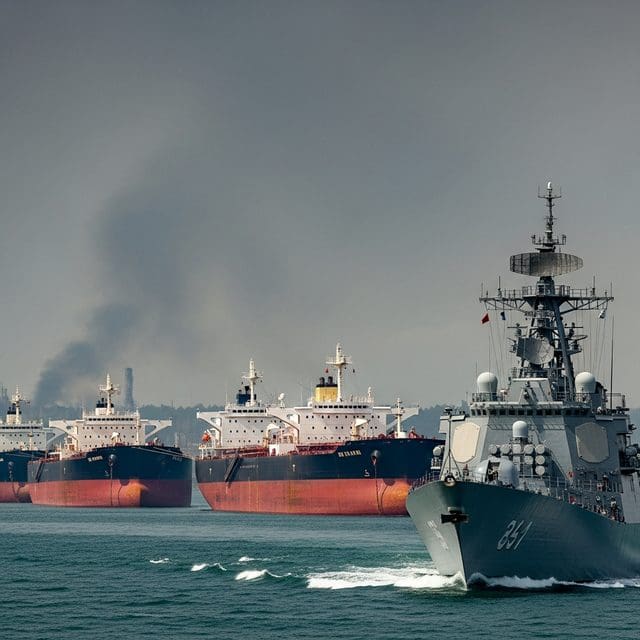
Direct hostilities between Washington and Tehran intensified this week with missile strikes in Jordan and tanker seizures, threatening global energy stability and refining capacity.
The geopolitical landscape shifted violently this week as the U.S. war with Iran entered an expanded phase of direct kinetic engagement. Following a series of American and Saudi strikes against Tehran-backed militias in Iraq that killed at least 20 fighters, Iran launched retaliatory missile attacks on American forces stationed in Jordan on July 29. These strikes ended a brief pause in hostilities and were accompanied by reports of explosions in Egypt, signaling a dangerous widening of the theater of operations. The Pentagon remains on high alert as the Trump administration navigates a conflict that most Americans now say is not worth fighting, according to recent AP-NORC polling.
In the maritime corridors, the situation has deteriorated into a functional blockade of the Strait of Hormuz. The Islamic Revolutionary Guard Corps confirmed it struck two additional tankers on July 31, while Kuwait reported intercepting drones in its airspace. In response, Saudi Arabia has formally called for the establishment of an international maritime defense coalition to protect Red Sea shipping. This blockade is a calculated move by Tehran to enforce its demands for war reparations and total sovereignty over the Strait, a position the U.S. and its allies have rejected as a violation of international law.
The economic consequences of these disruptions are manifesting in the global energy sector. Executives from ExxonMobil and Chevron warned on August 1 that fuel prices will remain elevated for the foreseeable future. They noted that even if crude oil prices stabilize, the wars in the Middle East and Ukraine have left global refining capacity critically short. This shortage was further emphasized by recent developments in the Black Sea, where Ukrainian drones reportedly sank a vessel belonging to the Russian atomic agency Rosatom, complicating civilian cargo navigation and further tightening the supply chain for critical resources.
Domestically, the American economy presents a stark dichotomy. The second quarter of 2026 saw accelerating growth driven by a massive surge in demand for artificial intelligence and computer memory technologies. Amazon stock recently posted its best day in over a decade due to cloud growth. However, this high-tech boom has not insulated the broader economy from the costs of war. Data indicates that one in five U.S. small and medium-sized businesses are on track to run out of cash within 90 days. The disconnect between the thriving AI sector and the struggling heartland economy is becoming a central point of friction for the administration.
While the U.S. focuses on the Iranian threat, other global actors are maneuvering to exploit the instability. India is currently executing a delicate balancing act, relaxing long-held policies on foreign direct investment to attract capital from both Washington and Beijing. Simultaneously, China is reinforcing its regional posture, with the People’s Liberation Army marking its 99th anniversary in Hong Kong by pledging to expand its role in regional security. These developments suggest that while the U.S. is bogged down in a realist struggle for Middle Eastern stability, its primary competitors are actively reshaping trade and influence in the Indo-Pacific.
The convergence of these factors—surging violence in the West Bank, the refining capacity crisis, and the technological race for AI dominance—places the United States in a precarious position. The ‘peace through strength’ doctrine is being tested not just by Iranian missiles, but by the economic resilience of the American small business owner and the volatile nature of global energy markets. As the conflict enters August, the stakes for American power have rarely been higher, with the risk of a multi-front engagement looming over the administration’s foreign policy objectives.

Olivia Kendall serves as the Senior Correspondent for Geopolitics, Defense, and Foreign Policy at Just Right News, where she provides a principled, conservative perspective on the complex forces shaping the global stage. With a career dedicated to deconstructing the intricacies of international relations, Kendall has become a trusted voice for readers who value national sovereignty, a robust military, and a foreign policy that prioritizes American interests above all else.
A native of Washington, D.C., Kendall’s professional journey is deeply rooted in her upbringing within the nation’s capital. Growing up in the epicenter of American political life, she developed an early and profound understanding of how policy is crafted and, more importantly, how it often fails to account for the values of the American heartland. This unique vantage point allowed her to witness firsthand the rise of globalist bureaucracies, fueling her commitment to reporting that champions the constitutional foundations of the United States. Her background as a British White American further informs her worldview, providing her with a keen appreciation for the Western tradition and the enduring importance of the “Special Relationship” in maintaining global stability.
Now based in Arlington, Virginia, Kendall operates from the doorstep of the Pentagon and the heart of the nation’s defense establishment. Her proximity to the decision-makers in the military and intelligence communities allows her to provide boots-on-the-ground reporting that is both timely and deeply informed. For Kendall, Arlington is more than just a base of operations; it is a daily reminder of the sacrifices made by the men and women in uniform. This connection to the defense community drives her rigorous coverage of military readiness and her advocacy for a “peace through strength” approach to diplomacy.
At Just Right News, Kendall is perhaps best known for her acclaimed feature series, “The World’s Shadow on America.” In this ongoing project, she explores the direct correlation between international developments and the daily lives of American citizens. Whether she is analyzing the encroachment of foreign adversaries in domestic supply chains or the impact of international treaties on local economies, Kendall’s work serves as a vital bridge between distant geopolitical shifts and their consequences at home. She rejects the notion that foreign policy is an abstract concern for elites, instead proving that what happens in the corridors of power in Brussels or Beijing has a tangible “shadow” that falls across every American doorstep.
Throughout her tenure, Kendall has remained a steadfast critic of international overreach and a vocal proponent of a clear-eyed, realistic foreign policy. She brings a sharp analytical mind to her beat, often challenging the prevailing narratives of the mainstream media to uncover the underlying truths that affect national security. Her reporting is characterized by a refusal to compromise on the truth and a dedication to the idea that a strong, secure America is the world’s best hope for liberty. As a Senior Correspondent, Olivia Kendall continues to lead the charge in providing the essential context and conservative insight necessary to navigate an increasingly volatile world.