

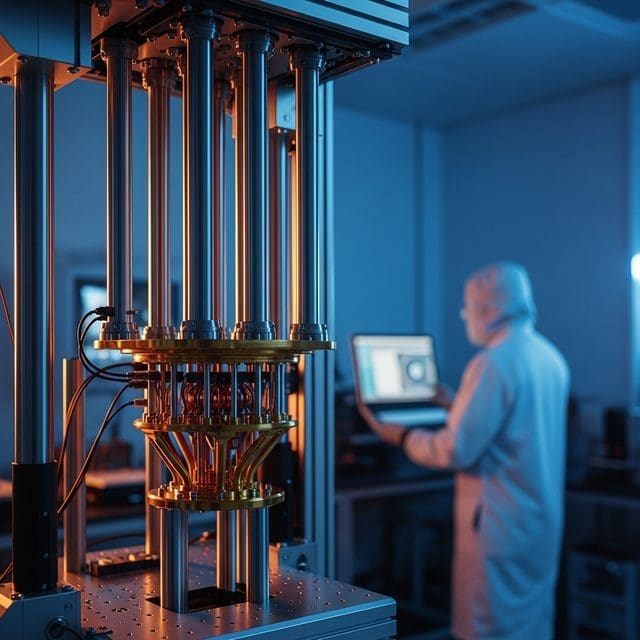
Researchers demonstrate a 70-logical-qubit system that outperforms classical supercomputers, introducing a new verification framework to ensure the integrity of quantum results.
In a significant leap for computational sovereignty and technological innovation, IBM and the University of Chicago announced a breakthrough this week that moves quantum computing from the realm of theory into a verifiable reality. The collaboration successfully demonstrated what they term a “trusted” quantum advantage using 70 logical qubits, completing a complex sampling task in just 15 minutes. For context, many of the world’s most powerful classical supercomputers currently face prohibitive runtimes when attempting to simulate these specific circuits, marking a clear practical separation between traditional and quantum capabilities.
For years, the promise of quantum computing has been shadowed by the “verification gap”—the fundamental difficulty of proving a quantum machine is actually correct when no classical computer is powerful enough to check its work. By utilizing a new verification framework developed by researchers like Bill Fefferman and Soumik Ghosh, the team has provided a statistically certified way to trust these results. This move directly addresses a long-standing skeptical critique of the industry: that quantum speed is meaningless without verifiable accuracy and transparency. The experiment, detailed in the paper “Sampling hard circuits with verifiably high fidelity,” represents a shift toward auditable milestones in a field often criticized for its “black box” nature.
The technical achievements of this run are substantial. The team executed 2,415 logical two-qubit operations and 468 logical T gates. Crucially, the researchers achieved logical error rates approximately ten times lower than the underlying physical error rates. This reduction in noise is a vital step toward building fault-tolerant systems that can eventually handle sensitive simulations in materials science, optoelectronics, and superconductivity. By demonstrating that logical qubits can outperform their physical counterparts, IBM is signaling that the era of error-corrected quantum utility is no longer a distant prospect but an emerging tool for national and industrial interest.
In a departure from the typical closed-door approach of Silicon Valley, IBM has publicly posted the 70-logical-qubit circuits and raw data on its Quantum Advantage Tracker. This transparency invites independent researchers to reproduce or challenge the findings, fostering a decentralized culture of accountability. This open-source benchmark is paired with further studies, including a companion report using Qedma’s QESEM error-mitigation software to study long-time dynamics on up to 74 qubits. These results were cross-checked against simulations by RIKEN and BlueQubit, which notably disagreed with classical predictions at these scales, further reinforcing the quantum system’s superior performance.
While quantum computing pushes the boundaries of the infinitesimal, the Large Hadron Collider (LHC) at CERN also reported progress this week through the ATLAS Collaboration. During the International Conference on High Energy Physics (ICHEP 2026), researchers announced the first observation of longitudinally polarized Z-boson pairs. While these results further confirm the Standard Model of physics, the ATLAS summary noted no significant “beyond-Standard Model” excesses. This lack of new particles at the LHC places even greater importance on the quantum breakthroughs in Yorktown Heights and Chicago, as quantum simulation may become the primary tool for discovering new physical laws where particle colliders have reached their current limits.
As these Future Frontiers advance, the focus remains on ensuring these technologies serve the interests of individual liberty and national capability. The ability to simulate new materials and secure communications through verified quantum systems represents a new era of American technological leadership that prioritizes precision and transparency over mere hype. By grounding these advancements in a framework of verification, researchers are ensuring that the next generation of computing remains a tool for truth rather than a source of uncheckable digital authority.

Mason Reed serves as a Staff Writer for Just Right News, where he spearheads the Future Frontiers & Special Projects desk. In an era defined by rapid technological shifts and evolving social landscapes, Mason provides a steady, principled voice, examining the innovations of tomorrow through the lens of traditional American values. His work is most prominently featured in his signature series, “The Next Horizon,” where he explores the intersection of emerging technology, national sovereignty, and the preservation of individual liberty.
A native of San Diego, California, Mason’s worldview was shaped by the unique culture of his hometown. Growing up in a region defined by its strong military presence and its history of maritime industry, he developed a deep-seated respect for the institutions that provide national stability and the entrepreneurial spirit that drives the American economy. This upbringing instilled in him a belief that true progress is not found in discarding the past, but in building upon a foundation of proven principles. His reporting often reflects this San Diego influence, emphasizing the importance of a robust national defense and the necessity of maintaining a competitive edge in the global marketplace.
Now based in San Francisco, Mason operates from the heart of the world’s technological engine. Living and working in the Bay Area provides him with a front-row seat to the advancements—and the ideological challenges—emanating from Silicon Valley. While many in the region embrace a “move fast and break things” mentality, Mason’s reporting serves as a vital counterweight. He offers Just Right News readers a “boots on the ground” perspective, documenting how radical local policies and the concentration of tech power impact the everyday lives of citizens. His proximity to the industry allows him to cut through the marketing jargon of big tech to uncover the real-world implications for privacy, free speech, and the nuclear family.
In his “Future Frontiers” beat, Mason tackles complex subjects ranging from the ethics of artificial intelligence to the burgeoning private space race. He approaches these topics with a healthy skepticism toward centralized bureaucracy, championing instead the decentralized innovations that empower individuals. Through “The Next Horizon,” he highlights the pioneers and thinkers who are working to ensure that the future remains a place where human dignity and constitutional rights are protected. He believes that the rapid pace of change requires more than just technical expertise; it requires a moral compass rooted in the Western tradition.
Throughout his tenure at Just Right News, Mason has remained committed to the idea that the future is something to be shaped, not merely accepted. His writing is characterized by a rigorous defense of American exceptionalism and a belief that the country’s best days lie ahead, provided it remains true to its founding ideals. Whether he is investigating the impact of automation on the American workforce or profiling the next generation of aerospace engineers, Mason Reed ensures that his readers are equipped with the insights they need to navigate a changing world with confidence and clarity.