

Nearly half a million New Yorkers lose Essential Plan coverage as federal cuts and rising inflation squeeze low-income household budgets and strain local safety nets.
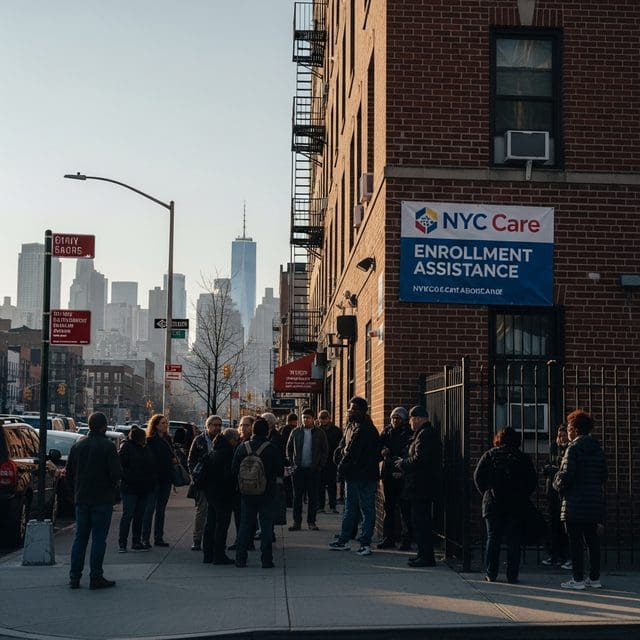
The promise of economic mobility often hinges on the stability of a family’s health and the integrity of their local support systems. In New York City, that stability is currently under trial. As of July 2026, approximately 460,000 low-income residents have seen their near-free Essential Plan coverage evaporate due to federal funding reductions. These individuals, earning just above 200 percent of the poverty level, now find themselves navigating a 60-day special enrollment window that expires in late August, facing the prospect of higher premiums and increased cost-sharing. For many, this is not merely a bureaucratic shift but a direct threat to the financial discipline required to climb out of poverty.
This retreat of federal support comes at a delicate moment for the American household. While June data shows a modest 0.2 percent rise in personal income and a 0.3 percent increase in consumer spending, the PCE price index remains 3.7 percent higher than a year ago. For those on the lower rungs of the economic ladder, these figures represent a tightening vice: nominal gains in wages are being steadily eroded by the persistent cost of living, leaving little margin for private medical expenses. The broader economy shows signs of acceleration driven by artificial intelligence and computer memory demand, yet this high-tech growth often feels worlds away from the families struggling to afford basic premiums in the outer boroughs.
In the absence of federal subsidies, local institutions and private-sector partnerships are stepping into the breach to ensure the safety net remains a springboard rather than a trap. Rocket Doctor recently announced an extension of its partnership with EngageWell to provide virtual urgent care, preventive services, and primary care navigation for underserved New Yorkers. By leveraging telehealth, these organizations aim to provide a bridge for the uninsured and underinsured, particularly those in high-poverty areas where physical clinics are scarce. This model emphasizes local resilience and technological efficiency, with Rocket Doctor already serving Medi-Cal and Medicare populations in California and New York to maintain access for the publicly insured.
However, the rapid expansion of digital health is not without its own set of risks to the vulnerable. On July 29, the Federal Trade Commission, alongside Utah and Los Angeles County, filed suit against Hims & Hers, alleging the platform shared sensitive health data—including information regarding weight loss and mental health treatments—with advertising giants Meta and Snap. The complaint highlights a troubling trade-off for low-income patients: the convenience of affordable online care may come at the cost of personal privacy, as sensitive data is allegedly used to fuel targeted advertising profiles. Such deceptive practices, including “Pay $0 today” intake hooks that lead to difficult-to-cancel subscriptions, undermine the dignity of the very people these services claim to help.
As the city’s Health Department and NYC Health + Hospitals intensify enrollment into low-cost clinics and programs like NYC Care, the broader lesson for policymakers remains clear. A recent study suggests that structural inequality is the strongest predictor of how well a community weathers a public health crisis, urging “inequality-informed pandemic preparedness.” For the thousands of New Yorkers currently transitioning between coverage plans, the path to upward mobility is not found in temporary federal windfalls, but in the reliable, transparent, and dignified access to care provided by the communities in which they live and work. True mobility requires a foundation of health that is not subject to the shifting winds of federal budget cycles.

James Foster serves as the Senior Correspondent for Inequality and the Social Safety Net at Just Right News, where he brings a principled and nuanced perspective to the most pressing economic challenges facing the nation. With a career dedicated to exploring the intersection of policy and personal responsibility, Foster has become a leading voice in documenting how government programs and economic shifts impact the American family. His reporting is characterized by a commitment to the “human element,” moving beyond cold statistics to highlight the stories of resilience, work, and community that define the modern American experience.
Foster’s perspective is deeply rooted in his upbringing in Birmingham, Alabama. Growing up in a city with a rich industrial heritage and a history of economic transformation, he witnessed firsthand the importance of the dignity of work and the strength of local institutions. In Birmingham, he saw how the most effective safety nets were often those woven by neighbors, faith-based organizations, and local civic groups. This background instilled in him a lifelong skepticism of “one-size-fits-all” solutions from distant bureaucracies, favoring instead the localized, community-driven support systems that he frequently champions in his writing.
Now based in Atlanta, Georgia, Foster operates from one of the most dynamic and rapidly evolving metropolitan hubs in the South. His location provides a front-row seat to the stark contrasts of the modern economy. From the gleaming towers of Atlanta’s financial districts to the struggling neighborhoods on the city’s periphery, Foster finds the stories that illustrate the complexities of upward mobility. His reporting from the Sun Belt serves as a microcosm for the national debate on poverty, highlighting how inflation, housing costs, and labor market shifts affect the working class in real-time.
As the lead for the acclaimed feature series “America’s Balancing Act,” Foster explores the delicate tension between providing a necessary hand up and fostering long-term independence. The series has become a cornerstone of Just Right News, offering a deep dive into the unintended consequences of social welfare policies. Foster’s work often focuses on the “cliff effect” and other systemic hurdles that can inadvertently discourage employment, arguing that true compassion is measured by how many people are empowered to leave the safety net, rather than how many are added to it.
Throughout his tenure, Foster has remained dedicated to the mission of Just Right News, providing a clear-eyed, conservative analysis of social issues. He believes that a free society thrives when individuals are empowered and the private sector is allowed to innovate. Whether he is interviewing small business owners about the challenges of a changing workforce or documenting the success of private charitable initiatives, Foster’s goal is to provide readers with the truth about the state of the American Dream. His work serves as a vital reminder that while the challenges of inequality are great, the solutions are often found in the strength of the American spirit and the preservation of traditional values.