

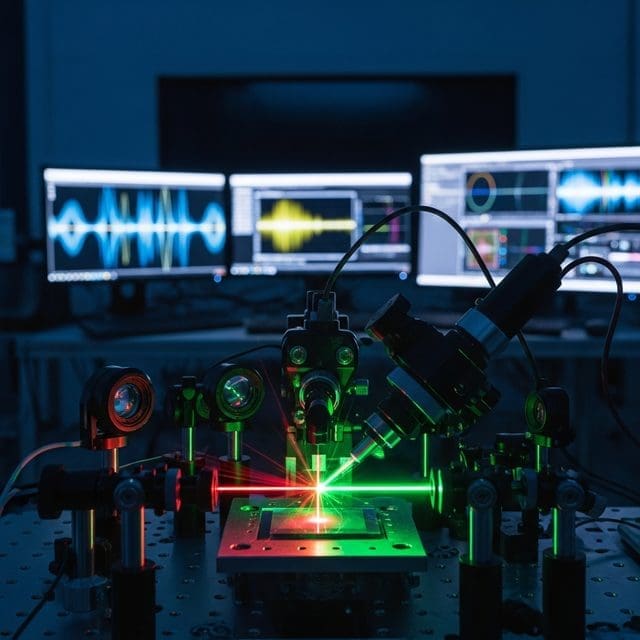
Researchers have experimentally confirmed the existence of Floquet topological states, using intense light pulses to rewrite the fundamental properties of matter and unlock new potential for quantum computing.
A significant milestone in condensed matter physics was reached this week as researchers provided the first direct experimental evidence of a Floquet topological state. Published in Nature Physics, the study demonstrates that the electronic structure of a material can be fundamentally reshaped using intense, rapidly oscillating light fields. This process, known as Floquet engineering, allows scientists to induce a topological phase that does not exist under normal equilibrium conditions, effectively creating new states of matter on demand through periodic driving.
The experiment focused on SnTe, a material where femtosecond light pulses were used to drive a specific band inversion. This transient state appears only during the precise moment when pump and probe pulses overlap, vanishing in approximately 100 femtoseconds. During this incredibly brief window, the atomic positions remain effectively frozen, allowing the light to dictate the material’s behavior. While the experiment confirms the existence of the state, researchers noted that the full classification of its topological character remains a target for future theoretical work, as the precise invariant classification of the transient phase is not yet fully determined.
Simultaneously, a separate team from the Institute of Industrial Science at the University of Tokyo has bridged the gap between abstract mathematics and physical reality. As reported in Nature Communications, the team utilized the “Smith hat”—an aperiodic monotile that solves the long-standing Einstein problem in geometry—to create micro-fabricated optical structures. When illuminated by lasers, these structures produced chiral diffraction patterns never before seen in conventional quasicrystals, revealing a new way to control light propagation through aperiodic media. This discovery suggests that mathematically exotic tilings can serve as design principles for new optical materials, offering a fresh route to probing chirality and long-range order in complex structures.
These discoveries arrive alongside critical advancements in quantum hardware efficiency. New methods for reading quantum bits faster with reduced hardware requirements have emerged, while researchers have successfully extended the lifetime of magnons—magnetic waves used for quantum information—by nearly 100 times. By reaching lifetimes of 18 microseconds, these magnetic waves suggest a path toward quantum computers that are significantly smaller and more resilient than current models. The research indicates that the current limitations on magnon lifetimes are not dictated by fundamental laws of physics, but rather by the purity of the materials used, suggesting that further industrial refinement could yield even greater gains.
In the broader context of quantum infrastructure, the private sector is moving rapidly to operationalize these theoretical gains. Companies like Gremlin and Tines are launching platforms to govern AI workflows and resilience testing, while Two Hands Corporation has entered external beta testing for its EntangleX quantum circuit simulation software. These tools are essential for bridging the gap between laboratory physics and scalable enterprise applications. Furthermore, the University of Warwick has proposed a new quantum chip architecture that utilizes built-in vibrations to enable long-distance qubit communication on a single chip, addressing one of the primary hurdles in quantum scaling.
From a sovereign perspective, these breakthroughs represent a shift toward decentralized innovation and national resilience. By mastering the ability to engineer material properties through light and geometry rather than relying solely on scarce natural elements, researchers are laying the groundwork for a new era of American technological independence. These light-induced states and aperiodic designs offer a roadmap for domestic industries to develop next-generation sensors and secure communication platforms that are shielded from external interference. As these technologies move from the transient femtosecond window into stable, operational hardware, they will form the backbone of a secure, high-performance digital future.

Mason Reed serves as a Staff Writer for Just Right News, where he spearheads the Future Frontiers & Special Projects desk. In an era defined by rapid technological shifts and evolving social landscapes, Mason provides a steady, principled voice, examining the innovations of tomorrow through the lens of traditional American values. His work is most prominently featured in his signature series, “The Next Horizon,” where he explores the intersection of emerging technology, national sovereignty, and the preservation of individual liberty.
A native of San Diego, California, Mason’s worldview was shaped by the unique culture of his hometown. Growing up in a region defined by its strong military presence and its history of maritime industry, he developed a deep-seated respect for the institutions that provide national stability and the entrepreneurial spirit that drives the American economy. This upbringing instilled in him a belief that true progress is not found in discarding the past, but in building upon a foundation of proven principles. His reporting often reflects this San Diego influence, emphasizing the importance of a robust national defense and the necessity of maintaining a competitive edge in the global marketplace.
Now based in San Francisco, Mason operates from the heart of the world’s technological engine. Living and working in the Bay Area provides him with a front-row seat to the advancements—and the ideological challenges—emanating from Silicon Valley. While many in the region embrace a “move fast and break things” mentality, Mason’s reporting serves as a vital counterweight. He offers Just Right News readers a “boots on the ground” perspective, documenting how radical local policies and the concentration of tech power impact the everyday lives of citizens. His proximity to the industry allows him to cut through the marketing jargon of big tech to uncover the real-world implications for privacy, free speech, and the nuclear family.
In his “Future Frontiers” beat, Mason tackles complex subjects ranging from the ethics of artificial intelligence to the burgeoning private space race. He approaches these topics with a healthy skepticism toward centralized bureaucracy, championing instead the decentralized innovations that empower individuals. Through “The Next Horizon,” he highlights the pioneers and thinkers who are working to ensure that the future remains a place where human dignity and constitutional rights are protected. He believes that the rapid pace of change requires more than just technical expertise; it requires a moral compass rooted in the Western tradition.
Throughout his tenure at Just Right News, Mason has remained committed to the idea that the future is something to be shaped, not merely accepted. His writing is characterized by a rigorous defense of American exceptionalism and a belief that the country’s best days lie ahead, provided it remains true to its founding ideals. Whether he is investigating the impact of automation on the American workforce or profiling the next generation of aerospace engineers, Mason Reed ensures that his readers are equipped with the insights they need to navigate a changing world with confidence and clarity.