

New findings from the University of Chicago and the DAMPE space telescope are democratizing quantum research and reshaping our understanding of dark matter through decentralized innovation.
The frontiers of physics are shifting as new discoveries from the laboratory to deep space challenge the long-standing hegemony of the Standard Model. This week, breakthroughs suggest the next era of innovation will be defined not just by massive government-funded colliders, but by ingenious engineering and decentralized research that brings high-level quantum capabilities to modest institutions. For those who value independent inquiry, these developments represent a vital shift away from centralized scientific gatekeeping.
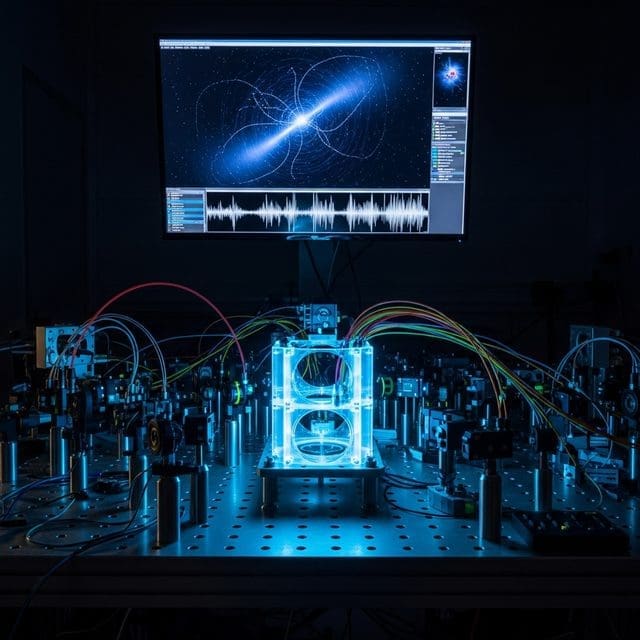
At the University of Chicago, researchers unveiled a simple tweak to optical-cavity hardware that allows for the creation of highly entangled quantum states. Previously, producing these states required immense resources and complex environments that only the most well-funded federal institutions could afford. By making small adjustments to energy levels, the team effectively democratized access to metrological-grade quantum states. This discovery allows smaller labs and private researchers to conduct advanced quantum experiments without relying on the slow-moving infrastructure of centralized bureaucracy.
While Chicago simplifies the quantum world on Earth, the Dark Matter Particle Explorer (DAMPE) satellite is looking outward. Recent data analysis reveals a universal softening of cosmic rays at a specific rigidity of approximately 15 TV across various atomic nuclei. This pattern rules out older, mass-dependent models of particle acceleration with over 99.999% confidence. The findings point toward a nearby cosmic accelerator and provide a rigorous framework for the hunt for dark matter. This space-based approach provides a necessary counterweight to terrestrial experiments at CERN, ensuring a competitive marketplace of ideas in the search for universal truths.
These advancements come as the private sector makes significant strides. On July 28, 2026, Two Hands Corporation announced that its EntangleX quantum circuit simulation software entered external partner beta testing. This move toward commercializing quantum simulation ensures that the tools of the future remain in the hands of innovators rather than being sequestered behind the walls of government agencies. Simultaneously, Aalto University demonstrated the first cyclic quantum heat engine inside a superconducting circuit, a feat of engineering that masters thermodynamics at the subatomic level. This could lead to more efficient energy use in the next generation of computing, providing a technological edge that respects the need for decentralized power.
Furthermore, the University of Warwick proposed a new quantum chip architecture utilizing built-in vibrations to enable long-distance qubit communication. This addresses a primary hurdle in quantum scalability: maintaining information integrity across a physical device. By using mechanical vibrations, researchers may bypass the fragile and expensive cooling requirements that currently limit quantum computing to large-scale data centers. This move toward integrated, robust hardware mirrors the traditional American preference for tools that are both powerful and practical for broad application.
As these discoveries mount, the traditional Standard Model is being tested like never before. Whether it is hints of physics beyond the model seen at the Large Hadron Collider or the realization that some black holes might be non-singular compact objects, the scientific community is entering a period of profound re-evaluation. For the principled observer, these developments offer a promising glimpse into a future where the mysteries of the universe are solved through competition, transparency, and the relentless spirit of discovery that defines the frontier.

Mason Reed serves as a Staff Writer for Just Right News, where he spearheads the Future Frontiers & Special Projects desk. In an era defined by rapid technological shifts and evolving social landscapes, Mason provides a steady, principled voice, examining the innovations of tomorrow through the lens of traditional American values. His work is most prominently featured in his signature series, “The Next Horizon,” where he explores the intersection of emerging technology, national sovereignty, and the preservation of individual liberty.
A native of San Diego, California, Mason’s worldview was shaped by the unique culture of his hometown. Growing up in a region defined by its strong military presence and its history of maritime industry, he developed a deep-seated respect for the institutions that provide national stability and the entrepreneurial spirit that drives the American economy. This upbringing instilled in him a belief that true progress is not found in discarding the past, but in building upon a foundation of proven principles. His reporting often reflects this San Diego influence, emphasizing the importance of a robust national defense and the necessity of maintaining a competitive edge in the global marketplace.
Now based in San Francisco, Mason operates from the heart of the world’s technological engine. Living and working in the Bay Area provides him with a front-row seat to the advancements—and the ideological challenges—emanating from Silicon Valley. While many in the region embrace a “move fast and break things” mentality, Mason’s reporting serves as a vital counterweight. He offers Just Right News readers a “boots on the ground” perspective, documenting how radical local policies and the concentration of tech power impact the everyday lives of citizens. His proximity to the industry allows him to cut through the marketing jargon of big tech to uncover the real-world implications for privacy, free speech, and the nuclear family.
In his “Future Frontiers” beat, Mason tackles complex subjects ranging from the ethics of artificial intelligence to the burgeoning private space race. He approaches these topics with a healthy skepticism toward centralized bureaucracy, championing instead the decentralized innovations that empower individuals. Through “The Next Horizon,” he highlights the pioneers and thinkers who are working to ensure that the future remains a place where human dignity and constitutional rights are protected. He believes that the rapid pace of change requires more than just technical expertise; it requires a moral compass rooted in the Western tradition.
Throughout his tenure at Just Right News, Mason has remained committed to the idea that the future is something to be shaped, not merely accepted. His writing is characterized by a rigorous defense of American exceptionalism and a belief that the country’s best days lie ahead, provided it remains true to its founding ideals. Whether he is investigating the impact of automation on the American workforce or profiling the next generation of aerospace engineers, Mason Reed ensures that his readers are equipped with the insights they need to navigate a changing world with confidence and clarity.