

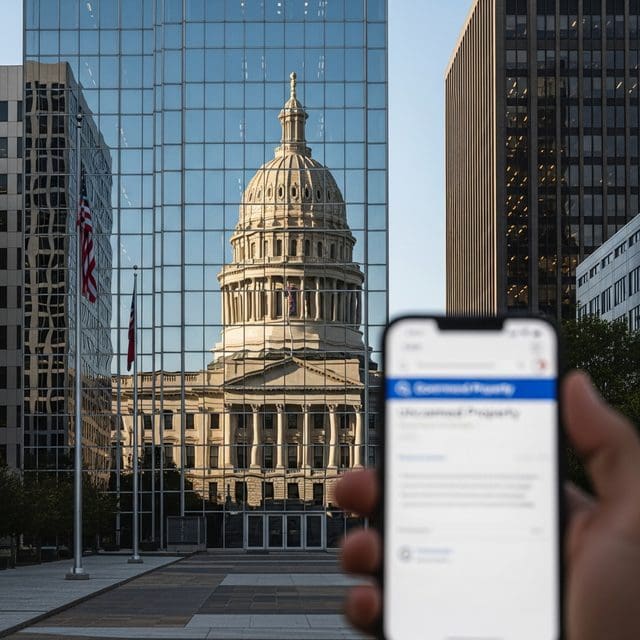
State treasuries are holding record sums of unclaimed property that could provide vital liquidity for American families struggling with rising rents and four-dollar gasoline.
As American households grapple with a persistent cost-of-living squeeze, a massive reservoir of private capital remains locked in state bureaucratic vaults. National data as of July 2026 indicates that state treasuries are holding more than $70 billion in unclaimed property. This pool of capital, consisting of forgotten bank accounts, uncashed checks, and insurance proceeds, has grown to unprecedented levels, with Pennsylvania holding up to $5 billion, while North Carolina and Oklahoma each report balances exceeding $1 billion.
The scale of these dormant assets is particularly pronounced in high-cost regions where the rent-to-income ratio has reached a breaking point. New York leads the nation with over $20 billion in unclaimed funds, followed by California with $10 billion and Texas with $7 billion. For the average claimant, these funds are not mere pocket change; average payouts range from $1,100 in Texas to $2,400 in New York. In Louisiana, officials reported a record $70.9 million returned to residents in July 2026, with checks averaging $900. Such sums can cover a full month’s rent or several mortgage payments for families living on the margin.
This liquidity arrives at a critical juncture. On July 20, 2026, the national average gasoline price climbed above $4 per gallon following renewed instability in the Strait of Hormuz. While a subsequent memorandum of understanding between the U.S. and Iran saw oil prices drop by 10% after claims the Strait is open for transit, the volatility underscores the fragile nature of household budgets. The intersection of energy costs and housing stability remains a primary concern for local sovereignty, as every dollar spent at the pump is a dollar diverted from property taxes or home maintenance.
In an effort to return these funds to the private sector, several states are expanding the definition of returnable property. Arizona updated its statutes effective July 1, 2026, to include gift cards, stored-value cards, and even frequent flyer miles. These changes reflect a growing recognition that in a digital economy, personal property often takes forms easily lost to bureaucratic inertia. By broadening these categories, states are unlocking a secondary stimulus that requires no new taxation, merely the efficient return of what already belongs to the citizenry.
Despite the clear benefit to housing-burdened families, a significant reporting gap remains regarding the most vulnerable populations. While state treasuries and national portals like the National Association of Unclaimed Property Administrators (NAUPA) updated their infrastructure as recently as July 23, 2026, there is little evidence of coordinated outreach between the Department of Housing and Urban Development (HUD) and state property offices. Such a partnership could target at-risk renters or those facing foreclosure, utilizing these forgotten assets to prevent homelessness without relying on inflationary federal grants.
Furthermore, officials are warning citizens to distinguish between legitimate state property claims and misleading online narratives. Recent reports of a “federal $1,400 payment” are largely inaccurate, often conflating state-level initiatives—such as Minnesota’s advance Child Tax Credit payments or Colorado’s TABOR refunds—with non-existent federal stimulus. For the principled observer, the solution to current fiscal pressures lies not in the expansion of the administrative state, but in the diligent restoration of existing private property to its rightful owners.

Deborah Cole serves as a Senior Correspondent for Just Right News, where she spearheads the network’s coverage of Housing, Infrastructure, and Mobility. With a career defined by a commitment to rigorous reporting and a focus on the fundamental pillars of American community life, Deborah brings a principled perspective to the complex issues that dictate how and where we live. Her work is grounded in the belief that sound policy, fiscal responsibility, and respect for private property are the essential foundations of a prosperous society.
Originally from Boston, Massachusetts, Deborah’s upbringing in one of the nation’s oldest and most historically significant cities deeply influenced her professional trajectory. Growing up amidst the architectural legacy and dense urban planning of New England, she developed an early appreciation for the importance of durable infrastructure and the role of local tradition in shaping neighborhoods. Her perspective is informed by the classic American values of her hometown—hard work, community cohesion, and a healthy skepticism of top-down bureaucratic mandates that often overlook the unique needs of individual citizens.
Today, Deborah operates from her base in Austin, Texas, a city that serves as a primary laboratory for her reporting. Austin’s rapid expansion and its status as a hub for innovation and migration provide her with a front-row seat to the most pressing challenges in modern infrastructure and housing. From the Lone Star State, she chronicles the tensions between rapid growth and the preservation of the American Dream, often highlighting how market-driven solutions and deregulation can address the housing shortages that plague many of the country’s metropolitan areas.
At Just Right News, Deborah is perhaps best known for her signature feature series, “Where We Live.” Through this platform, she explores the intersection of public policy and private life, moving beyond mere statistics to tell the stories of families, small business owners, and local developers. Her reporting frequently highlights the importance of mobility—not just in terms of transportation and transit, but as a vehicle for economic opportunity and social stability. She remains a staunch advocate for the taxpayer, consistently scrutinizing government spending on large-scale projects and advocating for transparency in how infrastructure dollars are allocated.
Deborah’s beat is more than just a collection of policy topics; it is an investigation into the physical and legal structures that allow families to flourish. Whether she is reporting on the impact of zoning laws on suburban development or the necessity of maintaining the nation’s highway systems, her work is characterized by a dedication to the facts and a respect for the constitutional principles that protect the rights of homeowners.
As a Senior Correspondent, Deborah Cole continues to be a vital voice for Just Right News, providing the audience with the clarity and context needed to navigate an ever-changing landscape. Her reporting ensures that the values of individual liberty and local sovereignty remain at the forefront of the national conversation regarding the future of our cities and towns. Through her tireless efforts, she remains committed to informing the public on the issues that hit closest to home.