

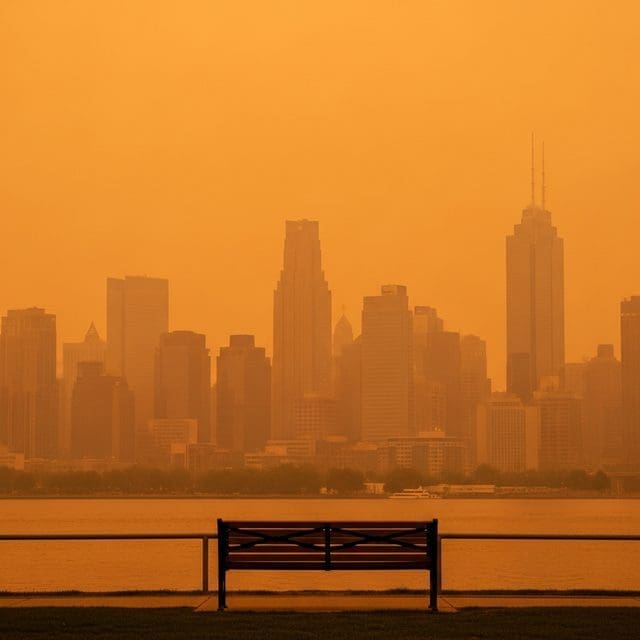
Record-breaking wildfire smoke from Ontario blankets the Northeastern U.S., highlighting the immediate domestic consequences of regional environmental mismanagement despite high-level international climate policy discussions.
While international bureaucracies at the World Health Organization and United Nations continue to debate the long-term frameworks for global climate adaptation, a more immediate and visceral environmental challenge has descended upon the Northeastern United States. As of mid-July 2026, more than 800 wildfires are actively burning across northwestern Ontario. The resulting smoke plumes have crossed the border, shattering air quality records and forcing millions of Americans to contend with the tangible health risks of regional environmental volatility. This surge in particulate matter serves as a stark reminder that climate-related health threats are not exclusively the province of developing nations or distant futures.
The current crisis in the Northeast highlights a critical gap in the prevailing development narrative: while billions in foreign aid are directed toward global pandemic preparedness and adaptation projects abroad, domestic infrastructure and cross-border environmental management often struggle to keep pace with immediate localized threats. The reliance on centralized global health initiatives frequently overlooks the necessity of robust, market-driven regional responses to such recurring atmospheric events. For the American public, the health implications of these fires are not a theoretical policy point but a daily reality that impacts labor productivity and healthcare costs, as evidenced by recent labor movements like the Teamsters Locals 79 and 512 ratifying new master agreements at Penske across the Southeast.
This domestic strain coincides with a period of significant geopolitical and economic realignment that complicates the global health and development landscape. The recent memorandum of understanding between the U.S. and Iran, which includes the reopening of the Strait of Hormuz without tolls and a 60-day ceasefire extension in Lebanon, has already impacted global markets. Oil prices dropped over 10% following the announcement on April 17, 2026, providing a measure of fiscal relief to American consumers even as they face the respiratory costs of the northern fires. This intersection of energy security and environmental health illustrates the complexity of maintaining national sovereignty within a globalized policy framework that often prioritizes bureaucratic consensus over immediate national interest.
Furthermore, the private sector’s role in the future of development continues to eclipse public sector initiatives, suggesting a new path for climate and health adaptation. The recent $75 billion IPO of SpaceX, valuing the company at $1.77 trillion in June 2026, underscores a massive shift in where capital is being deployed for long-term technological advancement. As private entities take the lead in aerospace and communications infrastructure, the traditional reliance on U.S. foreign aid as the primary driver of global development is being challenged by market-cap giants that operate outside the slow-moving mechanisms of the UN. This shift is further reflected in the financial markets, where geopolitical tensions caused SK Hynix shares to plummet 15% in July despite a successful U.S. ADR debut, proving that private investment remains highly sensitive to the stability that global health and security initiatives often fail to guarantee.
For the American taxpayer, the juxtaposition is clear. While the U.S. continues to engage with global health bodies on pandemic treaties and climate accords, the immediate priority remains the protection of domestic air quality and the stabilization of regional trade routes. The Ontario wildfires demonstrate that environmental security begins at home, requiring a pragmatic approach that prioritizes local resilience and fiscal transparency over the expansive, often nebulous goals of international administrative bodies. As Jay Clayton moves into his role as Director of National Intelligence, the integration of environmental intelligence with national security will likely become a cornerstone of a more grounded American development policy that favors evidence over ideology.

Rachel Vaughn serves as a Senior Correspondent for Just Right News, where she leads the network’s coverage of Global Health, Climate, and Development. With a career defined by intellectual rigor and a commitment to principled reporting, Rachel provides a vital conservative perspective on some of the most complex and high-stakes issues facing the world today. Her work is characterized by a refusal to accept bureaucratic narratives at face value, focusing instead on how international policies impact national sovereignty, individual liberty, and the American taxpayer.
Raised in New Haven, Connecticut, Rachel grew up in an environment dominated by elite academic discourse. This upbringing provided her with a front-row seat to the inner workings of the American establishment, but it also instilled in her a healthy skepticism of the “ivory tower” consensus. She learned early on that while academic theories may sound promising in a lecture hall, they often fail to account for the practical realities of the working class. This background drives her to bridge the gap between high-level policy discussions and the common-sense concerns of everyday citizens, ensuring that her reporting remains grounded and accessible.
Now based in Burlington, Vermont, Rachel operates from a unique vantage point within one of the nation’s most progressive political landscapes. Living and working in a region that often serves as a testing ground for radical social and environmental experiments allows her to witness the real-world consequences of these policies firsthand. From her base in the Green Mountain State, she provides Just Right News readers with essential “boots on the ground” reporting, documenting the friction between local mandates and the constitutional freedoms of the individual. Her presence in Burlington ensures that her critiques of globalist agendas are informed by a direct understanding of how those ideologies manifest at the local level.
In her acclaimed feature series, “Planetary Stakes,” Rachel explores the intersection of international development and environmental stewardship. She rejects the alarmism often found in mainstream media, opting instead for a sober analysis of the economic and geopolitical costs of global climate agreements. Her reporting frequently highlights the importance of market-driven innovation and the role of American leadership in fostering global health without ceding authority to unelected international bodies. Through “Planetary Stakes,” she has become a leading voice for those who believe that true conservation and public health are best achieved through transparency, accountability, and the protection of private property rights.
Throughout her tenure at Just Right News, Rachel has distinguished herself as a journalist who is unafraid to ask difficult questions of global institutions. Whether she is investigating the influence of non-governmental organizations on domestic policy or analyzing the fiscal transparency of international health initiatives, her goal remains the same: to provide her audience with the facts necessary to navigate an increasingly interconnected world. Her blend of East Coast intellectual heritage and her current immersion in the political heart of the Northeast makes her an indispensable asset to the newsroom and a trusted source for readers seeking a principled, conservative take on the issues that define our era.